I’m pairing these reviews together because they more or less stem from the same creative space. Erik Wøllo came to Tucson, Arizona, as part of Steve Roach’s SoundQuest Fest 2011. He played his superb piece, The Gateway, live during the show. Afterward, Wøllo and Roach seized upon the creative momentum that came out of the concert and spent the next few days at Roach’s Timeroom studio finishing up work they had started earlier in the year, which would become The Road Eternal.
 It’s not easy for me to be objective about Live at SoundQuest Fest because I was there, and it was something of a defining moment for me as an ambient music fan. I’ve been into Roach’s music since the 80s and am particularly appreciative of his tribal work. I was out in the desert for the first time. And I was among a gathering of my electro-tribe, meeting many of the people whose music I’ve come to appreciate over the years. So listening to this slice of Roach’s day-closing set carries a lot of connotations for me.
The work here lands squarely in future-primitive space, intertwining rapid-fire analog/sequencer foundations and long, drifting pads with deep, shamanic excursions. It kicks off with the nearly 30-minute “Momentum of Desire,” beginning with Roach working his synths solo, shifting from beatless washes to pulsing energy. The mood transforms as Byron Metcalf enters to bring a bit of tribal juju with shakers, rattles and drums at the start of “Medicine of the Moment,” and we leave the present behind. This is the start of a 25-minute long deep shamanic groove that runs through the fiery “Thunderwalkers.” As Roach and Metcalf prepare the space, didgeridoo players Dashmesh Khalsa and Brian Parnham enter, each taking up a six-foot stick, to trade otherworldly tones and pour them into the proceedings. The feeling takes on a sacred air as the quartet craft a largely improvised, live-looped atmosphere that’s all about instinct and existing in the energy of the moment. Musical intent is left behind in lieu of crafting a response-driven sound-image. It wraps around you. Roach’s ocarina slithers through; the didgeridoos bark, snarl and cajole; shadowy drones lay over everything, As the set moves into “Thunderwalkers,” Metcalf’s rhythms crack the darkness and energize the space with a living pulse. Power absolutely courses through every moment of this track. I love the chant sounds around the 7 minute mark–it’s Roach leaning into the mic with a “yyyah,” the single voice processed into a tribal call. Khalsa leads the way through the short, transformational track “Morphic” with more growling and yelping didge, the sounds intensified and thickened by Roach at the soundboard. Then it’s left to Roach to cool down the moment and bring it back toward the now with the pure synth work of “Off Planet Passage.” Echoes of Metcalf’s skins anchor the sound as it winds toward a quiet close.
Aside from capturing the energy of this superb grouping, Live at SoundQuest Fest also benefits from the way it carries reminders and hints of work past and future. The tribal sections call up thoughts of Dream Tracker, The Desert Inbetween and Serpent’s Lair–while also hinting at that disc’s upcoming follow-up; the analog work pulls from the energetic sources that inform and infuse so much of Roach’s recent solo work, including Immersion 5, which pulls from “Off Planet Passage.” An excellent record of a fantastic event.
If SoundQuest pulls the listener down into primal-memory introspection, The Road Eternal lifts them into a more optimistic and upbeat state of mind. The energy of rhythmic sequencers kicks in right away, a liquid shimmer that gleams across most of the tracks. Wøllo’s guitar hums and sings its way through the mix in an easy lilt that plays neatly off the geometries of the sequencer runs. (It’s at its finest in the cool coursings of “The Next Place” or softly sighing as the voice in “Night Strands.”) This is a work about velocity and movement, about going forward. Unlike the duo’s previous effort, Stream of Thought, which existed a moment at a time, The Road Eternal sets its focus squarely on the horizon and heads for it. But it’s not all pedal-to-the-metal. After revving the engine with the title track, “Depart At Sunrise” coasts into view, a panoramic vista opening slowly in front of you. The sequencers get dialed back a touch to make space for long pads and crunchy analog synth effects. “First Twilight” appropriately slows to a gentle ambient drift, Roach and Wøllo tinting their shared sky with lush aural colors fading into night. “Travel by Moonlight” eases the tempo back up, underscored by a rich, repeating bass pulse. Wøllo’s guitar soars as counterpoint.
Roach notes on his site: “Listening to these tracks while traveling allows the music to merge with the experience arriving at an integrated place where thoughts and imagination are unified as a soundtrack for one’s own road movie.” I’ll attest to that. The Road Eternal has softened many a commute and provided the incidental music for thought-filled evening drives home. Listen, and see where the music takes you.
Both discs available at Steve Roach’s web site and Projekt.

 Displaying a warmth that belies its title, Somnarium’s Frost is a 70-minute flow of soft-edged drone mixed with piano, guitar and manipulated voice and radio transmissions. Artist Michael Meara’s stated intent is to capture “arctic vastness and the impact such extreme environments can have on the human psyche,” and pulls inspiration from the written accounts of early polar expeditions. If that’s the case, the resultant music feels less like an impact than the quiet mental wanderings we embark upon when we’re removed from the overloading pollution of too much input and we find ourselves alone in our heads, the internal chatter beginning to clear. The spaces Meara reveals are wide and open, places where the sound of a thought can carry forever. The blend of ethereal wash and earthly instrument is balanced well in every track; listen to the quiet melancholy hiding within “Ice,” the piano reluctantly speaking through the flow. Frost‘s five tracks take their time in describing themselves; only “Nimrod” clocks in at under 10 minutes. Meara spreads his thoughts smoothly across the area he gives himself to work in, carves the sonic landscapes with patience and ease, and the pieces benefit from it. Frost is both calming and affecting, the way a good ambient disc should be. This is a disc you’ll leave playing for hours at a time.
 Trippy dub duo Praguedren launch themselves into space on their recent release, Aurora Australis, and the result is…well, trippy space dub. Having gotten used to their resin-coated, smoke-shrouded psychedelia, hearing Praguedren take on softer ambient drifts came as a very pleasant surprise. The dub trappings certainly haven’t been dispensed with entirely–the title track vibrates and wobbles with tremolo and wavering echo in a pleasantly head-messing way. But it does get cut loose in spots in favor of beat-free, dreamy flows like the closer, “Falling Upward.” This track shows, in classic soft ambient style, that these two can step well out of their comfort zone and still pull it off. A warm, inviting track of horizon-stretched pads. The real draw, though, is on those pieces when the two sides mesh easily together. Check “Neon Green Skies,” which moebius-twists its way smoothly from long, pipe-organ-feeling pads into a clubby/dubby vibe with snappy beats and back again. It’s a cool, nicely orchestrated blend that clearly marks Praguedren’s course for this release. The next track, “Polarity,” shows both sides but strips it down to a perfectly simple backbeat keeping time over big, long pads. When the beat drops off halfway through, you’re just left to coast back to earth on pure, relaxing clouds of ambient. And it’s a gorgeous ride down.
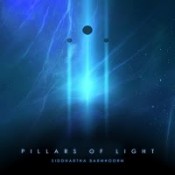 On his debut solo release, Pillars of Light, film composer and sound designer Siddharta Barnhoon offers a short suite of dramatic spacemusic pieces. It’s a decent introduction, albeit one that doesn’t stretch far enough to distinguish itself. The opener, “Foundations,” lays some good drumbeats over ambient flows for something of a techno-tribal feel, and its followup, “Artifacts,” manages to work its way to some strong visual imagery via clanking mechanical sounds and another dose of drums. From there, however, Pillars turns into your standard ambient music offering. I had this disc on loop for a while, but only ever really noticed it during those first two tracks. It has to be noted that Pillars clocks in at a lean 35 minutes or so–more an EP than a full offering. Barnhoon’s flows are quiet and well constructed, but given the short amount of time he’s asking us to invest, Barnhoon could have (or should have) gone further to give the work more impact, a more memorable aspect. The track “Nebulae” is a good example. It’s a pretty straightforward flow, but Barnhoon loads it in places with somber tones and a bit of texture that catch the attention. He then shifts the feeling back toward the light, creating a thread of drama that makes this track tell more a of a story and stand out. Don’t get me wrong–Pillars of Light is a workable collection of ambient flows that certainly doesn’t overstay its welcome. A good low-volume listen, and a hint of what I feel will be very good things to come from Siddhartha Barnhoon. A welcome addition to the ambient music world.
 If you do not enjoy drone–and by this I mean the absolute dictionary definition of the term turned into music, a seemingly endless stretch of what appears to be a single note, varied for the most part only by the slightest tidal pull of its own waveform–then you don’t want to listen to Kamil Kowalczyk’s Aurora. I don’t mind drone, but this was not an easy release for me to get through. The high pitch of the drone that makes up the beginning of the half-hour-long “Model II” was like listening to an old TV test pattern. A sense of “get on with it” crept in at the edges. Yes, there are subtle elements slipped into the flow, bits of electronic twiddle and pulse, but that barely wavering waveform holds court for 11 minutes before there’s so much as a shift in key–and then continues on its borderline flatline way. A second track, “Plasma,” offers another half hour of minimalist meanderings; luckily it benefits from being somewhat more dynamic. I wasn’t in as much of a hurry to be done with this one.
 Listening to Gaston Arevalo’s work is like wandering through someone else’s hazy recollections. You see the sights, you feel like you recognize what’s going on around you, but it’s all coming at you filtered through a gauzy wall of fog, the stuff that makes up the space between worlds. Arevalo’s propensity for soft focus in his music results in work that can have lively aspects tucked into it, yet always feels patiently laid-back. Habitat offers up eight such guided tours through the composer’s thoughts; they make for a superb wind-down listening experience that amps up exponentially when given close attention. Arevalo’s landscapes run deep and thick with detail. Floating backdrops of microsound and manipulated nature sounds are punctuated with the touch of acoustic instruments–guitar and piano–that stand out all the more for their comparatively concrete nature. (This is at its best on the mind-melting quiet of “Estuario.”) Rhythmic elements slide into place in spots without disturbing the flow. Even when Arevalo gets a little more aggressive with his sound, as he does in the sandpapery textures of “Agreste” or the glitch-strewn, chopped pulse of “Velero,” it’s balanced off with that overarching mistiness of sound and everything stays calm. Habitat is a relase you need to just dive into and let yourself coast downstream. It’s a short ride, gliding past in under 40 minutes but offering stunning musical vistas the whole way.
 Done right, tribal ambient music twists its way deep into your head to become something of a mass for your primal mind, a harmonic key that opens a path to your inner pre-Dawn-of-Man self and connects, in part, on a purely instinctual level. Equinox, the new release from Shane Morris, is tribal ambient done right–although the tribal tag may not be entirely accurate. It’s not all drums, didges and cave-wall echoes–although you do get a fair amount of that. Rather, it’s a neatly paced meditation down into yourself, textbook tribal where it needs to be, hushed, washed, vast and melodic where it should be, and pulled together in a way that ensures Morris’ path makes complete sense and a complete journey. The four pieces here run just under 45 minutes, but thanks to Morris’ pacing, the time feels wonderfully stretched while you’re in the middle of it all.
 Although it will make me sound like a complete shill to say so, I’m of the opinion that any project involving Phillip Wilkerson is a project extremely worth listening to. His solo works, including his long-form-drone offerings as Jane’s Scenic Drive, show a diversity of approach and a willingness to re-create himself each time out. Now, paired with Jourdan Laik as the duo Time Being, Wilkerson presents another side of his growing output–a soft, reflective disc that holds time in its hands to let the listener look deep within it. A Dimension Reflected takes gentle hold immediately as Laik and Wilkerson spin a velvety cocoon of classic ambient drifts. Most of the work here is on the uplifting side; warm, light tones that float above the listener and invite you to follow, excellent exercises in slowing the breath and seeming to soften the air around you. The duo do spend a short amount of time, most notably in “Future Forming,” skirting the edges of shadow and colder spaces without dropping into total darkness. Low-end, grumbling drones are tinted with high notes that fall like sunlight in their midst. With that out of the way, the meditative movements continue, the overall flow absolutely demanding it be played on loop. This is a work that will round off the harsh edges of your day, set your mind at ease and let you peacefully wander off to some quiet space inside yourself. I do hope to hear much more from Time Being–A Dimension Reflected is a superb debut.
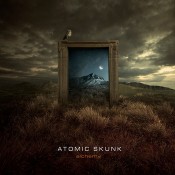 Rich Brodsky is cool. If you doubt me, just take a listen to his third Atomic Skunk release, Alchemy, and there won’t be any further questions. Alchemy blends world-music grooves, spacey ambient textures and atmospheric electronic touches to keep itself fresh and engaging over its seven tracks. The variety shows itself from the start. “Rhino” begins with nature sounds, then quietly twists itself up into an easy-moving groove riding on chimes that sound like a cross between a vibraphone and a kalimba. Beneath it all boils a heady mix of glitchy percussive elements. A great kick-off track. “Equinox” resonates with a strong and steamy Latin/gypsy vibe courtesy of Brodsky’s guitar, backed with percolating electronics. String sounds, like a half-muted electric violin, bring the melodic voice to this piece. “Serpent and Rose” is my favorite track on Alchemy, with calm sequencer lines arcing around a beautiful, wordless vocal sample that absolutely soars. Brodsky loads this one with plenty of drama and a narrative feel that demands repeat listens. “Sunwheel” opens with a mechanical grind that transforms itself into a funky rhythm. Drones and twinkling chimes fill the space. Brodsky slowly builds his way to a vaguely Middle Eastern feel, bringing in big, wavering chords to sing his song while the beat simply plies forth. “Lotusmud” starts off a bit on the dark side, then blossoms halfway through the track to become an uplifting piece coursing along on an airy flute melody. The beats go away on “Temple of Stars,” as Brodsky showcases his ambient side in a 23-minute deep-space drift out to the darker spots between galaxies. At times vaguely unsettling, at times spindrift-calm, it’s a fully immersive trip.
 Hypnagogue Music Reviews