
 Jim Combs is back in his Sensitive Chaos guise, quite intent on fully captivating you with a mix of uptempo electronica, world-fusion accents and lush ambient spaces. Seeker After Patterns is filled with deft switches of identity that showcase Combs’ range of expression. He also pulls in contributions from a handful of electronic/ambient heavy hitters. As always, Brian Good is on hand with his electronic wind instrument (EWI) and saxophone, lending sweet lines that still pull up embedded memories of Shadowfax every time I hear him play. Good’s sax absolutely flies in the opening/title track, breathing swirly smooth-jazz grooves over Combs’ right-angle sequencers. (The disc also contains two shorter radio edits of this track, the second of which puts Good right in the forefront from the start.) On “A Piece of Stars,” one of several live tracks, Combs is abetted by veterans Tony Gerber, Paul Vnuk Jr. and Christian Birk. This improvised track is a twisting road of silken sound; Vnuk snaps out rhythms on electronic percussion and Gerber spins his own airy EWI web while Combs and Birk handle synth duty. Simply stunning, with touches of exotic romance. On “Simon Stilites Dreams of Rain,” Otso Pakarinen co-pilots with Combs on electronics while John McNicholas unleashes a psychedelic mind-melt on guitar. McNicholas’ playing could liquify your brain at 50 paces as he grinds away over the pulses and flows beneath him. Combs himself goes wonderfully ballistic with the remastering of “Sensitive Chaos,” originally recorded in the mid-80s. Here he piles four tracks of bass, 12-string guitar and drum machine into a mad tangle that comes to sound like Hell’s own dulcimer, played at speed over a casually funky bass line. Can’t get enough of this one. Combs’ solo work on Seeker…. is also superb. “L’Ascension,” played on a Roland JD-800 worked through a looper, is a hushed and melancholic piece with a story to tell. “Warm Glow of the Atomic Fire” is a straight-up drone-based floater, waving slowly through the air and shifting form in its own good time.
Seeker After Patterns is a true look at how diverse and talented a musician Combs is. On his own, he can churn playful electronics like “Psychic Twins of Gemini,” which is just plain fun and which reminds me of my favorite Sensitive Chaos track, “Nightshift at the Baby Mecha Nursery” from Leak, or craft ambient flows with a soft hand. He collaborates beautifully and is obviously very much in his element in a live setting. Outside of all that, Seeker After Patterns is just a great listen that stands up to repeat plays thanks to its variety and quality. Which is why it’s a Hypnagogue Highly Recommended CD.
Available from the Sensitive Chaos web site.
 Cometa’s Minimal Way is one of those discs that took me a few listens to get used to–and even at that, I couldn’t fully settle in. Part of the reason is that I couldn’t shake the sense that musician Angelo Secondini didn’t fully trust some of the interesting drones he set forth in this captured live set. The opening track, “Simplicity (Wave 12),” sets what should be the standard for this disc. Here, waveform washes are allowed to follow their course over a catchy, straightforward backbeat. For eight minutes, that’s it…and it’s enough. Overall, Secondini’s drone work is excellent. It develops over an appropriate arc of time and shows the glacial-but-present shifts that mark good drone. But come to a track like “Nakedness II,” and in the middle of what’s a just-about-ideal, mind-grabbing drone, Secondini feels the need to throw in a jarring random splash of electronic sound and then let it fade down. Here is where the perceived lack of trust comes in. Let it be. The track didn’t need “more,” from a listening standpoint. Let the drone express itself. To be fair, he does this again in “Nakedness IV,” but there it’s slipped in more subtly and doesn’t quite shake the flow as badly. There, it’s a logical placement. The combination of the last two tracks, “Live-2” and “Nakedness IV,” is the best stretch of the disc. “Live-2” undulates like the water Secondini says is the inspiration for this disc, a soothing pulse neatly punctuated with some electronic shimmer. “Nakedness IV” brings a beat up and under over and over, beneath a mix of drones and pulses. Mid-track he lays in some aggressive sounds in stark contrast, then lets them ease out for a great finish to the disc. To be fair to Secondini, Minimal Way is the musical component to a music and visuals presentation, and live performance of this sort of music provides its own challenges. For the most part, he blends his minimalist side well with his beats and electronic accentuation. There’s good music to be had on Minimal Way; it’s very well worth checking out.
 Emotive phrasing meets minimalism and the art of hanging a pause in the new release from Antonymes, aka composer Ian Hazeldine. The License to Interpret Dreams is a disc in which you’ll be taken completely in by a piece and then wonder if it’s done or if the disc’s over–only to have Hazeldine drop another delicate note into a piece that’s briefly reveling in a bit of negative space. Hazeldine’s not afraid of silence, clearly recognizes its role in his work and uses it to enhance the experience. License… has an acoustic base, mainly piano with some strings in places, supported by light touches of synth pads and electronic texturing. With this, Hazeldine turns out spaces with a dream-like softness anchored in the certainty of the piano. He can also cull compelling ideas just from his instrument alone; the story at play in the deliberate delivery of “Landscape Beyond An Open Window” makes full use of its short two-minute span to embed itself in the listener’s emotions. “A Light from the Heavens” bulds from that same space, then adds strings and brushed percussion to build to a snap-shut closing. Throughout the disc, Hazeldine plays with other ideas as well. Some work better than others. The closer, “On Approaching the Strange Museum,” borders on dark ambient, foggy drones over a distant pulse of percussion that grows closer and heavier. (I am not quite sure if a long pause in this track is meant to separate it from a “hidden” track that follows, or if it’s just an artistically long pause.) “Womb of the Mother” also keeps itself in ambient territory, a drama carved in rising and falling notes. Where Hazeldine first goes slightly astray is with “Doubt,” where Jan Van Den Broek recites a piece by music journalist Paul Morley.Van Den Broek’s choppy delivery, meant to sync with the cadence of the instrumentation behind it, becomes a bit grating. (By comparison, the use of voiceover in “Oradour-Sur-Glane” is perfect, the disembodied narrator listing place names against a drone with very light piano sprinkled over it.) The following track, “The Door Towards the Dream” simply feels out of place, with bold,trumpet-like keys baying a little brashly. It’s not that either of these tracks are bad; they just feel like they belong somewhere else. For most of its listening time, The License to Interpret Dreams is inventive and engaging–especially if you don’t mind occasionally waiting for the next bit of beauty.
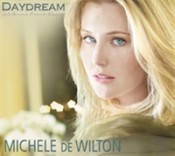 Well, you’re not likely to find a more accurately descriptive title than this anytime soon. Pianist Michele De Wilton offers eleven beautiful, classically influenced pieces on her new CD, Daydream, each played with passion, romance and fire. De Wilton is firmly in control of her dynamics here, able to confidently and competently take the listener from the bold, dramatic and flashy “Heaven’s Bridge” into the near-pastoral sigh and lyrical storytelling of “In the Garden of the Selfish Giant.” All in all, the disc moves very nicely from feeling to feeling without coming across as forced or jumpy. The centerpiece for me is “Winterbluegreen,” a quiet heartbreaker of a piece that softly and sadly confides itself in you in a near-whisper, De Wilton’s carefully picked high notes falling just short of crying. This one will find its way into your soul.
 DiN labelmaster and synth guru Ian Boddy brings his sonic sculpting tools to bear on a series of ambient and analog-based constructs from Parallel Worlds on the new release Exit Strategy. The outcome is a set of pulsing, tightly crafted pieces that drift in and out of shadow without dwelling too long within them. It’s a well-balanced meeting of the musical minds; the dark, while present in every track, isn’t too heavy and the sequencer rhythms aren’t too retro. The beatless explorations catch my attention more here; slow-moving and heavily detailed tracks like “Entwined” and “Hidden,” where Boddy and Bakis Sirros patiently stratify their layers and pack in grim atmospheres, arrive carrying a lot of sonic impact. (“Entwined” in particular brings a potent sense of narrative and tension that borders perfectly on unsettling without quite crossing over.) “Soliloquy” provides Sirros with the space to groove a little. It’s (comparatively speaking) the most uptempo track here, a moody dance where Boddy’s glissando keys sing in a wavering voice over Sirros’ bubbling, glitchy rhythms.
 I’ll start this review by letting the label describe the music on this new outing from Kalte: “At over six thousand metres below sea level, the Hadopelagic Zone is the deepest layer of the ocean, an area where water pressure is over a hundred times stronger than on the surface and where light cannot penetrate… Kalte explore the darkness that permeates this inhospitable space, music inspired by massive pressures and arctic depths, heavy sounds from unknown sources, ominous and dark tones never heard outside of this watery abyss.” And this is exactly what the duo of Rik MacLean and Deane Hughes deliver–a stunning density of isolationist ambient sound, chillingly cold and marginally disturbing. There’s no way to get comfortable with this disc; it’s clearly out to drag you down and exert itself in increasing sonic pressure until you succumb. Motion is minimal; light is non-existent; there is no relief. Listen to the Morse-Code-type beeps that cut into “Harbig-Haro Object.” Is there any question that it’s an unanswerable distress call? Too far down, too far gone. The rawness of the tone, the desperation, cuts through the thick dronework. Only we hear it, and we are powerless to respond. “Asthenosphere” grinds with cloying bass that pulses into the skull like ungiving pressure. Slowly, in this final track, Kalte relent just a bit to let the listener find their way back toward the surface.
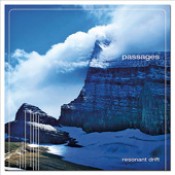 Resonant Drift throw something of a feint at the outset of their new release, Passages. “Summons” rises up boldly on big pads from Bill Olien’s synths and thick chords from Gary Johnson’s guitar before a body-seizing tribal rhythm lands in the midst of it all. It feels as though the duo are preparing to take off on the tribal track they hinted at in their previous release, The Call–but this is just a preparatory pulse, something to open your mind and spirit to the flow. Because Passages exists more on the quiet side of the Resonant Drift spectrum, a collection of tracks that move easily from quietly meditative to darkly experimental. The duo set their course quickly–after the potency of “Summons,” they move into the more hushed environs of “Departure.” Johnson’s guitar picks its way gingerly and with a light jazz touch through a mist of ambient chords that usher it along. But don’t get comfy–at this point it’s time for the two to give you a glimpse of their darker, abstract side with “At First Threshold.” This one is all feeling and impression, grim drones and dissonant side-sounds describing some point between here and the other side. There’s a hold-your breath quality at work here. And this is the formula for Passages; Olien and Johnson take you into reflective spaces for a bit, then pull you back across their more challenging sonic borderlands. This is best shown in the combination of “Beyond the Vision,” “Crossing the Threshold,” and “Two Worlds.” “Beyond…” is one of the quieter tracks, a perfect ambient offering that’s warm and enveloping, built on a dense fog of synth pads. “Crossing…” is thematically perfect, with rumbling bass drones, a processed didgeridoo wavering across the sound and a distant cry that feels both invocatory and imploring at once. Winds rise, darkness falls…and then it’s into “Two Worlds,” another safe haven of sound (which, it must be said, is all too short for something so lovely). The movement between tracks is flawless; it has the sense of a well-planned journey through the various spaces created. Passages closes out with “Transformation,” the longest track at 11 minutes, another classic, layered ambient flow. A strong low end anchors floating, wind-pushed chords as the listener coasts calmly to the end of a superb CD from Resonant Drift. Well worth the repeat listens it will certainly receive. Olien and Johnson simply get better with every new release.
 Perched comfortably between electronica and electronic post-rock, Brokenkites’ new release, Generation Ships, pumps along with cool charm and infectious hooks. With James Willard at the helm, the disc works its way through spaces both loungeworthy and darkly intense, powered by insistent beats and a sense of narrative in every track. This isn’t another round of rampant glitch-stitching; it’s solidly constructed IDM that resonates with hints of early 90s electronic music and classic electro-pop. Willard handles his shifts with ease; he’s as comfortable laying down the laid-back, storytelling feel of “Galactic” or the abstract, pared-d0wn tension of “Artifact” as he is charging into the intense, driving potency of “Swarm.” Generation Ships cruises easily along, with Willard finding a new way to keep you grooving in every track. Beats drop in at points apparently timed precisely to elicit head-bobbing in the listener. Once this disc gets ahold of you, it has no plans of letting you go–which you’re probably going to be okay with. Generation Ships is quite worthy of all the repeat listens it’s sure to get.
 On -afield- Broaddus takes field recordings from Los Angeles, San Francisco and Paris and “tunes” them before playing with various processes to craft them into a musical form. The resultant pieces retain some sonic imagery from their organic origins; Broaddus plays with levels to let these sounds peer out in spots or to be more noticeable in others. Voices taking on a ringing, almost ghostly tone in “Embarcadero Center – Justin Herman Plaza” as a lazy and patient chord structure floats through. I keep thinking I hear a fountain in “Da Vinci – Getty Center.” (Having never been there, I may be quite wrong, but there’s a distinct organic element in there.) Broaddus’ main meme here is to pulse his sounds in a waveform tremolo, which he kicks off immediately with the opening track, “Hotel de Lutece – Paris,” and returns to, almost aggressively, in “SF MOMA – San Francisco.” The dynamics within the pulse create a sense of rhythm and add a sun-on-water shimmer to his sounds that carries, in some form, through all the tracks. His textures here are, for the most part, soft and rounded, sonic curves with the occasional roughened edge.
 A Strange Mint takes a similar tack, but differs in its use of gritty micro-textures as a base underneath Broaddus’ pulses, which feel smoother than their -afield- counterparts, and a stronger prominence in spots for non-drone elements. Chimes ring across “Model M4”; waves of glissandi bob and roll through “Model MF2”; rain falls in mists and drips in “MF3c”; twanging, bouncy elastic percussion (I’d love to know the source of this sound!) peppers “Model MF1,” holding its own as Broaddus brings droning tones and near-feedback against it. The texture work is strongest in the distinctly corrugated surface of “MF3a,” a rumble strip of sound that juxtaposes perfectly with the minimalist flow under it. Broaddus notes that the pieces were “created by mucking about with some recordings of organic and man-made materials interacting; fashioning them into something yet undiscovered, a hybrid of the natural and the synthetic…” That idea, paired with Broaddus’ approach to slowly developing, minimalist drifts, gives A Strange Mint a unique identity and turns it into a must-hear piece of music.
 In spots it seems like Andreas Männchen wants to weed out the sonic weaklings with the first track of his new release, Float. After a wayward, tangled keyboard melody charmingly staggers around for a few minutes, Männchen fires up some dental-drill quality guitar feedback to see if you can keep listening. If you like your music on the experimental edge, at that point where the music/sound/noise line is scuffed and nearly imperceptible, you should try to get through. Because while Float can be very challenging, it’s also quite intriguing and thoughtfully put together. Männchen sandblasts his sound sources, leaving them peppered with glitches, jump-cuts, holes and seriously roughened textures. Nothing here is smooth; it’s meant to be felt on an almost tactile level. The strongest track on Float is “Molecular Stream,” which sends a host of sound-shapes careening around a simple, repeated motif on piano. That simplicity gives a sense of character, something just trying to stand on its own among everything happening around it. The sounds rise and thicken into a chordal accompaniment and the piano keeps asserting itself. It’s captivating, and even more so toward the end when Männchen deconstructs it. Männchen touches on drone and minimalism in spots, as with “Parachutes,” which builds itself on a flatline tone and fills with sparkling, random piano tones that feel like they’re falling from nowhere.
 Hypnagogue Music Reviews