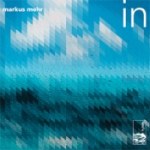
 The first two parts of a planned triptych (the third, Off, will release in January 2013), Markus Mehr’s In and Out are studies in extreme contrast. Effective, listen-worthy contrast. In is the comparatively quieter of the two, made up of two long tracks. “Komo” is built on a simple string phrase that patiently repeats itself while Mehr folds in new layers and levels. On top of that, it’s subjected to Mehr’s sonic surgery. The sound drops out or muffles, gets cut up and reordered. There is a stretch around the 16-minute mark that is pure, unexpected fun–more so in headphones. The timing is perfect–right when you think you’re just in the midst of some minimalist, unchanging construct, it changes. Often, I will say, in quite unexpected ways. Until the very end–which is unbelievably potent–Mehr keeps that base phrasing absolutely consistent. This track gets better each time I listen. The depth is delightful to explore. “Ostinato” rises slowly, as “Komo” does, but from the start it’s roughened up by a crackle of static. Melancholic strings come up beneath it and, as before, the sound builds up across time, developing into the same sort of base phrasing from the previous track. Again, the phrase stands staunchly against Mehr’s sound-additions. The trick here comes when Mehr begins sliding a totally different tune, on brass, under the developed flow. But it comes and goes like something you half-hear when you’re almost asleep. The static returns at the end–a nice touch.
 On differs from In in two basic ways. First, it storms straight in on an industrial-grade grind with “I’m Gonna Make You Love Me.” A big hit of percussion and raw distortion greet you, ushering you into Mehr’s mix of field recordings, drones and treatment. Visitors coming from In understand right away that this is a different place. Second, the tracks are quicker, their impact landing sooner and the moment passing in completion within a few minutes. Thus, Mehr packs a lot into those frames, and it’s broadly varied. A jazz-trumpet loop hides under the slow drones in “Flaming Youth,” its smoothness contrasting perfectly with the clicks and buzzes around it; another works as the base of “Duck Becomes Swan,” holding its own against clashing and crashing metallics and buzzsaw hums; rapid-fire clips of Greek folk music trip through the disorienting “Olympia”; Gregorian chant and field recordings of conversation intertwine in “Monks on the Beach.” One of the things I enjoy about Mehr is how he infuses his work with unexpected things that border on a sense of humor. “Only for A While” stands out against the tracks before it by coming in on quiet synth-strings, a simple ambient flow. You get about four minutes of that before a quick burble of sound momentarily corrupts the the flow, as if to say, “You didn’t think it was going to be that simple, did you?” With few extra augmentations, the flow then continues on its way. On is in some ways a more complex listen than In, although both have much to say and certainly enough sonic elements to say it well. Mehr rides the edge of experimental music without falling into a too-abstract space. His explorations are tethered by identifiable structures, but the farthest reaches of his intentions pack enough allure and interest to bring you to them and hold you there. In and On together leave me anticipating how Mehr will complete his triptych. Time will tell.
Available from Hidden Shoal.

 Dark, vicious, relentless. This may be all you need to know about The Seven Tongues from The Kali Ensemble. A side project of Michael Page, the man behind Sky Burial–a noise project I enjoy–The Kali Ensemble seems intent on pure alienation with this disc. There is neither point of entry nor release, and that’s clearly by design. After all, Kali is the destroyer. But I found myself needing to jump forward, hoping to escape the initial onslaught–it was just that claustrophobic. There are places where the pressure lets up slightly, which is to say that it stops kicking you in the skull for a minute, but I wonder how many listeners have the aural fortitude to take this kind of hyper-industrial beating. This is like sitting in the middle of a storm of sharp metal. As I said, I find much of Michael Page’s noise and drone work interesting. Past reviews here will certainly bear that out. But this is one of those cases where I have to say that if your tastes run toward very heavy, dark, industrial and experimental noise, you look into it and see if it suits you. As for me, I’m going to take a couple aspirin and hug someone.
 Synth.NL’s well-honed mastery of classic analog/Berlin music gets an extra dose of theme on his 2011 release, Apollo. This rocket-fueled joyride whooshes through a dozen sequencer-based scenarios, abetted by soundbites taken from Mission Control recordings. Michel van Osenbruggen neatly captures the feel of our early jaunts into space, from the rush of takeoff to the grace of zero-G to the expectation of splashdown. Many of the tracks here are powered by deep, rich bass lines, a solid and funky bedrock that perfectly supports his higher-end flights. This is at its best in the patient movement of “Docking.” The bass tiptoes along like the subtle and deliberate manipulations of the docking craft. At the same time, van Osenbruggen manages to pipe in a feeling of suspense. Apollo truly hits its stride when it’s going full-speed. “Apollo 11” catches me with a moment of sudden acceleration that puts me in mind of the 80s New Romantic band Classix Nouveaux–a burst of dance-worthy electro-pop groove that’s pure fun. Appropriately, “Reentry” is uptempo and energetic, but also carries a great hopeful feel–the sense of heading toward victory. The gentler pieces also excel in conveying the theme. “Earthrise” coasts along on a flute-like sequencer. Plucked notes reminiscent of the work of Ray Lynch carry the melody and paint a picture of the big blue marble coming into view in the distance. “Apollo 8” is a perfect floating spacemusic construct with Berlin influences at the edges. Electronic twiddles dance in the space around van Osenbruggen’s graceful melody. The overall atmosphere of Apollo, if you’ll pardon the pun, is wonderfully amplified by the voice samples. They create a real sense of narrative. van Osenbruggen is telling a story he’s very passionate about, and he puts that straight into the music. Apollo is a lot of fun to listen to, particularly at volume. (Drive with this on and you may likely exceed all local speed limits.)
 It’s standing policy at Hypnagogue that I do not review discs that are largely lyric-based. But on Patience, the new release from M. Rosin’s Godheadscope identity, the lyrics are pulled and twisted and half-buried in the mix, rendered down to chant-like aspects of a musical ritual. This 22-minute set of four pieces rides on heavy layers of guitar and synth drone as Rosin culls together elements of rock and folk and submerges them in his sound-field. The result is a sort of darkwave feel, moody and ruminative and weighted down with concern. Rosin’s voice takes on a priestly tone in “Solidarity,” the repeated phrase “our ruin now a temple” lifting like a homily over howling guitar chords from Claudio Alcara. “Medusa in the Cistern” is comparatively invigorating, hurrying in on a thick bass run. Here, more than on the other tracks, Rosin plays with his lyrics as a musical element, distorting the quick-paced, half-blurted recitation to the point of being indecipherable amid the raspy drones over it, but also heightening its sense of raw, fear-churned urgency. Patience makes the absolute most of its short run and is another release where it feels like your sense time was given the day off. Your twenty-two minutes inside Patience seems so much longer; it’s a wormhole of sound and sensation. A compelling piece of work from Godheadscope.
 Nils Quak is an artist possessing several identities and, with them, styles. On Aether, under his own name, his style is to grind away at you with dark, noise-based spaces. His sounds gnash, snarl and rasp in a fairly relentless onslaught against the listener. At times the work borders on unwelcoming, exhibiting a harshness that dares you to stay attached to it. What helps you hang on is when Quak drops in sounds that feel like he’s making a spontaneous, improvised decision. Unexpected glurgs of electronic sound get thrown into his established mosh of aggressive sonic mutations to get batted around. The fact that these decisions always seem correct is what makes you understand that Quak isn’t just reaching blindly or randomly. Aether is decidedly not about music; it’s about sound creation and manipulation in the moment, of muscling a response out of the listener by pushing their tolerance. Quak’s drones show a chord structure, but it’s clear they exist only as the floor around which his wilder elements careen and crash. This release is only 40 minutes long, but as it’s an endurance test, it feels longer. Hardy experimental-music and noise fans will find this to their liking. Others might be hard pressed to find a way in.
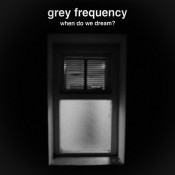 Murky drones culled from “field recordings and found sounds…played from audio cassettes through various effects pedals” make up the crux of When Do We Dream, the debut release from Grey Frequency. The pieces here are, according to the artist, mixed in one take. That’s a tricky proposition, and looking at it strictly from a dark ambient standpoint, he pulls it off reasonably well. But there’s a thickness of sound here, a ceaseless density that contributes to a lot of sameness of sound. Everything is ominous, weighty, and glacial in its forward progress. The texture of the sounds seems to change only slightly, track to track. I find myself wanting to move on, or to catch hold of some more tactile shift in execution. There are spots where this happens. The wobbling, resonant metallic clangs that rise in “Carbon Monoxide” are like a frightening wake-up call in the middle of an unfortunate dream, the sense of something bad about to happen. The slow-moving, higher-tone melody that whispers beneath the sound in “A Million Broken Hearts” is also a nice touch. What makes it work is how Grey Frequency keeps it scaled back like a distant dream against the fog-bank of drone. “Brownfield” threatens to take up a beat as what sounds almost like the manipulated sound of a train echoes over misty drones and a guttural snarl from somewhere off in the darkness. This track has a good rusty-industrial touch to it. When Do We Dream is aimed firmly in the noise/dark direction, and to that end, it does work. It’s not always comfortable, and the spaces it describes are, well, grey. Listeners whose tastes run toward the grim, uneasy side of things will want to have a listen.
 Another big dollop of sonic acid trip from the twisted mind of Dissolved. Please remain seated as this glitch-fueled ride takes you through synapse-frying beats, enormous hammers of dance-music memes, and wayward sound-clips from an obscure horror movie. Your pulse rises with the BPMs as Dissolved convinces your body to groove along with the madness whether you’re aware of it or not. A sure hand on the throttle lets Dissolved confidently ramp the pace up and down, curving the ride through spaces of weirdness and discomfort, only to come blasting out the far side at speed, strapped to a beat that’s ready to explode. It’s not easy to encapsulate all the things going on in a Dissolved disc; what matters is that it all comes together feeling like you’re in the hands of a sonic craftsman with a mischievous sense of humor and a deep inner groove. As off-putting as it can be at first, the further into you go, the more you understand. Give The Amber Surrealizations a shot. The payoff is waiting.
 An open mind and a touch of patience are good tools to have on hand when going into Stephen Christopher Stamper’s debut, Begin Anywhere. Like many of the experimental releases on the Runningonair label, this disc steps off from a pretty heady theoretical perch, involving “natural VLF radio phenomena…algorithmic composition… prolonged experimentation with the Debian GNU/Linux operating system, Miller Puckette’s Pure Data visual programming language…” and more. This initially manifests itself in aggressive, static-laden, generative-sounding tangles that border on being unapproachable. A piece like “Crackle On and On (Version 1),” the longest track on the disc at 12 minutes plus, stands a very good chance of putting off less adventurous/tolerant listeners. A random-feeling, constantly changing backdrop of sounds rebound their way through a minefield of (appropriately so) electronic crackles. There’s intent and movement in the piece, but after a while the interference overpowers the mix and can be a bit exhausting. A saving point in Begin Anywhere is that as Stamper proceeds, he shows that he can use his array of sounds in a way that’s less threatening, with fewer barbs and prongs. Deeper emotional threads emerge as he exhibits an ability to coax a response out of the listener rather than chasing it out. The calm-but-textured roll of “Growth” comes after a series of Stamper’s more out-there tracks, and the switch in sound and approach comes with a degree of relief. “Fata Morgana” and “Cantus in Memoriam” both carry a hint of sacred music; the former in its church-organ-like tones and latter in a certain meditative, hymnal quality. Begin Anywhere is not an easy listen, but there are spots where the effort pays off substantially. Stamper’s fearless compositional stance promises interesting things going forward.
 Consider the wild tangle of sound that builds up at the start of “Tailing Wind,” the first track on Forrest Fang’s new release, Animism, the orchestra warming up. Here, in one increasingly complex mass, you hear a wide variety of the sounds and instruments Fang is bringing into play. It’s a rich rainstorm of tones and timbres and feelings that Fang drenches you with before proceeding to pull out an energetic melodic line played on the kulintang, an array of small gongs struck with mallets, playing across a synth-wash backdrop. Thus, Animism gets underway, coasting and soaring on Fang’s mix of electronic foundations and earthy, acoustic instruments. Rich strings sounds form the basis of many of the tracks on Animism; Fang’s arsenal is globally sourced–bandurria, marxolin, baglama, and đàn bầu, along with their less exotic cousins, violin and mandolin. Between strumming, plucking and bowing, their pure organic feel and rhythms breathe life and vibrancy into Fang’s tracks. In “The Chameleon’s Paintbox,” all those modes of playing fall together and layer into a mesmerizing strata. It opens with a plucked melody–given its swarthy Eastern flair, I would guess it is the Turkish lavda–abetted by the singing notes of bowed strings. Other instruments step briefly out from the chorus, then rejoin the swirl of collective sound. Animism carries a very strong narrative feel as Fang spins out his scenes. “A Tributary Unwinds” begins in a dusky, dense place where careful clatters of percussion and vocal groans peek out from behind the trees; a violin, clear and high describes the course of the water. Fang modulates the pace beautifully as the voyage continues, hitting meaningful pauses that elevate the sense of story and movement. There are also deep ambient drifts on Animism. Long synth pads create the relaxed sigh of “Evening Chorus” as gentle, gong-like sounds resonate in the background. This track has a calm warmth and fading sense that really conveys the passage through twilight. “Resting Point” closes the disc out, 10-minutes of gliding, meditative washes and a wonderfully cleansing feel. Animism is another superb release from Forrest Fang, a rich work that rewards both deep listening and the many repeat plays it will undoubtedly receive.
 Hypnagogue Music Reviews