I’m pairing these reviews together because they more or less stem from the same creative space. Erik Wøllo came to Tucson, Arizona, as part of Steve Roach’s SoundQuest Fest 2011. He played his superb piece, The Gateway, live during the show. Afterward, Wøllo and Roach seized upon the creative momentum that came out of the concert and spent the next few days at Roach’s Timeroom studio finishing up work they had started earlier in the year, which would become The Road Eternal.
 It’s not easy for me to be objective about Live at SoundQuest Fest because I was there, and it was something of a defining moment for me as an ambient music fan. I’ve been into Roach’s music since the 80s and am particularly appreciative of his tribal work. I was out in the desert for the first time. And I was among a gathering of my electro-tribe, meeting many of the people whose music I’ve come to appreciate over the years. So listening to this slice of Roach’s day-closing set carries a lot of connotations for me.
The work here lands squarely in future-primitive space, intertwining rapid-fire analog/sequencer foundations and long, drifting pads with deep, shamanic excursions. It kicks off with the nearly 30-minute “Momentum of Desire,” beginning with Roach working his synths solo, shifting from beatless washes to pulsing energy. The mood transforms as Byron Metcalf enters to bring a bit of tribal juju with shakers, rattles and drums at the start of “Medicine of the Moment,” and we leave the present behind. This is the start of a 25-minute long deep shamanic groove that runs through the fiery “Thunderwalkers.” As Roach and Metcalf prepare the space, didgeridoo players Dashmesh Khalsa and Brian Parnham enter, each taking up a six-foot stick, to trade otherworldly tones and pour them into the proceedings. The feeling takes on a sacred air as the quartet craft a largely improvised, live-looped atmosphere that’s all about instinct and existing in the energy of the moment. Musical intent is left behind in lieu of crafting a response-driven sound-image. It wraps around you. Roach’s ocarina slithers through; the didgeridoos bark, snarl and cajole; shadowy drones lay over everything, As the set moves into “Thunderwalkers,” Metcalf’s rhythms crack the darkness and energize the space with a living pulse. Power absolutely courses through every moment of this track. I love the chant sounds around the 7 minute mark–it’s Roach leaning into the mic with a “yyyah,” the single voice processed into a tribal call. Khalsa leads the way through the short, transformational track “Morphic” with more growling and yelping didge, the sounds intensified and thickened by Roach at the soundboard. Then it’s left to Roach to cool down the moment and bring it back toward the now with the pure synth work of “Off Planet Passage.” Echoes of Metcalf’s skins anchor the sound as it winds toward a quiet close.
Aside from capturing the energy of this superb grouping, Live at SoundQuest Fest also benefits from the way it carries reminders and hints of work past and future. The tribal sections call up thoughts of Dream Tracker, The Desert Inbetween and Serpent’s Lair–while also hinting at that disc’s upcoming follow-up; the analog work pulls from the energetic sources that inform and infuse so much of Roach’s recent solo work, including Immersion 5, which pulls from “Off Planet Passage.” An excellent record of a fantastic event.
If SoundQuest pulls the listener down into primal-memory introspection, The Road Eternal lifts them into a more optimistic and upbeat state of mind. The energy of rhythmic sequencers kicks in right away, a liquid shimmer that gleams across most of the tracks. Wøllo’s guitar hums and sings its way through the mix in an easy lilt that plays neatly off the geometries of the sequencer runs. (It’s at its finest in the cool coursings of “The Next Place” or softly sighing as the voice in “Night Strands.”) This is a work about velocity and movement, about going forward. Unlike the duo’s previous effort, Stream of Thought, which existed a moment at a time, The Road Eternal sets its focus squarely on the horizon and heads for it. But it’s not all pedal-to-the-metal. After revving the engine with the title track, “Depart At Sunrise” coasts into view, a panoramic vista opening slowly in front of you. The sequencers get dialed back a touch to make space for long pads and crunchy analog synth effects. “First Twilight” appropriately slows to a gentle ambient drift, Roach and Wøllo tinting their shared sky with lush aural colors fading into night. “Travel by Moonlight” eases the tempo back up, underscored by a rich, repeating bass pulse. Wøllo’s guitar soars as counterpoint.
Roach notes on his site: “Listening to these tracks while traveling allows the music to merge with the experience arriving at an integrated place where thoughts and imagination are unified as a soundtrack for one’s own road movie.” I’ll attest to that. The Road Eternal has softened many a commute and provided the incidental music for thought-filled evening drives home. Listen, and see where the music takes you.
Both discs available at Steve Roach’s web site and Projekt.

 I’ll start this review by letting the label describe the music on this new outing from Kalte: “At over six thousand metres below sea level, the Hadopelagic Zone is the deepest layer of the ocean, an area where water pressure is over a hundred times stronger than on the surface and where light cannot penetrate… Kalte explore the darkness that permeates this inhospitable space, music inspired by massive pressures and arctic depths, heavy sounds from unknown sources, ominous and dark tones never heard outside of this watery abyss.” And this is exactly what the duo of Rik MacLean and Deane Hughes deliver–a stunning density of isolationist ambient sound, chillingly cold and marginally disturbing. There’s no way to get comfortable with this disc; it’s clearly out to drag you down and exert itself in increasing sonic pressure until you succumb. Motion is minimal; light is non-existent; there is no relief. Listen to the Morse-Code-type beeps that cut into “Harbig-Haro Object.” Is there any question that it’s an unanswerable distress call? Too far down, too far gone. The rawness of the tone, the desperation, cuts through the thick dronework. Only we hear it, and we are powerless to respond. “Asthenosphere” grinds with cloying bass that pulses into the skull like ungiving pressure. Slowly, in this final track, Kalte relent just a bit to let the listener find their way back toward the surface.
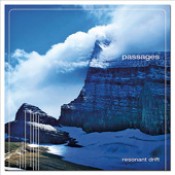 Resonant Drift throw something of a feint at the outset of their new release, Passages. “Summons” rises up boldly on big pads from Bill Olien’s synths and thick chords from Gary Johnson’s guitar before a body-seizing tribal rhythm lands in the midst of it all. It feels as though the duo are preparing to take off on the tribal track they hinted at in their previous release, The Call–but this is just a preparatory pulse, something to open your mind and spirit to the flow. Because Passages exists more on the quiet side of the Resonant Drift spectrum, a collection of tracks that move easily from quietly meditative to darkly experimental. The duo set their course quickly–after the potency of “Summons,” they move into the more hushed environs of “Departure.” Johnson’s guitar picks its way gingerly and with a light jazz touch through a mist of ambient chords that usher it along. But don’t get comfy–at this point it’s time for the two to give you a glimpse of their darker, abstract side with “At First Threshold.” This one is all feeling and impression, grim drones and dissonant side-sounds describing some point between here and the other side. There’s a hold-your breath quality at work here. And this is the formula for Passages; Olien and Johnson take you into reflective spaces for a bit, then pull you back across their more challenging sonic borderlands. This is best shown in the combination of “Beyond the Vision,” “Crossing the Threshold,” and “Two Worlds.” “Beyond…” is one of the quieter tracks, a perfect ambient offering that’s warm and enveloping, built on a dense fog of synth pads. “Crossing…” is thematically perfect, with rumbling bass drones, a processed didgeridoo wavering across the sound and a distant cry that feels both invocatory and imploring at once. Winds rise, darkness falls…and then it’s into “Two Worlds,” another safe haven of sound (which, it must be said, is all too short for something so lovely). The movement between tracks is flawless; it has the sense of a well-planned journey through the various spaces created. Passages closes out with “Transformation,” the longest track at 11 minutes, another classic, layered ambient flow. A strong low end anchors floating, wind-pushed chords as the listener coasts calmly to the end of a superb CD from Resonant Drift. Well worth the repeat listens it will certainly receive. Olien and Johnson simply get better with every new release.
 Perched comfortably between electronica and electronic post-rock, Brokenkites’ new release, Generation Ships, pumps along with cool charm and infectious hooks. With James Willard at the helm, the disc works its way through spaces both loungeworthy and darkly intense, powered by insistent beats and a sense of narrative in every track. This isn’t another round of rampant glitch-stitching; it’s solidly constructed IDM that resonates with hints of early 90s electronic music and classic electro-pop. Willard handles his shifts with ease; he’s as comfortable laying down the laid-back, storytelling feel of “Galactic” or the abstract, pared-d0wn tension of “Artifact” as he is charging into the intense, driving potency of “Swarm.” Generation Ships cruises easily along, with Willard finding a new way to keep you grooving in every track. Beats drop in at points apparently timed precisely to elicit head-bobbing in the listener. Once this disc gets ahold of you, it has no plans of letting you go–which you’re probably going to be okay with. Generation Ships is quite worthy of all the repeat listens it’s sure to get.
 On -afield- Broaddus takes field recordings from Los Angeles, San Francisco and Paris and “tunes” them before playing with various processes to craft them into a musical form. The resultant pieces retain some sonic imagery from their organic origins; Broaddus plays with levels to let these sounds peer out in spots or to be more noticeable in others. Voices taking on a ringing, almost ghostly tone in “Embarcadero Center – Justin Herman Plaza” as a lazy and patient chord structure floats through. I keep thinking I hear a fountain in “Da Vinci – Getty Center.” (Having never been there, I may be quite wrong, but there’s a distinct organic element in there.) Broaddus’ main meme here is to pulse his sounds in a waveform tremolo, which he kicks off immediately with the opening track, “Hotel de Lutece – Paris,” and returns to, almost aggressively, in “SF MOMA – San Francisco.” The dynamics within the pulse create a sense of rhythm and add a sun-on-water shimmer to his sounds that carries, in some form, through all the tracks. His textures here are, for the most part, soft and rounded, sonic curves with the occasional roughened edge.
 A Strange Mint takes a similar tack, but differs in its use of gritty micro-textures as a base underneath Broaddus’ pulses, which feel smoother than their -afield- counterparts, and a stronger prominence in spots for non-drone elements. Chimes ring across “Model M4”; waves of glissandi bob and roll through “Model MF2”; rain falls in mists and drips in “MF3c”; twanging, bouncy elastic percussion (I’d love to know the source of this sound!) peppers “Model MF1,” holding its own as Broaddus brings droning tones and near-feedback against it. The texture work is strongest in the distinctly corrugated surface of “MF3a,” a rumble strip of sound that juxtaposes perfectly with the minimalist flow under it. Broaddus notes that the pieces were “created by mucking about with some recordings of organic and man-made materials interacting; fashioning them into something yet undiscovered, a hybrid of the natural and the synthetic…” That idea, paired with Broaddus’ approach to slowly developing, minimalist drifts, gives A Strange Mint a unique identity and turns it into a must-hear piece of music.
 In spots it seems like Andreas Männchen wants to weed out the sonic weaklings with the first track of his new release, Float. After a wayward, tangled keyboard melody charmingly staggers around for a few minutes, Männchen fires up some dental-drill quality guitar feedback to see if you can keep listening. If you like your music on the experimental edge, at that point where the music/sound/noise line is scuffed and nearly imperceptible, you should try to get through. Because while Float can be very challenging, it’s also quite intriguing and thoughtfully put together. Männchen sandblasts his sound sources, leaving them peppered with glitches, jump-cuts, holes and seriously roughened textures. Nothing here is smooth; it’s meant to be felt on an almost tactile level. The strongest track on Float is “Molecular Stream,” which sends a host of sound-shapes careening around a simple, repeated motif on piano. That simplicity gives a sense of character, something just trying to stand on its own among everything happening around it. The sounds rise and thicken into a chordal accompaniment and the piano keeps asserting itself. It’s captivating, and even more so toward the end when Männchen deconstructs it. Männchen touches on drone and minimalism in spots, as with “Parachutes,” which builds itself on a flatline tone and fills with sparkling, random piano tones that feel like they’re falling from nowhere.
 Displaying a warmth that belies its title, Somnarium’s Frost is a 70-minute flow of soft-edged drone mixed with piano, guitar and manipulated voice and radio transmissions. Artist Michael Meara’s stated intent is to capture “arctic vastness and the impact such extreme environments can have on the human psyche,” and pulls inspiration from the written accounts of early polar expeditions. If that’s the case, the resultant music feels less like an impact than the quiet mental wanderings we embark upon when we’re removed from the overloading pollution of too much input and we find ourselves alone in our heads, the internal chatter beginning to clear. The spaces Meara reveals are wide and open, places where the sound of a thought can carry forever. The blend of ethereal wash and earthly instrument is balanced well in every track; listen to the quiet melancholy hiding within “Ice,” the piano reluctantly speaking through the flow. Frost‘s five tracks take their time in describing themselves; only “Nimrod” clocks in at under 10 minutes. Meara spreads his thoughts smoothly across the area he gives himself to work in, carves the sonic landscapes with patience and ease, and the pieces benefit from it. Frost is both calming and affecting, the way a good ambient disc should be. This is a disc you’ll leave playing for hours at a time.
 Trippy dub duo Praguedren launch themselves into space on their recent release, Aurora Australis, and the result is…well, trippy space dub. Having gotten used to their resin-coated, smoke-shrouded psychedelia, hearing Praguedren take on softer ambient drifts came as a very pleasant surprise. The dub trappings certainly haven’t been dispensed with entirely–the title track vibrates and wobbles with tremolo and wavering echo in a pleasantly head-messing way. But it does get cut loose in spots in favor of beat-free, dreamy flows like the closer, “Falling Upward.” This track shows, in classic soft ambient style, that these two can step well out of their comfort zone and still pull it off. A warm, inviting track of horizon-stretched pads. The real draw, though, is on those pieces when the two sides mesh easily together. Check “Neon Green Skies,” which moebius-twists its way smoothly from long, pipe-organ-feeling pads into a clubby/dubby vibe with snappy beats and back again. It’s a cool, nicely orchestrated blend that clearly marks Praguedren’s course for this release. The next track, “Polarity,” shows both sides but strips it down to a perfectly simple backbeat keeping time over big, long pads. When the beat drops off halfway through, you’re just left to coast back to earth on pure, relaxing clouds of ambient. And it’s a gorgeous ride down.
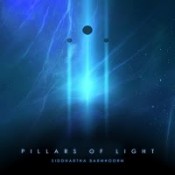 On his debut solo release, Pillars of Light, film composer and sound designer Siddharta Barnhoon offers a short suite of dramatic spacemusic pieces. It’s a decent introduction, albeit one that doesn’t stretch far enough to distinguish itself. The opener, “Foundations,” lays some good drumbeats over ambient flows for something of a techno-tribal feel, and its followup, “Artifacts,” manages to work its way to some strong visual imagery via clanking mechanical sounds and another dose of drums. From there, however, Pillars turns into your standard ambient music offering. I had this disc on loop for a while, but only ever really noticed it during those first two tracks. It has to be noted that Pillars clocks in at a lean 35 minutes or so–more an EP than a full offering. Barnhoon’s flows are quiet and well constructed, but given the short amount of time he’s asking us to invest, Barnhoon could have (or should have) gone further to give the work more impact, a more memorable aspect. The track “Nebulae” is a good example. It’s a pretty straightforward flow, but Barnhoon loads it in places with somber tones and a bit of texture that catch the attention. He then shifts the feeling back toward the light, creating a thread of drama that makes this track tell more a of a story and stand out. Don’t get me wrong–Pillars of Light is a workable collection of ambient flows that certainly doesn’t overstay its welcome. A good low-volume listen, and a hint of what I feel will be very good things to come from Siddhartha Barnhoon. A welcome addition to the ambient music world.
 If you do not enjoy drone–and by this I mean the absolute dictionary definition of the term turned into music, a seemingly endless stretch of what appears to be a single note, varied for the most part only by the slightest tidal pull of its own waveform–then you don’t want to listen to Kamil Kowalczyk’s Aurora. I don’t mind drone, but this was not an easy release for me to get through. The high pitch of the drone that makes up the beginning of the half-hour-long “Model II” was like listening to an old TV test pattern. A sense of “get on with it” crept in at the edges. Yes, there are subtle elements slipped into the flow, bits of electronic twiddle and pulse, but that barely wavering waveform holds court for 11 minutes before there’s so much as a shift in key–and then continues on its borderline flatline way. A second track, “Plasma,” offers another half hour of minimalist meanderings; luckily it benefits from being somewhat more dynamic. I wasn’t in as much of a hurry to be done with this one.
 Hypnagogue Music Reviews