
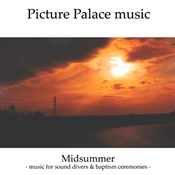
 We reviewers like to try to classify things. It just makes the reviewing life easier. Then along c0mes a disc like Picture Palace Music’s Midsummer, stubbornly refusing to be put into any one slot, and we scramble for the right words. In this case, the right word is: fantastic. Over its ten tracks Midsummer touches on melodic electronica, IDM, prog, synthpop and even a bit of Enigma-esque chant. Lead by Tangerine Dream’s Thorsten Quaeschning, who created PPM “to reproduce the musical dynamic and experiments of old live accompaniment for silent movies,” Midsummer is one of the most infectious discs I’ve heard in a while. If you want to be hooked immediately, head straight into “Midsummer’s Day.” Going from standstill to 60 in the space of a heartbeat, it wraps a catchy, hyperspeed rhythm and melody around a poem by Ralph Waldo Emerson, sung through a vocoder. Not cool enough for you yet? Let’s add in a guitar riff that pops in out of nowhere to hook you, and then layer on what to these ears sounds like a chorus of football fans singing an anthem from the stands. You may find yourself joining in. I simply can’t get enough of this piece. Which is not to discount the rest of the disc. As noted, Quaeschning, backed by up to six musicians, mixes up tone, temp and approach track by track to keep everything fresh. “Midsummer’s Eve” is an aggressive, guitar-heavy rocker–Quaeschning is joined by axe-men Djirre and Stephen Mortimer–that comes off with a certain spy-movie-soundtrack flair. “Seduction Crossing” is Quaeschning alone with synth, lap-steel guitar and a couple of tubular bells; the resultant feel is exactly what just came into your head–a sequencer-launched mix of classic TD structure with a shot of Oldfield. The guitar wails that come in around the 3:40 mark are like an extra boost of adrenalin. The three-part suite “Drowning Someone’s Sorrow Into the Ocean” begins as the most ambient piece here, opening in Part I with shadowy drifts lightly punctuated with an electronic pulse. Part II, the longest track on the disc, immediately takes up the pulse and elevates it, moving off into recognizable TD territory, polyrhythms arcing back and forth across the sound. Part III melts into chant and stronger, neo-tribal percussion (the instrument list includes stones and “boomwhackers”). There’s a great stretch beginning at the three-minute mark where the percussion takes over almost completely, just a whisper of a drone sliding beneath it and fading, and it’s absolutely hypnotic. Masterfully, Quaeschning polishes off the disc back in IDM territory with “Midsummer’s Night,” recalling the structure of the earlier “Midsummer” pieces, wrapping them around a sextet of lines from Shakespeare and giving it an 80s synthpop flair. (There’s a metallic flange bouncing around in spots; I won’t tell you which 80s dance hit jumps into my head when I hear it, but I’m willing to bet you hear the same. It’s that recognizable.) With this piece, Quaeschning ensures that our Midsummer ends on a very high note, leaving us energized, cleansed and alive, ready for more.
Midsummer is, beyond doubt, a Hypnagogue Highly Recommended CD.
Available from Groove Unlimited.

 If the Windham Hill label was still alive and well and adding new artists, I have no doubt Josh Johnston’s new release, The Shape of Things, would be on it. The disc is apparently a departure for Johnston, who notes on his web site that this is his first instrumental album. May I say: nice departure, sir. The Shape of Things is a calmly beautiful wine-and-candles collection of solo piano works, mostly ballads with an occasional uptempo piece tucked in for good measure. Johnston’s usual avocation as a songwriter peeks through the structure of his lovely piano musings; in tracks like “Nightsong 2” and “FVX,” you can almost see the hollows that are carved out of the sound, pools waiting to be filled with lyrics. The space is there and the piano takes its role as singer. And you get the feeling you’d sing along, the lyrics hitting you right in the heart, if they were there. Other tracks are solid, emotional instrumentals with no lyric aspirations, like “Atlantic” and “Cimiez,” both of which I find very moving and carrying a real sense of narrative. And right when you think he’s just another romantic balladeer, Johnston hits you with the jazzy stride of “The Late Train,” written by fellow Irishman and songwriter Roesy. This song finds the pianist getting a little flashy, packing the tune with stop-and-start flourishes and twinkling runs up and down the keys. He’s clearly making the most of his friend’s composition and having a ball doing it. Across the course of The Shape of Things Johnston plays with intensity and a surplus of feeling; there’s a story in every piece, and if they sound a little familiar it’s only because Johnston is leaving his own footprint on the well-traveled path of solo New Age piano. Pick your three favorite artists in the genre; now set Josh Johnston’s name next to theirs–because before too long it’s going to belong there. This disc is going to catch a lot of airplay on New Age radio shows and podcasts, and with any luck it’s not the last time Johnston decides to go instrumental.
 Steve Roach synthesizes familiar sonic territories and fresh approaches on his latest episode in the Immersion series, Immersion 5: Circadian Rhythms. If you’ve been following with the Immersion discs, as well as with Roach’s overall sound-story, the elements at play in this two-disc offering will come as a known quantity. The first track, “Phase 1,” opens with the intricate, insectile skitterings that first populated Roach’s Possible Planet, racing back and forth to track out cryptic symbols in your head. From out of the shifting clicks and warbles a misty wash arises that carries the listener easily into “Phase 2.” On this leg of the journey, familiarity comes from the shimmering cry of processed guitar. The rhythms ramp up in energy, urged forward by the sort of analog electro-pulse that’s powered parts of Landmass, Destination Beyond, and The Desert Inbetween. Personally, I really like this aspect of Roach’s work lately. It’s an understated drive that carves out a low-key but distinctly effective sense of shamanic percussion via electric channels. Against those slow-motion guitar chords it feels even more intense. Underscoring it all is a hushed bass line of Fever Dreams ancestry, peering out of the flow. And then Steve Roach manages to surprise me. The crux of “Phase 3,” for most of its half-hour-plus flow, is a repeating melody/motif that–dare I say it?–is kind of bouncy when you get right down to it. It’s light, bolstered at the edges with a sort of metallic, percolating percussive element, and it just lopes its way through swells of synth pads, loaded with tiny sound elements and just enjoying itself as it moves along. It’s a happy sort of sound, and it particularly works because the background sounds retain that minor-chord, deep-exhalation sense. The result is a very yin-yan feeling, active versus drifting, up versus down, energy versus calm. In the end, Roach melts away the rhythm and lets the drift take over with hints of that analog skitter roiling below the surface. And so the circle comes around and begins again for perfect looping–something I’ve been doing a lot of with this.
 It may be that I’ve gotten to a point where I have certain expectations when I see that I’ve received a disc from the folks at Spotted Peccary–expectations set especially by recent releases from Darshan Ambient, Helpling & Jenkins, and Deborah Martin. So it was a pleasantly interesting surprise to start up Johan Agebjörn’s The Mountain Lake and hear not the sort of cinematic New Age music I thought I’d get but rather a whoosh of electronic wind, a vocoder’d voice sample singing to me and an infectious club-music beat. My first thought was, “Count me in.” The Mountain Lake is more in line with the melodic electronica coming out of the Netherlands than its labelmates, trimmed around the edges with Agebjörn’s appreciation of 80s electronic music. It’s worth noting that said appreciation is always added lightly and well–it never goes overboard into cheesy nostalgia.(Although “The Stones Are Blasted” admittedly comes close.) You may catch wind of familiar synthpop memes floating around in the sound, but it’s more charm than distraction. What makes the disc stand out is Agebjörn’s skilled hand at tempering his dance-music beats with floaty washes. It’s especially effective in the 10-minute “Zero Gravitation,” where rain-spatter pulses fill in for rhythm–just sparse, small hits that I hesitate to call “glitch” because they seem like more. They’re balanced perfectly with a quiet, minimal wash that easily drifts along. Both sides of the equation carry equal weight; Agebjörn never pushes one over the other, and winds the whole thing down to a beautiful, calm close. “Swimming the Blue Lagoon” is one of the highlights here. It makes excellent use of a chopped vocal sample and hanging stretches where Agebjörn pares the moment back to a minimum of sound and movement to create a space that feels loaded with expectation. The track also happens to be toe-tappingly upbeat. “The Chameleon” also takes advantage of that sort of hesitant, minimal feel blended with tempo. Agebjörn knows how to make you wait to hear the next sound, and he knows how to make you want to wait for it. Most of The Mountain Lake is energetic without having to resort to kicking it up to the frantic pace that many glitch-style musicians do. Agebjörn finds a perfect spot between hit-the-floor danceable grooves and downtempo chill, and it’s a comfortable spot that I’ve spent a lot of time in lately. (For a dose of absolute laid-back chill, head straight for the slow and sexy “Love Ray,” which is so perfectly loungey that it ought to have a cover charge.)
 Imaginary Numbers is experimental composer Betty Widerski’s foray into live looping using mainly violin and viola. To a point, the idea works well. The first three tracks find Widerski, aka Reverse Polish Notation, improvising over her loops, building her sound a phrase at a time. These, to me, are the strongest pieces here. “Rainforest” opens the disc with a slight Asian flair, a swirling arpeggio singing over a dialogue between plucked and bowed melodies. “Ashes”is my favorite piece on the disc, a work that patiently builds from an insistent string pulse and a knock-on-wood rhythm. Where “Rainforest” built its layers quickly, “Ashes” generates a feel like someone else has just walked in and pauses before adding to the movement. There’s a beautiful sadness here, a true ache of the soul in Widerski’s strings. “Tango de la Luna” is rich and befittingly dramatic. The looping here comes off more as Widerski’s backup combo keeping time rather than a simple repeating backdrop. The appeal in these early tracks is the way they seamlessly blend the intimacy of a chamber music performance with minimalist undertones, paired with the knowledge that Widerski’s doing it alone. Unfortunately, the wheels start to come off for me with “Subterra.” The computer-generated beat feels out of place in the wake of Widerski spending her first tracks investing the listener in the idea of complex rhythmic structures being formed through loops. Granted, this track is (as noted on the cover) an improvisation over computer-generated noises, but the unchanging beat becomes monotonous, and it pulled me away from the more interesting aspects of the piece. She follows with a straightforward version of a traditional tango, “Tango a Unos Ojos,” which she arranged and on which she also plays piano. It’s a temporary, quite lovely, respite before the final two tracks. I have listened to them, but as they are straightforward songs, I would prefer simply to say that I don’t review songs and leave it at that.
 I like the idea: pairing Native American flute with modern, uptempo rhythmic backdrops. What I like somewhat less on Oakensong’s Flutecore is the actual execution. Having listened to it several times now, I think that the underlying problem for me is that it often feels like Oakensong (aka Victor Eijkhout) tries too hard to infuse cool, to do the “new music for old souls” thing. The result can be a heavy-handed sound that plods along rather than dances. First impressions count, and Oakensong’s opening piece, “Rain in the Canyon,” devolves by the track’s end into a muddled briar patch of confused sound that had me hurrying to skip it. Listening to it made me wary about going forward. A later track, “The Flute Also Dances,” has a similar effect, that feeling of forcibly jamming together musical thoughts that could work well if they were more gently dovertailed into a single idea. When Oakensong keeps his music closer to the source, he truly hits the mark. The too-short “Dirt Roads” is a nice piece where the flute absolutely sings across understated accompaniment–it shines because it keeps things simple and knows where its strength comes from. The windy swirl of “The Spring at Dusk” is a potent sound-prayer, a dervish that picks up power as it picks up speed. For me, Flutecore is an uneven and uncertain disc with underlying promise. Eijkhout is a talented flautist; it’s just that the concept behind the disc doesn’t carry his playing well.
 Having most recently lifted listeners upward with the celestial/sacred drifts of
  Because I first caught the electronic-music bug in the 70s and early 80s through artists such as Tangerine Dream, Jean-Michel Jarre and Kraftwerk, the truth of the matter is that any musician now doing sequencer-based, Berlin-style music (and doing it well) pings my nostalgia button and therefore has a bit of a thumb on the scale when it comes to a review. Chuck van Zyl is certainly a well-known name in this genre, a talented artist who keeps the old-school flame burning both as a member of Ministry of Inside Things and on his own. His newest release, Memory Space, hits all the right analog buttons (or knobs) as he lays down fluid, flute-like melodic contrails over precise and perfectly constructed sequencer runs. If you’re not into this largely retro style, Memory Space may hold marginal interest for you, or even seem limited. However, van Zyl mixes things up as best one can, given the base equation of a very angular, clockwork bottom end and the artist’s particular melodic style (which, let it be noted, I’d gladly listen to all day) and he does steer his musical musings from that classic framework and off into spaces that are darker and more experimental. In fact, the disc starts with the abstract piece, “Time,” where skeins of analog sounds spiral off into a whispering void as an ominous bell peals. van Zyl smoothly segues that into the crystalline arpeggios of “All Souls’ Day,” and as he lifts choral voices out of his gear, we find ourselves in that sonic sacred space, paying tribute to Froese and Schulze and all those who crafted the path. Between these two tracks, one gets an understanding of the balance at work on Memory Space. The centerpieces of the disc are three long tracks that give van Zyl the room to really stretch, explore and showcase his mastery and love of this style. “September Cemetery” is the first, and it helps to re-express the balance by opening with clouds of warm ambient chords and a bounding melodic line that puts me in mind of early Giles Reaves. (In fact, it just came to me that the echo I’m hearing is from Reaves’ Sacred Space.) “Marble Orchard Nocturne” lacks only Art Cohen’s guitar to make this a picture-perfect MoIT track. The energetic sequencer is a van Zyl signature, and his free-form playing absolutely soars here. Not to throw an endless stream of reference points at this disc, but this one puts me smack in the middle of Tangerine Dream’s Sorcerer soundtrack–an album that was absolutely influential on my appreciation of the Berlin style. Late in the track, van Zyl seamlessly downshifts to more vaporous drifts, and the effect is mesmerizing and soothing. “Stories in Stone” begins in an interesting space, with blocky notes stepping precisely, if not a bit mechanically, over choral voices. After a few minutes, van Zyl sends the whole thing flying, high and clear, and never looks back. This one is pure Chuck van Zyl–no comparisons are needed. In this I hear the playing that has made me an MoIT fan, the keyboard soul of the duo. The tracks between these longer pieces are not to be ignored, by the way; they’re equally rich in character, diverse and perfectly constructed, parts of this very effective whole.
  If there’s one thing I’ve learned through exposure to three CDs by J.C. Mendizabal–two as Kyron, one with Radio Free Clear Light–it’s that from the moment you start one of his works, the experience is going to be interesting at the very least, likely challenging, and ultimately rewarding. Perdurabo, his latest out under the Kyron moniker, plays with the possibilities of rhythm and repetition. The 12 tracks here all have a certain bounciness to them, a pattern set from the first track, “Suscipio,” which is also about the most user-friendly one here. A melodic phrase with a vibraphone/kalimba tone winds around and around itself while light glitchwork fills in the background. It’s catchy and appealing. With the concept in place, Mendizabal contorts and reconfigures his basic idea across the rest of the tracks; in doing so he makes us consider not just what we’re hearing but what we’ve already heard and how it relates. The tonal familiarity is there, but the new forms force us to re-think the concept. For example, a memory of the pattern eases out from under a scratchy electronic rasp in “Itineris,” but our ability to hold that memory is tempered by the arrival of new sounds and Mendizabal’s slow removal of that element. And so it goes, with the listener re-engaged by each new track but still trying to piece things together. Is the metallic, clanking percussion in “Fas” following the same pattern as the carrier-tone sounds in “Viator”? Are there echoes of that first track in the speedy, elastic glitch of “Tumulus”? It’s that odd sonic deja vu working its way into our heads again while, at the same time, Mendizabal’s smooth use of noise and glitch confronts us with the “is this music?” question. That’s part of the allure of Perdurabo–its ability to make us think, but in the same moment infect us with a touch of the beat. Mendizabal’s musical equation holds up quite nicely across repeat listens. Perdurabo is a Hypnagogue Highly Recommended CD.
 Hypnagogue Music Reviews