
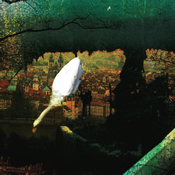
 Dubstep’s inherent trippiness gets tuned up and supercharged in the hands of sonic mechanic Mikronesia (aka Michael McDermott) on his new release, Sick with Silence. Break out the headphones for this one, and just let the echo-amped grooves wash over you. McDermott brings the listener in with a long call on the melodica and a backdrop of twiddling electronics to start “Black Rain.” It’s nearly two minutes before a beat fully establishes itself and three before it gets assertive, but once it comes, the groove is on. The main variable in McDermott’s equations here is his use of noise. He runs the gamut from lightly augmenting tracks with low-volume crackles to unleashing all-out waves of static-loaded bliss. Distortion plays a big role here as well. All of it, however, perfectly supports his smooth dub intentions. “Smuggler” is a great example, a fully packed bowl of smoky goodness with guest Erb Blazer rocking the mic with rhymes. Here again walls of electronic sound fill the space. (We’re back to the lyrical poetry on “What What” with John Morrison hitting high speed lines.)
Along with the well-formed dub, McDermott also offers his usual array of tormented sound. “Porn Anchor” is a dark, twisted vehicle for a melodica that seems to have lost its way. I also like the spooky confines of “Contourist,” where glass-bottle notes ring out against mechanical pulses, and the tonal identity shifts at work in “Moon Pebble.” McDermott closes with the glitchy, random sounds of “Calm Intent,” which borders on minimalism with its dense repetition and surprising simplicity of construction. The last three minutes of this track break down to a steady electronic pulse-beat fringed with noise at the edges. It reminds me, in its blend of flow and beat, of DAC Crowell and Kurt Doles’ “Rain Forest Garden,” one of my all-time favorite ambient tracks. Great ending piece.
And the bass…oh, the bass. Throughout Sick With Silence McDermott lays down spongy, meaty basslines you can practically reach out and touch. Just listening to the thick, resonant low end on “Ketut” made me want to run out and drop good money on the biggest subwoofer I can find. It keeps the pieces very true to their dub heritage. And just happens to be groovy as hell.
Sick With Silence clocks in at under an hour, but it’s the sort of CD that takes its time in your head. Firmly sound-packed and engaging enough to make sure you run it through at least a second time. A great outing from Mikronesia.
Available from the Mikronesia web site.

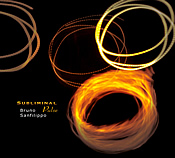 Bruno Sanfilippo continues his run of excellent CDs with his latest release, Subliminal Pulse. Sanfilippo’s tour this time moves through nine tracks that follow a soul-pleasing path of reducing themselves slightly in complexity as they go, from the starlight shimmer and mathematical rhythm of “The Third Geometry” down to the prayer-like sighs of “Mantram.” Within that framework each piece stands on its own, but the whole still carries a strongly unified feel, an unwavering continuation of intent. The difference in tracks comes off as less of a change of direction than the way the mind courses from one thought to the next, taking up an idea and moving off with it. The centerpiece here is the 14-minute “Intrinsic Fluctuations,” a thoughtful landscape of sound that keeps folding in on itself to find new identities. It passes through quiet spaces, spacey quietude, shadowy moments and the border of rhythm (with some nicely understated percussion), each transformation modestly making itself noticeable. My problem in trying to write this review has been that every track borders on being too lovely for words; they simply must be heard. “Santa Luminosa” has a hint of gypsy violin mourning through its sad song. The title track begins with a music-box-type melody and gently builds from there as misty washes ease in at the edges. It feels like remembering. “Pulsum Sacrum” will absolutely carry you off with it, a slow-breath drift centered by two repeated sets of three notes–one set rising, the other falling, both carrying, as the title suggests, a sacred-music feel. This is a deep prayer for the soul, and a balm for the mind. Loop just this track and you may be setting yourself up for a religious experience. As always, Sanfilippo’s mastery of sound textures enriches the experience of each track. Deep, focused listening reaps incredible rewards and opens entirely different worlds. Quite simply one of the best CDs of 2011 so far, and definitely a Hypnagogue Highly Recommended CD.
 After two tracks of interesting, if fairly straightforward, glitch-heavy electronica, something very interesting happens on Drifting in Silence’s Lifesounds. Out of the middle of the rich ambient wash that kicks of “Rorschach” comes a methodical and distinctly rock-based drumbeat, followed by a heart-grabbing shoegaze-derived melody made of crunchy, rasping guitar. More chords, loud, distorted and forcibly metallic, pile on to form a sonic strata, and the whole thing just turns magnificently catchy. At that stage, Lifesounds distinguishes itself as being more than yet another fast-rhythm electro-pastiche. In fact, I find the disc more interesting when composer Derrick Stembridge isn’t doling out the glitchwork. The lush, half-awake ambient drift at work in “Tremer” is perhaps the best offering here–and the longest, a 10-minute dip into listening bliss. The title track, which closes the disc, is a close cousin to it in feeling. It’s got a real sense of warmth as Stembridge builds a wall of mist around the listener. As good as the more “ambient” tracks are, Stembridge also gets credit for his excellent beatwork on the glitch tracks. He shows a strong hand at pairing the standard rapid-fire sound arsenal against slower-moving backdrops for a superb contrast, as evidenced best by “Fixer.” Here Stembridge cleverly throttles up and down by turns to keep the ride moving and interesting. The racing sequencer runs late in the track are a nice touch, and everything simply fits where it lands. A great track. Another winner here is “Existence,” which drops in piano against the driving electronics along with a hushed ambient flow to up the effectiveness of Stembridge’s sharp pairings.
 The Child Set Free is Human Metronome’s attempt to create “a purely organic-sounding album” using a minimal amount of soft synth but a rich dose of flute and hand percussion along with guitar and field recordings. The attempt is quite successful; The Child Set Free is an intimate CD that sometimes feels quite like background music for a contemplative walk in a Japanese garden–and sometimes feels like there’s something about this garden they’re not telling you. Eelke van Hoof surrounds the listener with his crafted reality and creates a space that shifts between calmly cool and unnaturally shadowy, a place distinctly cut off from the world. The opening track, “Gi,” is a perfect 18-minute introduction to van Hoof’s sound-set. The details of his landscape fill in slowly, starting with wind and water sounds, the flute coming in like a whisper. Late in the track we hear the first guitar sounds, played with a pleasing hesitancy. van Hoof composed this largely on the fly, improvising in the moment and later adding finishing touches. (“Perfectionism was always lurking around the corner,” he says on his web site.) In the pieces “Yu” and “Jin,” van Hoof takes the listener through his darker spots, the clanging of gongs and temple bowls offsetting the sounds of a stream in the backdrop. “Meiyo” feels like a bridge between realities, opening with distorted bells, carrying the listener through a space that slowly gains solidity, and closes with more bells, notably more stable. Blocky percussion in the last few minutes grounds this idea of a return to a more physical place. The 15-minute closer, “Konshi,” is a purely quiet space, a misty, mind-salving dronewall that perfectly concludes the journey.
 Groaning, experimental dark ambient drawn from bass, altered vocals and broomsticks. Personally, I couldn’t find an entry point here, nothing for me to latch onto as a listener. The best I can offer is to say that in looking into Kristus Kut, it seems his strong point is live, largely improvised performance art pieces. Maybe on that level it works better? This is just too esoteric for me. The closest I get to being able to listen is in the sparse, cold patience of “The Inbetween Sleep.” The trance-inducing percussive elements and the stretches of semi-silence between them work their way into my head. Beyond that I simply feel left out. As always, I suggest readers look into music that I don’t “get.”
 It has taken me several listens to come to something of an appreciation for Brian Vassallo’s Memoirs of a Lifetime. The short explanation of the disc is that it’s a spacey, classic-style synth album filled with textbook sequencer work, whooshes of electronic sound and a healthy dose of swelling, cinematic passages. Vassallo wears his influences on his sleeve, and you’ll hear them all clearly. What kept surprising me as I listened is that for an artist whose background, at least according to his website, is so extensive, the music on Memoirs seemed at times to be shackled by an almost amateurish hesitancy that often felt heavy and ponderous. I hear it first in the beginning of Part Four, and that may only be because Parts Two and Three are noticeably smoother. Part Two is a lush, richly arpeggiated spacemusic piece, spot-on in every genre regard. Part Three immediately shifts into a mechanical rhtyhm, crisply angular where Two was wave-form smooth. From there, Memoirs becomes a so-so ride for me, but Vassallo recaptures me late in the disc with Part 8 (out of 9), which carries a nice low-end bounce, a cool rhythm that Vassallo eases his melodies over. It’s catchy. With the closer, Part 9, Vassallo hits that cinematic aspect, skimming dangerously close to the edge of being bombastically New Agey–but I have to confess that he catches me with the big, bold synth lead that feels like a full-on arena-rock guitar. Memoirs of a Lifetime is a decent listen that, for me, thrives better when it’s mixed in with other music. Vassallo has clearly picked up a lot from his influences, and his playing, when it feels more free, is excellent. The music here suffers only from being too familiar at times, and I’ll be the first to admit that it may be due to me hearing a lot of this type of music lately. If your tastes run strongly to the J-M Jarre side of things, it’s definitely worth a listen. (Hint: You’ll want to head directly to the high-energy thrust of Part Six.)
 Spiritually powerful and jubilant enough to scour your soul clean, …And Love Rages On! from worldmusic trio AOMUSIC caught me entirely by surprise. It’s a robust, joyful disc driven by thundering drums and the heavenly heights of singer Miriam Stockley’s voice. (Stockley is the voice behind the act Adiemus.) Backed by Richard Gannaway on strings and vocals and Jay Oliver on keys and synths, Stockley varies between actual lyrics and sound-chants that neatly transcend the need for words. When Stockley sings, feeling takes over and you purely understand the intent. Of course, the pieces with actual lyrics work, too. “In Lake’ch” takes its title from a Mayan greeting and explains, by translation and a smoothly serpentine tune, that it means “I am another you.” “Ena Na Lena,” if I’m reading correctly, pulls together Gaelic, Swedish and Polynesian to chant “Little flame, my flower of light.” “Sheyu” carries a call for peace and beauty, and does so peacefully and beautifully. Stockley is not alone here, vocally. Gannaway’s voice comes in as a nice lower counter to Stockley’s hawk-circle registers on “Sheyu,” “Tio Da Ye” and “Ena Na Lena.” Sounds drift in from all over the globe in the nine tracks here. Pennywhistles vie with didgeridoos; harp sounds trade licks with guitars; drums of all kinds kick through to lay down the base and set listeners grooving. (You will be excused if you leap up to dance during “One Kaleo,” where the Children’s Choir of Beijing sings–about Little Red Riding Hood, believe or not–over a fast, funky riff.) Celtic songs nudge against African rhythms and Middle Eastern structures. Children’s choirs from around the world fill out the sound–and it all comes together in a sort of musically utopian stew. …And Love Rages On! keeps its upbeat tone going strong through an all-too-brief 45 minutes. It passes quickly, and you’ll likely be inclined to give it another go-round. But first take a moment as the disc ends to feel the way it’s worked its way inside you, the way it feels like it’s left a little extra power in your spirit, a little more hope in your soul. This is vibrant, feel-good New Age music that has grown on me and affected me more with every fresh listen.
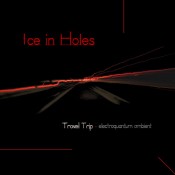 If every CD is a journey, then ambient duo Travel Trip’s Ice in Holes is that one where you’re just sort of going along, heading somewhere, and all of a sudden you jolt into awareness and realize that you know you’ve been driving but you’re not sure for how long or where you are in relation to where you thought you were or where you were headed, but you find that at the very least you’re content that there’s something interesting outside the window…wherever you may be. Marco Seracini and Augusto Tatone bring together synthesizers, electronics and fretless bass in improvised pieces that seem like they have a destination but are happy to wind their way through spaces that are ambient, jazzy and firmly experimental in turn. Not surprisingly, it can be a bit of a mixed bag, and Ice in Holes hits the mark about half the time for me. Tatone’s bass brings a grounded, earthy feel to many of the tracks, with that familiarly round, springy sound. It coils neatly around Seracini’s drifts in the opening track, “Alaska Dreaming.” The duo are perhaps at their middle-of-the-stream best, which is to say neither too straightforward nor too deep into left field, on one the two longest tracks here, “Considerations About Sandy Dennis.” There’s a bit of muddling about as a space is established after launching with a sound bite from Dennis’ 1969 film “A Touch of Love,” with Tatone grinding tones from his bass, but it eventually settles into a mind-salving blend of drifts and noise–sometime subtle, sometime less so. This is where the pair’s chemistry is strongest and because of that, because of the quality of the interplay, the oddness seems less distracting. By perhaps apt contrast, a companion piece, “Considerations About Sandy Dennis in the Mirror,” starts similarly but eventually gets tangled up in its own soundweb, with too many things fighting to be noticed–it’s improvisation that’s gone off the rails and is actively working against itself. Even in the more accessible tracks like the opener and its followup, “MenoMale MiniMale,” a listener has to come into Ice in Holes with an open mind and a willingness to try to work through it. This one will sit better with experimental-music fans than casual listeners.
 To get straight to the point, Olekranon’s {bilial} is every bit as subtle as a storm of roundhouse kicks to the face–and that’s exactly why I like it. You get about 35 seconds to prepare yourself as a feedback whine rises against noise clusters and then Ryan Huber starts hammering away with a relentless, gear-grinding, industrial gnash of aggressive noise, its assault-with-intent-to-kill sensibility upped by heavy metal-quality drums beating you roughly about the head. As it juggernauts along, forcibly dragging you behind it, {bilial} openly flaunts its rock heritage. Listen to “Brng Yvwh” and you’ll hear a definite rock framework; it just happens to be filled with a flesh-stripping mix of caustic noise and anger. A repeating bass run under it all accounts for a lot of the familiarity–like the way you remember the first person who ever punched you in the face. Has to be said that {bilial} can suffer from a bit of sameness, track to track. Huber’s topmost sound, sort of an ongoing scream filtered through five miles of white noise, is always here, always in force. He wisely dials down the intensity here and there, but it’s only so he can crank it back up. “Deka” grinds its way down into an almost relaxed moment, shedding layers of spiky armor, and the moment it’s done the title track kicks the door down and proceeds to beat the living shit out of you sonically. But it’s a beating you may beg for again later. I love this track for its blatant, screaming punk-rock feel–punk rock that’s exponentially overmodulated. “Daisycutter” stands out for its use of battering-ram drums to take control of the sound under one of Huber’s most densely layered waves of noise. Here’s what I truly like about {bilial}: if you’ve got so much as an ounce of rage that you’ve been suppressing, or even a shadow of a primal urge that gnaws at your subconscious, {bilial} is going to find it, tear it out of you and make you look at it. This is a raw, unapologetic, visceral piece of work that doesn’t care whether you like it. It knows you’re feeling it because it’s already chewed its way into you from that first scrape of processed guitar. Volume up, please. All the way up.
 Hypnagogue Music Reviews