Emmalee Crane: Crowd of Reeds

crane_crowdOn her latest release, Crowd of Reeds, Emmalee Crane offers up electro-acoustic chamber pieces that seamlessly blend new classical music with understated ambient supporting structures. The resultant sound is intimate and organic, very human and deeply affecting. Leaning heavily on rich string drones, comparisons could be drawn to an earthier Stars of the Lid, with the drones being grounded and given a lyrical lift by piano, brass, guitar and more. Sarah Conroy, J. Patrick Brookman, and Miles Fender assist, which gives the music even more of that small-combo chamber feel. Crane peppers her work with interesting touches, from clatters of sound to field recordings to vocal drop-ins, but the focus stays firmly on the music and its rich emotional content. Fender’s guitar work in “The Seventeenth Wheel” brings a twangy solidity into the midst of quiet drones and wavering sound-forms, later augmented with Conroy’s clarinet. Together, they create a meaningful voice. Crane’s piano on “Manitoba,” my favorite track here, has a definite heartbreaking quality to it. The structure sounds almost simple, and allows the repetitive song to truly drill down to an emotional core. Long-drawn strings melt into a drone on “The Summer Fell Silent,” a core-resonating bass sound with a signature raspy edge. As the strings layer and open into a more melodic space, all you can do is close your eyes and let this somber sonata wash across you. It leaves off beautifully at the end, teasing the listener with a need for just one more note that isn’t coming.

Crane packs 10 pieces into this 40-minute offering. Although short, the songs here are firmly filled and fully realized. The brevity seems to reinforce the chamber-music sense, the intimacy of a small recital. A superb release.

Avaiable at Emmalee Crane’s web site.
Hollan Holmes: Phase Shift

holmes_psHollan Holmes pays homage to astronaut Neil Armstrong on his new release, Phase Shift, and in doing so offers the best work of his short but increasingly impressive career. As with his previous discs, Holmes’ music varies between an analog sound that pings all the listening-pleasure centers in old-school fans, and  broad, far-reaching spacemusic excursions. In fact, the final two pieces, “Morphogenesis” and the title track, covering about 15 and 33 minutes respectively, are incredibly deep stellar flows, alternately calming and quietly dramatic. “Morphogenesis” lifts slowly out of silence to find its way to that place where all spacemusic goes at some point, the ever-popular angelic choral pads. Holmes does a great job of dialing them back to a sort of celestial whisper, a perfect accent to the misty borders and earthy bass drones of his larger drifts. “Phase Shift” is the more ethereal of the two but none the less substantial in sensation. Long undulating washes dissolve across time into a fog of surrounding sound; it’s simply a classic ambient feel, all slow evolution and crossing pads for deep and pleasing immersion. Holmes’ structure here is impeccable, giving a distant sense of melody within the flow. Prior to this long stretch, he opens with sharp and well-shaped sequencer lines in “A Precarious Trajectory” and “The Road to Perdition.” These are an analog lover’s joy ride, energetic and angular, the sounds bouncing and rebounding beautifully. Have your Tangerine Dream points of reference handy. “The Road to Perdition” is punctuated with mighty, fist-on-keys chords, big slams of sound  that pack some serious resonance. A great touch. Falling in the middle is  “Lost Memories.” It opens in a quiet space, its pads soft and gentle, and later takes on a light touch of sequencing. Again, Holmes elegantly folds in this aspect so that it grows organically into the piece and builds to a point of focus. Underneath it comes a repeating melodic phrase that feels a little pastoral. Holmes takes almost a full minute to strip the sounds back down and prepare the listener for the deep trip ahead.

It’s been an absolute pleasure to spend a lot of time dropping into Phase Shift. The deep end of it is remarkably so, a full-on brain massage edged with emotion. Its uptempo side is simply fun, not just for its nostalgic side but for the quality of the interlacing of lines as well. Holmes makes it sound effortless, and his sense of overall pacing creates a well-realized sonic through-line. Another superb offering from Hollan Holmes. If his name is not on your radar yet, check again. It needs to be.

Available from Hollan Holmes’ web site.

Stephen Savage: Future Memories

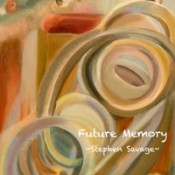
savage_futureIt’s interesting. Stephen Savage says that with Future Memories he wanted to create synthesizer-based spacemusic. If that’s the case, then this is the jazziest, least spacey spacemusic I’ve ever heard. He finds his way there by the time he reaches the track “Gravity”–and he manages to all the right memes with his big, sweeping pads and glittery sounds–but even that winds up with a jazz tint. And that’s okay, because Future Memories is a comfortable ride that finds its voice in its blend of jazz, laid-back New Age, and a hint of spacemusic. The jazz element is strongest, and Savage, whose credentials include stints with both Berklee College of Music and the New England Conservatory of Music, is clearly at home there. “Then There Is Here Now” sounds like what would happen if Steely Dan decided to go a bit more prog. Fagen-esque breaks and phrasing mark the spaces between tweaky arpeggios that scurry up and down the scales. Savage also unfurls some tasty guitar licks here (and throughout the disc) for extra zest. Michael O’Connell’s rock-solid drumming adds flair and power. “Hold That Thought” carries echoes of Lyle Mays in its crisp and lyrical piano. “Riding the Cusp” spills out filled with electro-jazz funk, its Return to Forever keys underscored by percussion from O’Connell.  This track will do your soul some good. Savage’s ambient-leaning pieces are equally well executed. “Ponder” and “Lux” float right along, with “Lux” adding in a little extra dramatic flair.

Firmly slotted in the New Age category, Future Memory‘s jazz pedigree makes it a nice wind-down disc, with the electronic edge bringing in a lot of dimension and room to play. Jazz fans will find themselves playing the name game as they go along, but Savage makes each piece his own and everything here is rock-solid. Very enjoyable.

Available at CD Baby

Supersimmetria: Golden Ratio

supersim_ratioTaking off from an oddly abrupt start that had me worried about the condition of the road ahead, Supersimmetria’s Golden Ratio delivers a mix of dark-industrial grind, glitchy rhythms, and deconstructed music-class musings. The disc purports to be about the effect of rhythmic and arhythmic elements working in unexpected ways and blended into spacious sounds. To the listener this comes out as interesting cross-rhythms punching their way through sound forms that build to palpable thicknesses. The formula tends to be: start with a simple phrase or sound, repeat and layer, weaving complexities and loops, and allow the thing to gain mass and impact. “Still Thinking About the Law That Regulates the Universe” and “Structure” build off piano motifs. The first uses a base of two notes, paired with little flourishes, to set the tone. Those two notes work as anchors as the sounds load up, before disintegrating toward the end. The other is played as a charmingly stilted set of notes trying to hold  their own focus as a snarling electronic sound forces its way in to change the feel. Golden Ratio revels in its grittiness, and its strongest moments are where it takes that to a high level–the distorted washes and pure industrial metal-on-metal pounding in “Atmosphere,” or  the tinkling glitch and old-school electronic feel of “Descent.”

All in all, Golden Ratio is effective and powerful. It’s going to appeal more to those whose tastes run toward, but entirely into, noise. The glitchwork here is excellent, and there’s a lot of thought behind how things are constructed. A good higher-volume listen.

Available from Industry 8.

Chronotope Project: Chrysalis

chrono_chrysA couple months back, I sat in on a stillstream.com listening party for the release of Chrysalis, the new release from Chronotope Project. At the time I only caught the last two tracks, but as I was listening I found myself looking forward to taking the time to make a deep dive into Jeffrey Ericson Allen’s latest. Turns out the wait was worth it, as Chrysalis has revealed itself as easily one of the best releases I’ve heard this year. In these five tracks the listener gets a blend of downtempo, spacemusic, and textbook ambient, fused together with Allen’s classical training. (He cites Debussy as a strong influence.) That last aspect shines through in the tight structures and progressions throughout, like the use of an ostinato phrase (and I will confess I cribbed that from his website) in soft chime-like tones that forms the bedrock of the opening, title track. That sort of solid, near-linear musical mindset gels perfectly with the vaporous and boundless freedom of his ambient structures, and complements the composer’s intricate patterns when he shifts into a Berlin-like space. Without meaning to sound fawning, you know you’re in good sonic hands pretty much from the first note, and remain so, without a bump, until the last. Headphone listening is an absolute must in order to catch Allen’s intricate detail work. There is a point in the beautiful drift of “L’Avenue Du Ciel” where he mixes together a field recording of water, crystalline glissandi, and a coolly pulsing sequencer bass line for a stretch that is simply mesmerizing. It’s a pleasure to listen how Allen manipulates these sounds within your headspace, keeping them moving like living entities. “Trance-Missions” is a 25-minute joyride that reminds me of Erik Wollo’s work in its snappy sequencer trails and sighing chords. I like the way this expands and contracts as it moves, shifting from its initial broad and spacious drifts to tightly packed rhythm-fueled passages and then back out. A deeply immersive space. “Reflecting Pool” eases into the disc’s most ambient flow, beginning with tones like meditation chimes, the sounds rippling outward. Quiet tonal phrases lend some solidity to the feel, warm string pads float through, and a sense of pure calm just descends over the piece. Guitar at the outset of the last track, “Eternity’s Sunrise,” comes as a pleasant surprise. Here, Allen says, he turns to Debussy for the structure, eventually opening into “…a slow psychedelic sunrise–so Debussy plus Moody Blues.” Once again, his layers build to an elegant and headphone-worthy depth, and there is more of that expert blend of restraint and release, of the mathematical and the organic. This is the piece that made me look forward to this disc back at the listening party.

Chrysalis is a stunning piece of work. It sounds fresh each time you listen to it, and offers nearly immeasurable depth. It seems like there’s always something new to hear, a new place to be taken. Kudos to Jeffrey Ericson Allen. This is a standout recording. I recommend visiting Allen’s web site to read his interview with Blake Gibson. There’s a lot of insight to be gained.

Available from Relaxed Machinery.

Llewellyn: WolfLore

llew_wolfBefore I get to what will be a generally good review of Llewellyn’s WolfLore, I have to say that I could have done with less actual wolf. I’m for all establishing a thematic through-line, but sometimes less is more. Give me a wolf howl at the start of the disc, then tell your story. I get it. Unforunately for my tastes, the howling is peppered throughout WolfLore, and in spots it’s more distracting than enhancing. That being said, WolfLore is an ear-pleasing, toe-tapping bit of world music that brings in flavors from Celtic to Native American and beyond to honor this animal teacher and guide. Your mind may go straight to the Enigma file when the title tracks kicks into gear. Between the catchy backbeat and the sound of the flute here, I kept waiting for a whispery “Mea culpa” to float in. A drop that brings in acoustic guitar is handled perfectly. Llewellyn’s guitar work is definitely a highlight throughout the disc. Its rich Spanish flair runs through “Lunar Power” as it trades the spotlight with flute; on “The Teacher” it picks up some Andean cred to go with beautiful pan flute and traditional flute over hushed pads. Two tracks here stand out for their energy and slight departure from the New Age template that guides the disc. “Running Free” starts out a bit on the twinkly side, with piano and bird song, almost to the point where it’s too sugary for me, but then an electronic beat and bass riff come in to start a bit of a fire, transforming into a hoot-and-holler Celtic dance of pure joy. Violin and bodhran plant us firmly in the heart of Eire. “The Clan Returns” comes in on heavy drums before melding into a very cool downtempo groove. Flute here takes on a light-jazz tone, playing across hand percussion. The beats are nicely complex, and instantly infectious. More guitar rounds out the laid-back sound.

Once again, Llewellyn has offered up a very smooth blend of sounds and styles that transcend the mystical/New Age overlay of his musical persona. This disc should be filed under World Music for its globe-spanning influence. You could even take off its wolf suit and it would stand nicely on its own as a solid guitar and flute disc with strong Celtic roots and some lounge influence. A pleasant, well-crafted journey from Llewellyn.

Available from Paradise Music.

Ken Elkinson: Music for Telecommuting

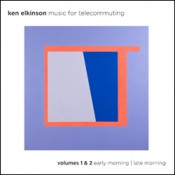
elkin_telecomKen Elkinson may be out to flood the world with charming electronic music. After introducing himself to the e-music world with his six-disc Music for Commuting, he now returns with the two-disc Music for Telecommuting, and intimates in his press release that there might be two more double discs in the works! Elkinson’s work is marked by two things: a textural lightness paired with occasional washes of melancholy, and pop-song brevity. The main trope here would seem to be to take a fairly straightforward song structure, give it some soft focus at the edges by wrapping it in pillowy synths, then ease in dose of emotion. Many of the tracks ring with easy familiarity. “Windowless” mixes a twinkling sequencer run with billowing chords–which play a part in many of these pieces, something I’ll get to in a moment–for a somewhat nostalgic late-80s feel. The slow-moving “Conditions” reminds me of Jarre’s calmer passages, a very evocative piece with a sweet sadness underlying it. “Endless,” with its gentle electric piano melody and string-like chords, pings the memory of something I’ve heard, yet remains just enough itself to keep the other from intruding. But, again, it takes me toward the 80s.

Music for Telecommuting may prove a little too fluffy for some. It’s nicely constructed and a relaxing listen, but for me–and I quite like Elkinson–it’s better mixed in with other music rather than taken straight. The back end of the disc feels a little too dependent on the aformentioned blossoming chords. When they’re lined up one after another, it threatens to be repetitious. To some degree, their presence across the whole collection can wear just a little thin when you listen in one go. I enjoy a lot of what’s offered on Music for Telecommuting, but I take it in measured doses.

Available from Ken Elkinson’s web site.

Triangular Ascension: The Chronos Anomaly

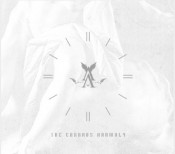
triang_chronosBecause I am not a fan of brash, hyper-dramatic, thematically drowned dark ambient, Triangular Ascension (Federico Ágreda Álvarez) almost lost me early on in his new release, The Chronos Anomaly. Good thing, then, that my gig here is to hang in there and see what else a disc has to offer. And by “good thing,” I mean good thing for me, because The Chronos Anomaly begins as one type of disc, but evolves to become something better. Álvarez creeps in at the start of the first track,”Time Crystal,” creating a haunted, sparse space dotted with the near-tribal overtones, including a growling didgeridoo, that play a stronger part later in the disc. But then it’s time to bomb the thing with huge symphonic bursts and lay in tortured moans and cries to fill in the background and make me worry that I’ve come across a pretty standard dark ambient disc. And yet, as soon as the disc moves into “Industry of Silence,” things are different. Cave-drip ambient gives itself over to a cool beat cross-bred with industrial clamor and maybe even a slight glimmer of post-rock structure. (He revisits this feel, in even gritter, more hardcore fashion, on the grinding and aggressive “End of Time.”) This is not the bombast I was greeted with; this is almost subtle in execution, more sophisticated in its approach, and suddenly I’m along for the ride. Álvarez wends through a couple different sound zones as he goes, from dark and abstract (“Dream Devourer,” “The Future Code”) to that edge-of-tribal tone (“Carpe Noctem,” “Above the Remnants”). Because of my own musical predilections, this is my favorite stretch of the disc. In “Carpe Noctem” Álvarez lays down an earthy bass drone, adds bird and atmospheric sounds, and drives the pieces forward with percussion, eventually taking the listener into sparse, echoing depths and cold atmospheres. The Chronos Anomaly rises back upward on the thickly packed but lightened pads of “The Cleansing.” The closing track, “Final Movement,” surprises with an almost New Age feel, starting with more of those here-comes-the-dawn pads, which give way to a bit of stormy weather, before unfolding into a melody with tapped percussion and Spanish guitar. (I guess when you’ve made it through the darkness, you flamenco a bit.) A very cool way to end.

The more I have listened to The Chronos Anomaly, the more I’ve found to enjoy. Álvarez is at his best when he keeps away from the bombast and works with stripped-back and densely layered sound. There’s a lot of potent emotion at work in these flows. The darkest stuff is suitably unsettling, leaving you stranded in a churn of near-noise. Admittedly, I skip over the first track when I listen now; I feel it’s the weakest part of the disc because it tries too hard to set the scene. It’s in subtlety that this work finds its strength. The Chronos Anomaly is well worth listening to, particularly for dark ambient fans.

Available from Cyclic Law.

Perry Frank: Music to Disappear

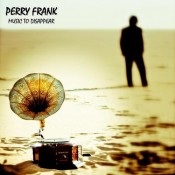
frank_disapprReleased in 2012, Perry Frank’s Music to Disappear is a collection of songs the composer posted to various sites (YouTube, Soundcloud, etc.) in 2011. These pieces range from pleasant New Age songs to interesting electronic-music excursions with an ambient feel, with a bit of straight-up post-rock in the mix. This, particularly with some tracks being stronger than others, can make it a bit of a mixed bag on a start-to-finish listen, but Frank’s range of talent extends equally across his styles, so as part of a shuffled mix or even shuffled on its own, Music to Disappear can really shine. You’ll come across “Landscape of A Twilight Lamp,” which carries a little echo of Steven Halpern in its keyboard structures, but mixes in an interesting depth of background sound. It feels like a sad song interspersed with echoes of memory. Very moving.  Its followup, “Song for the Afternoon,” pairs a Windham Hill-type guitar song over coursing synth backdrops. On “Another Place Another Time,” Frank opens with acoustic guitar, adds in other instruments to build to a romantic swell, then hands it off to piano. There’s a long pause mid-track, and it comes back in a more ambient form, quiet pads and long organ chords, once again building back to reprise the melody, with a little extra swagger. New Age fans will eat this one up. For pure fun, there’s the considerable charm of the folk dance that is “The Ballad of the Late Clock,” overflowing with Mediterranean flair. (I felt like shouting “Opa!” once or twice.) “CandleLight” is the rocker here, a song I can’t get enough of. It’s packed with power-pop guitar and wears its hooks on it sleeve. Once it gets going, it’s just flat-out energetic and comes to a great close. The biggest surprise here is the closing track, “Pleiades Star Cluster,” a spacey (obviously) and somewhat ambient piece that begins as a whisper, drifting on pads and what sounds like more field recordings. Late in the track it changes gears; Frank drops in an almost dubstep-type beat (I’m reminded of AWOL Nation’s “Sail”), and a wobbling melody ushers the ride home. Guitars and high chords offer up a borderline-Floyd kind of feel as it powers to its endpoint. Certainly the best track here.

Variety is the spice of Music to Disappear, and Frank’s ability to hit all his styles well puts a lot of promise on future, perhaps more focused releases. For now, I’m content to shuffle this one into my mix and see what Perry Frank serves up to me next.

Available from IdealMusik.

Giulio Aldinucci: Archipelago

aldinu_archiThis brief four-track from Giulio Alidinucci, who also records as Obsil, is meant to showcase the composer’s electro-acoustic work. To that end, he  employs various sound sources, including pipe organ, Mellotron, synth pads, and field recordings, which he then manipulates. The result is work that stays on the quieter side, but shows a lot of diverse texture. Three of the four tracks are quick hits, the longest, “Aria,”  running just five minutes. That piece floats quietly, using the pipe organ as its starting point, drawing a simple and soft line from start to finish. That feeling, unfortunately, is marred by the extremely abrupt start to the second track, “Satellite.” It feels like a bad edit that got left in the final product, and it sounds amateurish. Otherwise, its wavering tones and sprinklings of piano notes and other wayward sounds make for an interesting, nicely textured few minutes. “Short Circuit” opens with the sounds of walking in the woods, the crunch of leaves underfoot, and wends its way into rich, watery tones. Pads and light touches of piano add to the backdrop. Toward the end of this piece, Aldinucci plays with cutting out the sound in spots, which, to me, distracts from the flow of the thing. I’m sure it’s a conscious choice, but it feels like an error. The closer, “R’n’R Through Broken Headphones,” builds up from a long drone. The sources here are synth and field recordings, but processed heavily into dense structures. Aldinucci adds subtle textures and rhythm beneath them, then builds those to more overt manipulations. I like the way he ramps up the intensity on this, just to strip it back coming into the final minutes, paring back until we’re left with the field recordings, like a return to the real world. For an offering that rolls in at under half an hour, Archipelago packs in a lot of intent and effect. Well worth checking out.

Available from Other Electricities.