Hanetration: Timelapse

hanet_timelWithin two minutes you will either be totally on board with Hanetration’s Timelapse or you will be completely done with it. Guaranteed. Sharp, dissonant strings wail almost painfully over an insistently thudding beat in “Moon” as Hanetration basically tries your patience. From there, each track in this 30-minute test of wills finds its own way to challenge you. Truth is, you’ll need to be firmly in the industrial/noise camp to get anything out of this. I listen to a track like “Thought,” with a ticking sound that feels like it’s counting off its 90-second run while a speaker-rumbling bass tone vies with a test-pattern drone, and I feel like I’m missing something. Or when “Square” suddenly erupts in overamped noise and pounds on my skull for a while–where am I going with it? For me as a listener, I have to say I don’t know. I only know I’ve sat through a half-hour of somewhat random industrial noise, I feel a little lost and I may have a headache. This one is for diehard industrial fans only. Give it a listen if that’s you.

Available at Bandcamp.

Red Shifting the Oceans: Constellation

rsto_constConstellation is a very familiar-sounding album that’s rooted in an old-school style but which lacks an edge of originality that would serve to lift it beyond simple imitation. The songs here are decent, if a bit by the numbers, but there’s nothing out of the ordinary. Red Shifting the Oceans doesn’t miss any of the requisite waypoints on the journey. The New Agey piano ballad is here on “Tethys Unveiled,” with its metronomic programmed drums; the high-energy, techno-like song is here in “Glimpse of Life,” which is an admittedly fun piece before its lack of change wears out its welcome; a touch of world flavor even slips in with an Eastern-style string break in “Rosetta.” Here I must give RSTO some credit, as this prog-lite ballad is fairly catchy. But, as with many of the tracks here, it is plagued by an unpolished feel, the sense that the artist has to work well within the strictures of the genre. It’s like, this is the box and we must stay in the box. It renders the music a bit flat which, when you’re already coming across like you’re just copping styles, seems like more of a problem. It doesn’t help on the originality end that “Tethys Unveiled” and “Skies of Tethys” share the same core melody. It could very well be that the pieces are meant to be thematically linked by this (as the titles would suggest), but it mostly serves to amplify the release’s overall sense of “I’ve heard this all before.” One track does kind of stand out here: “Sibylla” manages to briefly crack the mold with hand percussion holding a steady beat while RSTO assails it with harsh-edged electronics. It’s not a great track, to be honest, but it’s a track that shows some original thought, so points for that. Unfortunately, it also cuts off oddly before dumping into the next track, which happens more than once on Constellation, so…points off there.

There’s potential in Red Shifting the Oceans’ work, but as long as it’s held in check by those self-imposed boxes, we won’t hear it. The work here is good enough that you may want to give it a listen, even if you may come away feeling that you already know these songs.

Available from the Red Shifting the Oceans web site.

Aquarelle: August Undone

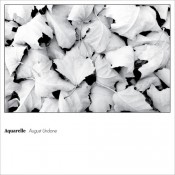
aquar_augustThick tangles of guitar-based drones get mixed with distant touches of acoustic instrumentation on Aquarelle’s new release, August Undone. Sound artist Ryan Potts offers five pieces of varying density, all with a strong dynamic sense. The equation gets established straight away with “Within/Without” as piano notes push against a solid, hissing wall of noise, setting up a contrasting tone that gains ground to take the lead. The shift is handled so smoothly, you barely notice the hiss’ recession until it’s gone. From there, Potts lifts up the remnant sounds, giving them something of a pipe-organ grandeur as they push the piece to its close. As an opening track, this does a fine job of telling you what the artist has to offer and that, start of the track notwithstanding, this is not just a noise/drone work. The message comes through clearly again in “Sandpaper Winds,” with folksy acoustic guitar grounding the grittier sounds behind it. “This Is No Monument,” the longest track here at nearly 12 minutes, takes a minimalist approach, repeating phrases varying just slightly across time as the layers build. Around the 4-minute mark, Potts dials things down a touch and delivers us into a sort of meditative space, echoing piano finding a gently hypnotic pulse that flattens to a drone and then works its way back up. This is one of those pieces that you need to dive into ears-first to take in Potts’ subtle manipulations. There is a lot of harmonic work going on, so pay attention.

August Undone has grown on me as I have delved more deeply into it. Working past the noise, which I don’t mind at all, and focusing on the additional dimensions Potts works into his pieces reveals the considerable scope of thought behind it all. Even where he hits us with nearly crushing levels of static-thick noise–and I’m looking at you, “Clockless Hours”–when your ear and mind latch onto the motion and harmony at play and the strong contrast work, the depth belies the apparent simplicity of the noise genre. By modulating his sounds to give balance between approachable and inapproachable, Potts delivers a work that requires your attention.

Available from Students of Decay.

Darshan Ambient: Little Things

darshan_littleIdeally, a music reviewer will exhibit a sense of subjectivity as he or she heads into a fresh review. It’s kind of our job. But we are human, some opinions to the contrary, and not only do we end up with artists we enjoy, we also have those whose next work we truly look forward to. For me, Darshan Ambient is one such artist, which is why these last few months have been difficult for me. You see, I review strictly in order of when releases were sent to me and I don’t move people up in my queue just because I happen to quite like their work. So here is Darshan Ambient’s Little Things, which came to me back in August, and only now can I sit down and thoroughly immerse myself in Michael Allison’s latest. And let me tell you that while the wait was not easy, it was worth it.Here we have another graceful blend of contemporary instrumental pieces, lightly spiced with world and jazz flavors, laid-back and deep, with just the right amount of catchy hooks hiding in the flow. Allison notes that with this disc he has gone back to his ambient roots; you certainly hear it in the swirling washes that greet you as “UnUsual Thursday” opens the proceedings. Those washes then shift toward the back as Allison layers in a melody to take the piece in a more New Age-ish direction.  “Soft Portrait” is an Eno-esque pairing of slow and simple phrasing repeating on piano, respecting the harmonic contributions of its resonant tones, with quiet pads to sing counterpoint. Another take on this is offered up on the title track, which almost feels looped. A basal phrase begins repeating itself, gets a bit more electronic texture, then meets a similarly restating piano phrase. Allison slowly deepens the layering and the flow, and creates a piece that’s more than a bit hypnotic. What makes Little Things, outstanding, however, is its diversity. Yes, there are pieces with that ambient timbre, but then there are tracks like “W. 52nd,” which brings us more of Allison’s cool trumpet, the kind we enjoyed on his Miles Davis-themed Dream In Blue. (And it may just be me, but I always catch a hint of Mark Isham phrasing in Allison’s horn.) This is one of a few tracks with a nice world flavor to it, and that jazz edge. There is also some delicious slide guitar work throughout the album that really catches my ear. It speaks up beautifully in “Shadow Country,” over hand percussion and an understated bass riff that holds down the rhythm. I also like it in “There!,” which opens with a rush of string sounds echoing Steve Reich and then blossoms thanks to the slide, which takes on a slack guitar sound that practically has a paper umbrella sticking out of it. Little Things is a true pleasure to listen to. Allison is a craftsman and a talented multi-instrumentalist who infuses every song with tons of pure feeling. This is a pensive and personal disc, a perfect end-of-day listen that will have you in its hold down to the last perfectly hanging note of the soundtrack-worthy closing piece, “Exile.” Don’t wait like I had to; listen to this now.

Available from Spotted Peccary.

Tetuzi Akiyama and Jeff Gburek: Respect

akiya_respectGuitar improvisations backed with light electronic touches, played with absolute attention to the potency of space and silence. For 20 minutes, Tetuzi Akiyama and Jeff Gburek converse, their back-and-forth on acoustic, prepared, and slide guitar exploring tone, texture, and the pure expression of the moment. Being improvised, there is always that air of controlled randomness, of hovering at the edge of uncertainty, and the four pieces here do occasionally drift into slight cacophony. What saves those moments, for me, is the duo’s ability to not only keep within their framework, but to readily pull back out of it into a more traditionally focused form. The balance of harmony and dissonance tends to lean in favor of the latter, but not egregiously so. It’s an equation that demonstrates how we only really know the simplicity of the one against the challenge of the other, with the added lesson of how we perceive space in music, how it can heighten our attention to the moment. So, yes, Respect will play better when it falls upon ears that embrace the role of dissonance and non-standard structure, ears that are willing to try to accept the truth and rawness of expression found here. While Akiyama and Gburek flirted with losing me in spots, mostly on the second part, there was something here that made me stay, and I’m glad I did.

Available from Spectropol.

Hessien: Calcifer

hessien_calcTwenty minutes of electro-acoustic music in the vein of Brian McBride and Loscil, Hessien’s Calcifer uses its brief time to make a solid impression. Tim Martin and Charles Sage send the listener immediately into a space where misty washes and long drones spin behind slow guitar lines with “Wrong Turn At Albuquerque,” then thicken the wall of sound with “When the Planets Align.” When the mass of drone in the latter track lets up to allow the guitar to speak in a growling voice raspy with distortion, the release is a tactile thing. “From Beyond the Fourth Wall” cools things down a bit, taking a repetitious, post-rock stance that curls its way into a hypnotic pattern, aided by a white-noise backdrop. The release closes out with the ambient feel of “There Are No Coincidences.” This is a gentle, windswept piece where the guitar textures whisper very quietly beneath the wash like distant thoughts. Best thing I can tell you about this is that at just 20 minutes, Calcifer did exactly what it should: it made me want to hear more from Hessien. You may, too. So take the time, drop into these nicely layered textures and drones, and see what you think.

Available from Sound In Silence.

Undermathic: Indistinct Face

underm_indistMaciej Paszkiewicz returns as Undermathic and brings big, edge-of-symphonic electronica with him on Indistinct Face. The work here is dense and lands with considerable force. Paszkiewicz’s beats punch out their cadence; his sound layers are designed to bury the listener; and the scale ranges from passing moments of relative simplicity to panoramic vistas that all but burst into view. This is not your standard electronica release. It clearly aspires to be more while still utilizing familiar elements. “Colorize,” for example, has a distinct drum ‘n bass lineage, with booming percussion crushing out the foundation, but its swelling strings stand in counterpoint to take the overall piece into a fresh space with a cinematic feel. Speaking of which, “When?” has the kind of oversized dramatic chops that would make it perfect as a soundtrack piece for some dark, moody movie. Between orchestral string pads and drop-the-hammer punctuation from piano, this is another piece with sizable mental visuals. Mid-track there’s a shift of style which Paszkiewicz navigates smoothly, taking the track into a more modern-electronic space. It’s not as if he’s left the glitch side behind, however. There’s some nice work hiding in “Three Different Worlds,” the hurrying, skittering sounds coming in to spatter the background with texture. On Indistinct Face, however, that side of his style mostly resides in the back seat as a more contemporary instrumental approach takes hold. If you’re not big on drama and a bit of bombast, this may not your best introduction to Undermathic’s work. I’ve enjoyed its depth and potent emotion. It rewards deep listening with detail, but also often begs for extra volume to drive its impact home. Great work from Undermathic.

Available from Tympanik Audio.

Andrew Young: Inkplaces

young_inkplacesStrictly fare for the experimental music crowd, Andrew Young’s Inkplaces is “…representing granular synthesis, but on a larger scale.” Tearing field recordings into component moments, improvising with a patch created in MAX/MSP software and lacing the proceedings with pink noise, Young focuses on the “microscopic textures within a sound.” This makes for 25 minutes of challenging listening that has its “wtf” moments–like the booming ship horn that explodes in the middle of “Artifacts 2” or the slight electro-freakout in “Traces/Tapestry/Pinkfour.” While it’s not easy to take hold of, there’s a lot of interest to be had in digging down into Young’s sonic minutiae. Things crackle and hiss and crunch as Young repurposes them, crossing into fresh textures and expressions.

Inkplaces is a brief 25 minutes in length. For some, this will be quite enough. I can’t say I’ve enjoyed my excursions into it as much as others may, but I can say it has made me pay attention to it. In the places where Young’s sound-washes filter down into a drone-like space, I have found myself getting wrapped in it. The detail work is excellent  even if the approach can be a little off-putting. Those whose tastes run deep into the land of the abstract will want to give it a spin.

Available from Spectropol Records.

Miaou: Bring the Lights

miaou_bringBring the Lights is just under 30 minutes of feel-good electro-acoustic music with a dose of post-rock gently stirred into it. Though light, it gains a lot of depth through its excellent production work. If your tastes run to shiny, infectiously toe-tapping music, this the place for you. Glockenspiels ring out bright notes, guitars pluck and strum away delightfully, and suddenly you want to be out in a field on a sunny day, spinning around for no reason. This is especially true on the closing track, “Water & Us,” which ramps up to an almost carnival-like feel, big and happy and carefree. The trio (Tatsuki Hamasaki and Mayumi and Hiromi Hasegawa) can get pensive as well, hitting that with the slow and lovely shoegaze sigh of “Paper On You.” Bring the Lights is a delicious appetizer of an offering, short and sweet and perhaps leaving you wanting more. I like it in a mix where its sudden brightness shines a little better than it does on its own. Still, it’s been fun letting it roll through a few times in a row. Definitely worth checking out, especially if your spirits need a little uplifting.

Available from Sounds in Silence.

Phelios: Gates of Atlantis

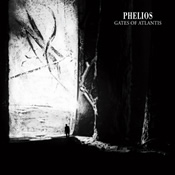
phelios_gatesBold, cinematic  dark ambient is in store for you on Gates of Atlantis, the new release from Phelios. Although it’s something of a by-the-book dark outing, being grim, weighty, and a little on the bombastic side in spots, Phelios (aka Martin Stürtzer) refines it with his storyteller’s eye to fill it with a narrative sensibility. His vistas are large-scale and compelling, even if we’ve seen their like before. Take a track like “Hibernation” or “The Shadow Out of Time,” where ominous martial drums pound out a dramatic cadence and dark-wind drones brush coldly past as our mind moves in a smooth tracking shot through Stürtzer’s aural imagery. (Pär Boström’s cover art beautifully captures the tone, along with the album’s sense of scale.) Or find your way into sparse spaces described in long, miasma-draped drones that barely move. (“New Stellar Age.”) You know these zones if you’re a dark ambient listener; they are familiar ground. Thus, it takes a strong guiding hand to not simply settle into cookie-cutter genre memes. Stürtzer does that with authority and, in doing so, gives us a story worth listening to. Hail, Atlantis!

Available from Malignant Records.