Bubble (aka John Sobocan): O

bubble_o“An ambient exploration of sounds and light,” says the website, and I couldn’t agree more. Designed for headphone listening but equally effective left to float in the open air, O is graceful and warm from its first note, and proceeds from there to just wrap itself slowly around the listener. By the time the first track, “Crop Circle,” has softly faded away you should be suitably calmed, if not downright sedated, and nestled in comfortably for the rest of your trip. The layers here are not deep; it’s more that each element is lightly woven through the next, given over to a short but beautiful coexistence before they make way for each other. In less certain hands this could result in a thin sound that would be unattractive. But here it lends to the gossamer quality of the music and the glittering tone. Spun through the tracks here is a lovely sense of patience. Pads stretch and notes hold and things fade slowly. It’s a nowhere-to-be feeling that’s augmented by the warmth of Sobocan’s tones and the ability to aurally “watch” these things glide and shimmer. There’s no need to call out individual tracks here; it’s all a seamless whole once you’ve been subsumed into the flow. Perhaps the pinging chimes of “Ponder” could be mentioned for the way their organic sound nudges you back to awareness, or that “Kalki” has a slightly dark edge to it, but it’s playing right now as I’m writing, and I’m quite content to talk about the release in terms of its gentle, esoteric, mildly mind-altering effect.

I question, but only lightly so, Sobocan’s choice to use some tones that border on, if not feedback, a high-pitched test pattern sound. (Listen to “Page 2.”) Although they work tonally, the effect of the sound is distracting and what I don’t want in the course of this pleasant ride is to be distracted by a comparatively harsh sound. But, like most things here, it fades off to let a new sound speak and the thing keeps going. On loop. Always on loop. A fantastic, intricate and beautiful set of works from Bubble. Listen to it now.

Available at Bandcamp.

Tim Held: Alb(L)um

held_albumWhat we have here, friends, is a quick batch of glitchy oddness that has taken me a while to get into–but, like many of the odd-at-first offerings I get, Tim Held’s glitch-based Alb(L)um has found a tentative place in my ears. “Part improvisation and part random chance Alb(L)um’s key components were created by running percussive and melodic sequences through a synthesizer hooked up to various boutique guitar pedals,” says the artist’s site. Held created a batch of five- to ten-minute tracks using this process, then “scoured each track and sliced out sections he liked and then built songs around the selected sequences.” So we’ve got a bunch of disparate elements being stitched and soldered together to create beats and riffs that play with a familiar structure while being unmistakably unfamiliar and somewhat random. Controlled chaos, if you will, and Held controls it in some interesting directions. Spoken-word drops lend some old IDM cred to the thirteen quick pieces here, and mighty doses of wubwubwub bass make some tracks-“Duncan’s Duality” in particular–feel like dubstep’s weird cousin. “Blip” gets downright industrial. Fat, speaker-rattling bass tones and a processed muffled shout come away like Trent Reznor got his hands on some really good acid. (On another listen, I felt like I was picking up a leftover Suicide vibe.) “This Is It Baby” is a subverted club song. It keeps its thudding, unchanging beat and growling bassline, pounding themselves into a hypnotic haze as a voice repeats “Crazy universe” over and over. This is a full-volume-or-nothing affair, a fun track that just wants to be your best friend. Your maybe-scary, something’s-not-quite-right best friend.

Alb(L)um is going to scare off a lot of people very early into its 33-minute run. It’s freaky and fast and won’t sit still. The sound samples can be raw and harsh and they’re not exactly gently melded together. But take a chance–turn up the volume, open the mind, and let Tim Held’s art try to beat you into submission.

Available at Bandcamp.

William Gregg: Epiphenomenon

gregg_epiFollowing the strong reception for his debut release, Source of the Hardware, which featured the artist in live performances, William Gregg hunkered down in his studio to put together his sophomore effort, Epiphenomenon. When I reviewed Source, I commented that I looked forward to hearing what Gregg could do with a deeper focus. That bit of musing is fully answered here, and the answer is that he turns out a rich, beautiful set of electro-acoustic pieces perfect for long-term looping. Overall, the tone is soft and very spacey, into which Gregg inserts his earthbound instrumentation. “Luminarian 5” puts a halting piano melody against rise-and-fall washes, then spatters the backdrop with echoing found sounds to create a mildly unsettling atmosphere. “Epicycle” is another piano-accented piece, but without the gritter treatments. It’s like a gentle adagio in space. “Planete Rouge” and “Dream’s World” bring crisp, ringing guitar notes into the mix. The first is dreamy and light, the fingerpicked acoustic melody playing patiently and pausing to let spirals of electronic sound pass. The other pushes forward on a springy sequencer line and a folk-music feel from the guitar. Harmonics add a nice touch. On the closing track, “Ur-Th,” the guitar embraces a dark and serious tone, but it’s still warm and…well…earthy. The bass strings resonate throughout, giving off a slightly sad tone as they step downward. The pads here are big, swirling things, a little hypnotic and quite calming. Gregg hits a straightforward spacemusic sound in spots as well, with the classic bounce-and-flow of “Negative Entropy” moving into the deep pads of “Starlight.”  This straightforward space piece has a rich low end that counters a glittering higher side. The way these two tracks seamless move one to the next is a sensibility that plays across a lot of Epiphenomenon; there’s a great sense of flow here in the way Gregg strings together tonally similar tracks. “Praeludium II” and “Flight” are another good example, sharing the texture of plucked strings, allowing the pieces to glide together based on that commonality. With that in play, the release proceeds without a bump to jar the flow.

And here’s the kicker: Gregg composed all twelve pieces over a three-week period and recorded in a single four-hour session. Have a listen to Epiphenomenon and you may not believe that to be true. But don’t worry–on the repeat listens that are likely to follow, you’ll come to accept it. This is even more than what I was expecting from William Gregg.

Available at CD Baby.


Paulina Cassidy: Sugar Wingshiver

cass_sugarSlip through the veil and enter Paulina Cassidy’s dreamy, faerie-flecked world for a while. Fifteen atmospheric pieces that straddle the boundaries of ambient and dream pop wait for you here, with soft vocals chanting beneath heavy layers of echo and effect. Flitting by in just under an hour, Sugar Wingshiver‘s individual tracks offer brief visions, but they’re fully formed and engaging. While I don’t normally review lyric-based releases, Cassidy’s breathy delivery and deep treatments of her words, on most tracks, render them down into less distinct melodic elements–instrument rather than word. As she sighs through “Luna Sea,” I know there’s a story being told but it’s more about the way the cadence of her voice melts into the slow-moving song under them. (The inside of the CD cover offers the lyrics.) In places, however, the story does take the forefront, as with the pairing of “Voodoo Lily” and “Loup Garou.” Snaky bass and heavy echo bring Lily’s story to life; “Loup Garou” stalks through a misty landscape with a distinct feeling of mystery and moonlight. It’s one of the best examples of what Cassidy is doing with the music here, building it largely on a backdrop of soft washes and grounding it with tapping hand percussion. “Bird On A Mission” uses this, along with short phrasing on the low end of the piano, and ties into into rhyming wordplay. Cassidy varies the approach in places with purely instrumental cuts, like the beautiful and too short ballad “In A Labyrinth of Light.” “Fire In Our Eyes” render the artist’s voice into sighs and cries and underscores them with a pulsing beat and stuttering electronics.

Sugar Wingshiver is another excellent release from this unique artist. Take this journey.

Available from Projekt.

Al Gromer Khan: Far Go

khan_farFar Go is subtitled “Raga and Ambient Studies,” and Al Gromer Khan absolutely delivers a hearty batch of both across a dozen engaging tracks. Exotic world flavors and infectious beats make up one side, deep meditative drifts provide the other, and more often than not they meld in a deliciously peaceful coexistence. Khan tends to give them equal space, punctuating passages of warmly flowing pads with the crisp, bright twang of the sitar, the sharp rap of clay pots and tabla, and the pleasant, bending gulp of drums. Tracks such as “Procession for Vilyat Khan” and “Black Raga” are great examples; both are slow, seductive dances lead largely by percussion. As the background fills with misty washes, Khan’s sitar curls through them with serpentine grace. Its sound is deliciously bright and solid, a dancer glimpsed through a lotus-leaf haze. “Gambhira (The Inscrutable)” carries a similar feel but wraps it in a gauze of shadow. The drums are heavier, almost tribal, and the tone is mysterious, right down to its back-out-of-the-room fade.  To take in the more ambient side, head for the blend of “Urbanicum (excerpt)” and “A Strange Kind of Peace.” The first is the darker of the two, a slightly shifting drone with a nice low end. It uses its scant three-minute run to lull you into a relaxed state, then hands you over to the warm, dreamy flows of the other. Light chime tones punctuate the sound. I would loop this track for meditation purposes; it’s pretty much perfect. After spending the better part of an hour chilling you out, Khan returns you to the surface with the funky, strolling (no pun intended) beat of “I Walk Everywhere.” The deep sound of a stand-up bass completes the rhythm section, and Khan grooves over it on sitar. A nice close to a very good release. Far Go is the kind of disc you can set playing quietly in the background and it will grab your attention where you need it to; for the rest of the time it’s content to soften your space and improve your mood. A more attentive listen reveals the practiced complexity of Khan’s stylings and the way he weaves his sounds together. This is definitely one that deserves a listen.

Available from the artist’s web site.

Funerary Call: The Mirror Reversed, Part I

funerary_mirrorFrom its first vicious bass snarls, bestial wails and tortured cries, Funerary Call’s The Mirror Reversed, Part 1 establishes its intent to make you uncomfortable, then spends 45 minutes or so showing you how. While Funerary Call certainly does the dark/black ambient thing right, I found myself getting a bit bored with it after a while. It’s dense and heavy and grim, and the artist modulates those sensations well enough, but it never seems to do much or go anywhere. From a genre standpoint, it does its job; it makes you uneasy and creates a big, dark world of sound. But nothing really stands out or tries to makes it more interesting than other dark ambient releases I’ve heard.

Those who like this genre may find more to enjoy. For me, it’s a pass.

Available from Cyclic Law.

Beyond Sensory Experience: Faint

bse_faintNormally when I get things from the Cyclic Law label I brace myself for another experience that’s dense, dark and ominous. Faint, the new release from Beyond Sensory Experience, is not like that–at first, anyway. It certainly gets there in spots, but for the most part it’s more of a sort of hazy, dream-washed meandering in a sadly reflective state of mind. A “life glimpsed through gauzy veil” quality hangs over everything, established right off the bat as a woman’s voice, half-awake or perhaps just half-aware, slurs through a three-count in waltz time for a lone piano to take up, equally drowsy in its unchanging repetition. The use of voice samples figures into the mix in several places on Faint, dialed back to the texture of a partial memory and thickened with echo. There’s a slightly voyeuristic feel to it when you find yourself listening closer to make out the words although maybe you’re not supposed to. On “Respect,” “Yearning,” “Blank” and, especially, “Stale,” this aspect is particularly strong. The urgent, almost desperate tone of the voice in “Stale,” in fact, gets downright unsettling. The fact that it’s paired off with a slow funeral march on echoing piano just augments it. There are also a lot of pause points on Faint, gaps between notes filled with resonant sound and expectation. Artists Drakhon and K. Meizter respect the potency of the pause enough to make the most of its emotional weight, and are extremely precise with details. There are no wasted sounds. And when the duo decide to drop the dark-ambient hammer on the proceedings, they drop it hard. It comes like an industrial press in the middle of “Stumble,” an effectively jarring moment as thunderous blows punch into a bed of droning pads. Nice juxtaposition.

Listening to Faint is like being part of a shared bad dream, one that you wake up from still feeling the uncertainty and concern. It works its darkness into the listener patiently but distinctly, and the richness of the sound makes you want to head back in and listen again. This is not off-putting dark ambient, but it still offers a fair challenge to the faint of ear. Definitely worth a listen.

Available from Cyclic Law.

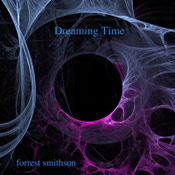
Forrest Smithson: Dreaming Time

smiths_dreamYou can probably guess from title of this release what its overall tone is, and for the most of the first of its four tracks, you’d be right. While Forrest Smithson never strays too far from the standard equation of setting slowly arcing pads off to drift against and through one another, he wisely infuses some of his passages with understated sequenced beats, field recordings and richer textures for a fuller ambient experience. All in all, it’s a calm and meditative hour, and each of the tracks is of sufficient length on their own to allow you to slip in and get lost. Headphone listening makes the most of Smithson’s attention to detail, but it’s a nice open-air listen as well, and loops easily. It’s not long before you’re deep in the sounds of Part I, the longest of the suite, floating along on the ambient structures. The change in this piece is handled with perfect subtlety; a quiet shuffling sound leaks in at the periphery and resolves itself into a rhythm. Smithson keeps it dialed back so that it remains an effective texture, something that reaches you without intruding on the flow. So there’s Dreaming Time‘s allure, a well-executed and never heavy-handed manipulation of tone and texture. Part II kicks off in a spacemusic sort of zone, with a light, hand-percussion-style rhythm already in play. It finds its way into a section where a cool sequencer riff imparts a classic electronic touch over a pad structure. Again, the new feel eases, makes itself at home in your head, and then you’re back to just chilling with the flow. Part III shifts the feel somewhat by showing up with a suspenseful tone and its share of shadowy imagery. It’s heightened by Smithson’s use of a creepy, sing-song arpeggio running up and down over the proceedings–not to mention the sudden, cutting caw of crows. Perhaps this is where our dreams get a mite uncomfortable, but we’re still deep in it. Part IV begins by carrying the resonant unease, with ringing temple bells and choral pads leading us back the way we came. Light breaks slowly, birds chirp, there are children’s voices, and we come around to the classic ambient space where we began. I’m not crazy about the voice recordings here; I feel that they pull focus a bit, but it’s a very minor quibble since they don’t last long. What does work is the feel of a fully formed journey coming to a close. Smithson makes each piece here its own entity but there is a nice tonal through-line that connects one to the next. Ambient fans will find a lot to like here.

Available from the artist’s web site.

303 Committee: Conquest

Grey-saturated minimalism and the cutting unease of darkness are the order of the day on Conquest, the new release from 303 Committee. Through the course of 43 minutes of noisy drone, artist Ryan Huber continually drops the weight on his listener, pressing down into the psyche. There are only brief respites, and I’m counting the space between tracks. There’s hopelessness here in droves–just the beginning of “Damascene” is enough to make you question your own existence. As always, Huber is all about texture and density. The sounds here pulse and grate (hello, beginning of “Adironam”) and gnaw (“Proselyte,” with its unpleasantly insectile murmurings) and rip and just keep closing in on you. Certainly not light listening. It will take an appreciation of deep noise, raw minimalism and sonic viscera to enjoy Conquest. 303 Committee takes no prisoners.

Note: Not sure how to get ahold of this release. The 303 Committee Bandcamp page says it’s not set up yet, though it’s there. Inam Records has a link on Discogs, but I’m not comfortable linking to an open marketplace like that. Google away if you’re interested.

Matt Kwid: Passive Listener

kwid_passiveOn his blog, Matt Kwid advises us that “Blaster Master,” the first track on Passive Listener, was created on his phone. Pretty ballsy way to begin, if you ask me. Using the highly regarded digital audio workstation Caustic, Kwid powers his way into your ears with full-on chipset attitude and a boppy bit of retro charm. Just when you figure that’s what you’re in for, hello, when did we drop into a Pink Floyd break? Get used to it. While Passive Listener retains a strong retro feel for most of its run, Kwid throws intriguing curveballs into the mix. It’s why the release has become one of my preferred downtime listens during the time when I’ve been waiting for its official turn to be reviewed. I’d be shuffling my queue, a catchy piece would come on and when I checked it, it was another Matt Kwid song. Honestly, there are points where it sounds like someone got a 1980s synthesizer for their birthday and wanted to try it out, but it’s also infused with the kind of unbridled joy and sense of discovery that gift would bring, and it all just works. “Waiting Room” is a shot of robotic jazz with its own stiff geometric charm. The programmed drums get a little repetitive for me, and I can only take so much of that particular tinny sound anyway, but crisp electric piano riffs and half-second vocal barks take my mind off it. “Drift” starts off sounding like it’s going to break out into a Jan Hammer theme song, morphs halfway through into something sounding like an out-take from Bowie’s “Space Oddity,” but wins you over along the way with its meaty bass melody and nostalgic appeal. All in six minutes. Then in comes the star: “Mekanism” reaches out to you through an opiate haze, between liberal use of whammy bar and sound processing. As a rhythm track that sounds for all the world like the demo mode on an old Casio keyboard thumps and clinks its way patiently along, Kwid lays in a spacey sequencer line and then drops in big doses of quivering tremolo guitar goodness. I love this track for its drunken wobble and its glossy, slack-guitar-style chords just shining up above everything. “Omission” closes the disc with more guitar taking the lead, this time dousing you in soul-soaked blues riffs.

Passive Listener is just five tracks and 44 minutes long, but it certainly does what it should: it makes me want more from Matt Kwid. The retro feel and the halting approach may put some off. Even I have to admit that sometimes it sounds like a talented amateur is at the helm. But every track here is strong, fully able to catch your ear. Plus, Kwid quietly slides in a sort of evolution in the flow. We slowly move from basic electronics to jazz hints to guitar, and each new track feels like it begins with an echo of its predecessor. I can leave this on loop, and have, and it keeps me listening. Give it a try, then wait for more from Matt Kwid.

Available from the artist’s web site.