
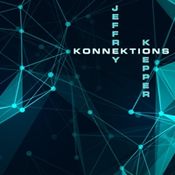
 Konnektions represents more of what I’ve come to expect from analog synthesist Jeffrey Koepper. This puts me in odd position as a long-time Koepper appreciator. I have said that I would like to hear him do something more with his impressive cache of vintage gear than another set of nostalgia-fueled Berlin-style music, but once Konnektions gets going, and particularly by the latter half of the release, I’ve set that concern aside and just accepted the bouncy, wave-driven ride. Make no mistake: you’ve got to love sequencers here. Koepper’s skill at crossing their angular streams in ever-growing layers is as impressive as ever, but we’re still talking about a lot of variations on onetwothreefour onetwothreefour onetwothreefour. (You just read that in your best “sequencer voice,” didn’t you? Perfect!) The more I have listened to Konnektions, the more I have stopped dismissing it as a more-of-the-same situation because, although it is more of the same, it’s just really good and immersive. And there is a bit of differentiation. “Oracle” is the kind of thing I’d like to hear more of, a beat-free, spacey drift full of big chords and a touch of drama. He melds it nicely into “Pantheon,” which has a light Eastern feel in its carefully stepped cadence. “Trance Electric” is where the album really takes off for me. It starts with more of the spacemusic overtones, and lets us hang in there for several minutes. Once the vibe is locked in and hypnosis has taken over, he laces in the sequencers, nice low-end notes, and leaves the lazily oscillating waves lifting and dropping in the background. As he does throughout the album — and this is a saving grace — Koepper very smoothly segues into the faster, early-Roach-reminiscent “Astral Mechanika.” It comes of like a lost track from Traveler, and its building energy is a very cool wakeup call coming out of the preceding piece. “Mercury Circuit” completes my favorite stretch of the album by taking us back into the void, then matches the velocity of “Astral…” but with brighter tones. Those three tracks cover over half an hour of deep, very, very good Berlin-style work. Which, again, I am not complaining about. But the other day, while this review was in progress, I had my library on shuffle. A song came on. To my ears, it was clearly Koepper — turned out to be a track from Sequentaria. So perhaps you can see my dilemma: I want some differentiation, but then I find myself in the kind of space that Konnektions brings me to, and all my arguments go out the window, onetwothreefour onetwothreefour.
Indulge your old-school desires and grab a listen to Konnektions. Koepper has carved out this niche for himself, and every album is a celebration of what brought us here in the first place.
Available from Jeffrey Koepper’s web site.
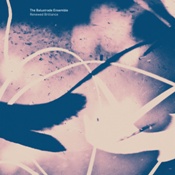 If you took a piece of chamber music, a sort of small-consort, genteel kind of thing, and carefully eased it through a gauzy, eyes-half-open filter to create a here-but-distant motif, you might end up with something like Renewed Brilliance. Guitarist and composer Grant Miller brings a team of acoustic musicians into the studio as The Balustrade Ensemble, and together they turn out nine hard-to-define pieces that are deep, engaging, complex without being pretentious, and well worth listening to many times over. I like that nothing here demands to be heard; Miller’s shadowbox vignettes are full of minute details and thoughtful structures. The slow and graceful movement of “Aerial Verandis” describes, in my mind, a lithe, porcelain ballerina dancing alone. Clockwork pizzicato makes it feel charmingly mechanical, a thing of springs and well-worn gears. Too imagery-ish for you? Have to admit, this happens a lot as I pass through this album. I can’t help but see, in my mind’s eye, everything coming across in the blurred sepia of old photos. The tone is set straight away with “Bathyal Reel,” Miller’s first guitar notes ringing clearly over an ambient-esque wash. But listen closer, and that wash is made of many elements and they begin to slip their way to the front but remain half-hidden in the haze. “The Arch Scopes Cleave” layers on the crackle of old recordings as it showcases Erik Friedlander’s lush cello work. The piece feels fragile but important enough to carefully show us. A rivulet of sadness courses quietly through it. Deterioration of sound is a factor in “Processionary” as well. Miller picks out a clean melody, supported by strings, and every now and then the sound suddenly crunches, skips, or warbles. (I assume this is courtesy of Scott Solter, who is listed in the credits as “Recording, mixing, and tinted vapors.”) This is the kind of thing I enjoy—taking something simple and clean and then coarsening the sound somehow or adding that unexpected element. And throughout Renewed Brilliance, there are plenty of well-made unexpected moments. A deeply explorable work from The Balustrade Ensemble.
 First things: I would have preferred fewer vocal drops on Mestesis’ Her Place On Earth. It’s just a personal preference. I don’t mind the device, but it’s easy to overdo—and this album comes pretty close to crossing that line. With that out of the way, I’ve been enjoying the narrative, cinematic nature of Mariano Sinestesia’s work, which the composer describes as his “abrasive, ambient and cinematic side.” The seven songs here blend bits of laid-back lounge, airy jazz, and ambient washes in pretty much equal measure. “Your Dreams Are Your Destiny” is my favorite piece on the release, a snappy pairing of a glitchy beat and a dramatic, melodic piano line played out in thick chords, augmented with string pads.”Her Brainwaves” takes us in the other direction, out toward space music with layers of shiny sequencer work and accompanying pads. It’s a more directly uptempo piece, and gets more so later in the track, which really hooks me in. “Her Voice” heads down a minimalist path, with crickets, keening voices, and dark strings. A great atmospheric piece. But it’s the dependency on the vocal drops that keeps getting in the way for me. “This Is You” comes in with the kind of bubble and bounce that reminds me of Ray Lynch, then plops some spoken-word on top of it, which adds nothing for me. I find it gets in the way of the piece’s energy and brightness. Same goes for “Warmth It’s OK”—lovely as the poetry may be, it brings little to the piece. When it moves out of the way and Sinestesia brings in crossing ambient pads with more of that galactic glimmer, the piece opens up. And I’m sure that whatever kid at the end of “Riding An Elephant” is saying for almost a minute and a half is charming if you speak the language, but I just want to say, shhhh….
 Okay, so this is about the happiest friggin’ album I’ve listened to in a while, and I absolutely should not enjoy it as much as I do. Two things: It’s all of 15 minutes long and it is packed to the gills with glorious musical cheese. But from the first mariachi-type trumpets of “Summer Night Joy,” I’m laughing and whooping along with it. Oh, the strings, the strings that escaped from your grandmother’s whoopie-making albums from back in the day, they’re just magical in how obvious they are. “Dancing Star” has a sort of Bollywood dance number wannabe feel. It aspires to be one, but it’s a bit too thin. It whump-thumps its way through five minutes and is actually the weakest of the three. “Chasing” wants to find its home in a club, with its little arpeggio runs on synth and lots of echo. Bang a house beat in there and it’s just wheeee. This album is so not in line with my tastes, but every time “Summer Night Joy” has come on while I’m driving, I turn it up and just dig on it. I don’t know if I could take more than the 15 minutes that’s here, but whenever Volume 2 comes out, I have a feeling I’ll take a curiosity peek. It’s not amazing work, but it’s fun work.
 The Infinite Calling is guitarist Daniel Turner, who comes at you with his various delays, effects, and looping pedals and a desire to burrow very deeply into your brain and set it drifting. Given that Vidya is a loop-based album, you can prepare yourself for a lot of phrases repeating in a quite unwavering way, but Turner is also deft at adding fresh elements and breaking the linear construct of his work here and there to keep it from going too stale. (We’ll get back to that.) Truth be told, once your head is firmly in the grasp of a track like “Centrifugal Spirals” and Turner has not only laid in his metronomic repetition but has also built his sound to an impressive density, you’re probably not going to be in any mental state to give much of a damn. “Ambedo” has the same effect, but Turner accomplishes it with a far lighter sound. Most tracks open with a fairly active phrase, laid down to establish the baseline. This is about the only place you really hear the framework before it starts to melt into the layers that are piled on top of it.”Shunyata” gets to a point where the sound all but spirals its way around your head, an oscillating tone like a glissando looped upon itself over and over. Turner takes bigger risks in sections of his four-piece suite, “Liquid Continuum.” Part I has moment where the sound burbles up suddenly, a temporary disturbance in the flow that quickly gets grafted into the heady wash. Late in Part II Turner breaks into a bluesy kind of riff that proceeds to go all ouroboros on itself. That lick, when it comes in, is a cool surprise. In all, the pieces all here do their job—they absolutely engender a bit of an altered state of mind, as hypnotic drones tend to do—and Turner’s playing and skill with looping is good. But this formula always runs the risk of getting too samey. When I’ve heard a track from this album come up in my shuffle, it absolutely holds my attention, especially in headphones. There interplay between lines is interesting to dive into for a while, and the brain-salving effect is pretty much unavoidable. But as a straight-through listen, its hold is less strong. Still, Vidya has been a good introduction for me to The Infinite Calling, and I look forward to hearing more. Get your brain ready for a bit of an immersion, and give this a listen.
 No matter how much music I listen to or write about, it seems that I am constantly introduced to acts and artists who’ve been turning out music for X years without my ever hearing of them. Case in point: Green Isac. From what I read on the Spotted Peccary web site, Andreas Eriksen and Morten Lund have been going strong for 25 years. And yet it’s only now, when they’ve expanded their roster and added the word “Orchestra” to their name that I get to experience this excellent blend of world styles, jazz-informed structures, and cinematic New Age sensibilities. The array of instruments brought into play here is impressively global, and the styles, although most have a bit of Middle Eastern flair, cover pretty fair ground as well. The jazz influence shows up nicely in the piano-fronted “Algebra,” accented with smooth strings and a bit of a Latin feel to the drums. “Hapi” catches me with its chugging rhythm, collection of percussion, and the way in which it slithers along. The guitar work here — or at least I think it’s guitar —adds to that feel, the sneaky way the notes slip out and rise up. I like the dark edge to this track, particularly in the very beginning. It’s got power. “Dr. One” is another mildly dark track that also offers up touches of tribal — strong drums and the sharp ceramic snap of a ghatam (yes, I looked it up). A growl like didgeridoo slips into the mix, which is always a bonus point for me. There is an exhilarating break in “57 Varieties” that blows me away each time it comes around. It’s this sudden rock surge that throws out the crunchy world feel that you’ve been enjoying, and it comes so fully exuberant and loaded with energy that it just sweeps you up. Pure joy.
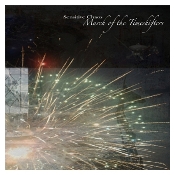 The formula that creates the distinct sound of Sensitive Chaos has not changed drastically throughout Jim Combs’ musical career. Rather, it has continued to deepen and evolve through added players and a careful, constantly adjusted balance between snappy electronics and warm acoustics. March of the Timeshifters is front-loaded with talent: Brian Good (as always) on sax and electronic wind instrument (EWI); Josie Quick on violin; Gregg Hurley and Tony Gerber on guitars, with Gerber also contributing EWI; Paul Vnuk Jr on synth and percusssion; and Christian Birk on synth. With those ingredients, you can only expect the outcome to be delicious, and it is. I have always enjoyed the sense of play that runs through any Sensitive Chaos release. It always sounds like Combs and a few friends have gotten together for a good musical time and we get to sit in on it. Much of that feel is carried in Combs’ own light and angular synth work. He favors chime-like tones and squishy notes with a nice analog bounce to them. As they carve their right-angle patterns, they contrast perfectly with the smoother arcs of the other instruments. Quick shines on “Gypsy Moth Dance,” slipping through Combs’ spattering synth droplets. She takes the front mid-track, and delivers on the title’s promise with fire, flair, and drama. She lays down more beauty on “Cream and Variations,” whipping upward-curling spirals into the air like laughter. As always, Good’s sax winds like a silk ribbon through the proceedings. Listen to the way “The Romance of Train Travel” builds—rising up out an almost-ambient hush, each player dovetailing into place to deepen the sound. The subtle chugging is a nice touch that carries throughout. When Good rolls in and Quick starts playing off him, it’s bound to make you smile. In my head I know that each person may have laid down their sections for this piece at different times, but the vibe of thing lets me imagine that everyone’s gathered at the studio to jam and this is what comes out. It has that much of an honest, of-the-moment sense to it. A highlight of the release. Deep immersion comes courtesy of the Floyd-like and magnificently titled “The Heliosphere Is A Harsh Mistress.” Vnuk lays down Nick Mason drum lines over a dreamy wash of synth and EWI. Between this and the quiet closer, “Voyager Surfs the Interstellar Seas,” we leave the uptempo world behind and just coast into the shiny void.
 After many albums that explore a kind of voyeuristic borrowing of other people’s memories and moments and lacing glimpses of them through haunting melodies, Joe Frawley simplifies the situation just a bit on The Night Parade. Frawley takes his cue from characters in the commedia del’arte, and relies more on the sound of his piano than on the melancholic atmospheres he typically creates out of snippets of sound. Still, we do not lose the adjective haunting here. In his selection of keys, in his reliance on weighty, resonance-packed pauses, in his echoing production, we still find ourselves peering into a place we were perhaps not meant to see. “Pantomime” is one of three tracks born out of improvisational sessions between Frawley and guitarist Greg Conte. This is “classic” Frawley, his piano lines cut at dangerous angles and showing a propensity for jazzy flairs while pieces of singing (either from frequent collaborator Michelle Cross or soprano Kay Pere) spin around the room. “Speak, Columbina” is another piece that uses a standard Frawley trope: fraction-of-a-second long snips of a hesitancy in speech, of the breath between words that captures the beginning or ending of something spoken, paired up with eerie runs on strings and more of the jangly piano. Where The Night Parade differs and shines is in those places where Frawley sits mostly alone with his piano. The title track trills forth its first few notes sounding very New Age. Only the lightest augmentation accompanies it, a whisper of harmony. Again, there are moments where a hint of the jazz rolls in like a wave of pleasure. Subtle cooing from Cross rounds it out. “Pierrot Dies” is played like Frawley is figuring out where to go. The notes come in sudden rushes after meaningful pauses, an urge to say something. The sound is clean, unadorned at the outset, and appropriately sad.
 Julien Demoulin last showed up around these parts as Silencio, whose album Floods left me wanting more. Loose Ends is a group of pieces he recorded over the last 10 years, most exhibiting a laid-back post-rock vibe rich in pleasant guitar lines. By turns it exhibits optimistic brightness and alone-time introspection. “The Clarity of Purpose” immediately energizes the room with a galloping pace and a blend of guitar rock and electro-pop. (Do I detect a subtle hint of Ultravox here?) Shiny chime tones add some extra polish. “Fading Mind” lures me in with a warbling bass sequencer run. Demoulin folds in more elements like they’ve just entered the room and sat down—light taps of percussion, high chords, and guitar notes. It all stays low-key and almost ambient until he throws in a quick drop, and turns it into a full-on post-rock piece to captivate me even more. He shows a different and slightly surprising side on “A Moment With Doyle,” giving us a tender, ballad-style melody on what sounds to me like a dulcimer. A potent folk-song vibe runs through it, a rustic charm, and Demoulin further underscores it with field recordings and vocal clips at the start and finish. “What’s Left” leaves a trail of melancholy in its wake, with Demoulin picking out a slow and sliding guitar melody over quiet pads and a softly whistling accompanying line. Piano late in the track lends weight and gravity. There’s a lot to like on Loose Ends, although I could do without the 36-second shrug of an opening track and the song “Into Shade”—its drowsy, drooped-shoulders vocal does nothing for me beyond muddying up a good instrumental flow.
 There is a point in “Headspincrawl Kopi,” the first track on Amorosa Sensitiva, where I got the sense that Benjamin Finger was just reaching up into the air around him, grabbing the next sound that floated through, and weaving it smoothly into in increasingly complex flow. Sounds were just appearing. A sequencer bass line had found its way in somewhere. There were little squibbles of sound and snipped vocal pads. And still it wasn’t done morphing, because I’d swear “Three Blind Mice” drops in there on strings before things start to deconstruct. This is the overarching sense of the album, a patchwork of sound sources pulled through themselves over and over to realize fresh forms. Some of it threatens to derail into experimental chaos, but that’s also germaine to Benjamin Finger’s style. He doesn’t often leave sound or structure uncontested; he needs to pull at it to see what he can make of it. He bullies it into dissonance to make it find its own way back. In doing so, he challenges the listener to stay with him, and that kind of perseverance can pay off. Particularly on this album, his underlying structures and thoughts are soft and melodic. Warm strings paint the surface of “When Face Was Face Kopi” and “Waltz in Clay Kopi.” The latter track adds piano, soft and graceful, but it has to work its way past a barrier of reverse echo. When Finger hits the last few notes unadorned, the cleaner, simple sound has real impact. Less adventurous listeners might head for the exits when the wild free-jazz sax of “Whirlbrainpoolin” storms in, but if you’ve got an ear for it, stick with it as Are Watle’s mad spirals do battle with a clash and clatter of drums. (I hear thoughts of Archie Shepp hiding in here.) This track might be overlong by a minute or two, but as an expressionist moment, it’s got something going on. In my fairly limited exposure to Finger’s work, I have come to expect the sudden turns, like the appearance of gruff and deeply reverberated guitar in “Bum Finger Notes.” But I’ve also learned to listen closely. There are no spare sounds in these compositions, and the foundation of his pieces is typically a beautiful melody, there to be not just subverted but coaxed to a different standard of aural beauty. Accept the challenge and give this a listen.
 Hypnagogue Music Reviews