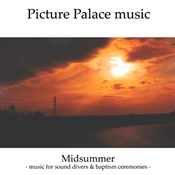
 We reviewers like to try to classify things. It just makes the reviewing life easier. Then along c0mes a disc like Picture Palace Music’s Midsummer, stubbornly refusing to be put into any one slot, and we scramble for the right words. In this case, the right word is: fantastic. Over its ten tracks Midsummer touches on melodic electronica, IDM, prog, synthpop and even a bit of Enigma-esque chant. Lead by Tangerine Dream’s Thorsten Quaeschning, who created PPM “to reproduce the musical dynamic and experiments of old live accompaniment for silent movies,” Midsummer is one of the most infectious discs I’ve heard in a while. If you want to be hooked immediately, head straight into “Midsummer’s Day.” Going from standstill to 60 in the space of a heartbeat, it wraps a catchy, hyperspeed rhythm and melody around a poem by Ralph Waldo Emerson, sung through a vocoder. Not cool enough for you yet? Let’s add in a guitar riff that pops in out of nowhere to hook you, and then layer on what to these ears sounds like a chorus of football fans singing an anthem from the stands. You may find yourself joining in. I simply can’t get enough of this piece. Which is not to discount the rest of the disc. As noted, Quaeschning, backed by up to six musicians, mixes up tone, temp and approach track by track to keep everything fresh. “Midsummer’s Eve” is an aggressive, guitar-heavy rocker–Quaeschning is joined by axe-men Djirre and Stephen Mortimer–that comes off with a certain spy-movie-soundtrack flair. “Seduction Crossing” is Quaeschning alone with synth, lap-steel guitar and a couple of tubular bells; the resultant feel is exactly what just came into your head–a sequencer-launched mix of classic TD structure with a shot of Oldfield. The guitar wails that come in around the 3:40 mark are like an extra boost of adrenalin. The three-part suite “Drowning Someone’s Sorrow Into the Ocean” begins as the most ambient piece here, opening in Part I with shadowy drifts lightly punctuated with an electronic pulse. Part II, the longest track on the disc, immediately takes up the pulse and elevates it, moving off into recognizable TD territory, polyrhythms arcing back and forth across the sound. Part III melts into chant and stronger, neo-tribal percussion (the instrument list includes stones and “boomwhackers”). There’s a great stretch beginning at the three-minute mark where the percussion takes over almost completely, just a whisper of a drone sliding beneath it and fading, and it’s absolutely hypnotic. Masterfully, Quaeschning polishes off the disc back in IDM territory with “Midsummer’s Night,” recalling the structure of the earlier “Midsummer” pieces, wrapping them around a sextet of lines from Shakespeare and giving it an 80s synthpop flair. (There’s a metallic flange bouncing around in spots; I won’t tell you which 80s dance hit jumps into my head when I hear it, but I’m willing to bet you hear the same. It’s that recognizable.) With this piece, Quaeschning ensures that our Midsummer ends on a very high note, leaving us energized, cleansed and alive, ready for more.
Midsummer is, beyond doubt, a Hypnagogue Highly Recommended CD.
Available from Groove Unlimited.


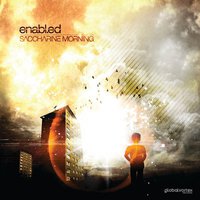 There are times when I quite like the chaotic energy that drives glitch. There are times when I really admire what goes into stitching microswatches of sound together, or even just using software to turn sound into moments of noise and bring them together in a mad flurry that resolves itself into a tasty rhythm. And other times I’m really just quite done with it because it all feels overdone and repetitive. Listening to Enabl.ed’s Saccharine Morning, I go through both of these sensations. A lot of work has obviously gone into the tracks here but it’s massive tangle of sound after massive tangle of sound. The one track that truly catches me is the closer, “Girls Only.” It’s the only piece that feels like it aspires to more than lightspeed soundbursts. It takes its time and feels more developed, using the glithch instead of just overloading your head with it. Ironically, I also like the “hidden track” that’s tacked onto it after a long stretch of silence. They both show character, depth and a touch of restraint. Beyond that, Saccharine Morning moves through without leaving much of an impression; it’s another glitch/glitch-hop disc. If your taste runs to glitch, give this a listen. It may be that I’ve overdosed on microbeats lately.
 Neuropol purports to be something of an aural guided tour through “a fictional city where bleak scenarios of a post-apocalyptic world are painted.” It’s good that there is a well-realized thematic intent at work here; the problem is that it’s often smothered beneath piles of genre-requisite leaden cloaks of bass-heavy drones. There’s movement and texture here, and a lot of sound sources pulled in and manipulated, but I couldn’t shake a constant “let’s get on with it” feeling–long stretches where I waited for something more interesting to happen. This is a disc you need to listen to in headphones. The density of sounds is laudable, and between the overt and the sublimated there’s a lot to hear. To me, Tholen is most interesting in the track “Cryogenic Ceremonies,” which starts with the sounds of a struggle–shivering breaths, groans of pain, a sudden silence–that come off exactly as unnerving as the artist clearly intended them to be. At the very end, a piano, played slowly, breaks through the drone. All in all, Neuropol is a decent dark ambient CD that’s content to not upset the status quo of the genre. Fans of this style should definitely give it a listen.
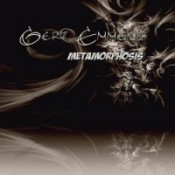 Nineteen stalwart analog warriors are rallied into service to form the sonic force behind Gert Emmens’ new release, Metamorphosis. Inspired by the sounds that came from playing around with a borrowed ARP sequencer, Emmens decided to “stick to the oldies” for this disc. The outcome is a deliciously retro pack of tunes that travel through all the familiar spaces. I admit it took a couple of listens for me to latch onto Metamorphosis. At first I found it a bit too angular, almost clunky and nostalgically forced. Emmens’ style eventually grew on me. The sound here is big—as many as 15 of the synths Emmens lists on his liner notes appear on a single track; aside from “Emotive Disparity,” which is just three minutes long and played only on a Yamaha CS-80, the fewest number of keyboards is 12. So there’s typically a lot going on at any given moment from a sound standpoint. The tracks here are fairly long, and Emmens is prone to shifts of style as he goes. The opener, “Strategem of Morality” goes through such strong switches of identity over its 14 minutes that I initially found myself checking iTunes to see if I’d moved into a new track. The changes work, once you get used to them. At first I found them a little jarring; after a few listens, paying closer attention to Emmens’ transitions, it seemed more like a cross-fade than a jump cut. The middle of “Collision” bursts into a cool, feel-good break–very 80s in tone, but timelessly funky. Caught me by surprise, and then caught me chair-dancing. “Opaque Divergence” works its way to a strident, almost military cadence, growing bolder and more dramatic as it goes. “Pace of Voyage” jaunts happily along, downshifts with a literal hiss of the brakes, then fires back up on a catchy sequencer pulse. Like many of his Groove Unlimited labelmates, Emmens’ work quickly calls up a score of influences and homages. But it’s not a bad thing; when familiarity is done well and crossed with an ample dose of fresh approach, the connections we make in our heads can just amplify the experience. Does Metamorphosis sound like TD and JMJ in spots? Of course it does. But more to the point, it sounds like Gert Emmens using them as a base from which to launch his own expressive excursions.
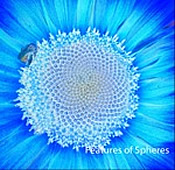 Crickets chrip. A gentle sound rises like wind-blow fog. Shapes emerge. And so John Sobocan begins to craft around you his minimal, mesmerizing and immersive work, Features of Spheres. Sobocan works from a base of drones and atmospheric sounds, a mix that gives the pieces here depth and character. The atmospheric touches can be simple and soothing, like the night-sounds in “Silence” (which swirls like water, eddies of tone working in endless spirals) and the birdsongs chittering around an expectant air in “Leaves on a Forest Floor.” Or they can be a touch more challenging, like the metallic clank and clatter at the end of “Brother” or the doppler-like string runs punctuating “Ma.” They all add a distinct touch to their respective tracks. Sobocan’s drones are also varied in character and feel. The rasp of the foundation sounds in “Brother” contrast with the softer, hypnotic gauze of “Purple Stretch,” the breezy, paper-thin chords blowing through “Leaves…” or the big, held-breath pads with a pipe-organ timbre in “Glow.” Moreover, Sobocan is clearly mindful of the effect small movements create within a drone structure. He uses it cautiously and effectively to create moments of awareness and kinesis. Purists might argue that this isn’t drone, per se. It does have more overt textures and moments of solid sound, but much of Features of Spheres is like a long exhalation, largely unchanging and gorgeous in its lack of movement. But then you’ll come across a track like “Driving My Mailbox,” with fingerpicked notes, heavy atmospheric icing and a thick, well-layered variety of sounds at play. The more and deeper I listened to Features of Spheres, the more I heard and the more it really took hold of me. A perfect looping disc that doesn’t wear out. It’s original enough in approach and diverse enough in execution to keep a listener well engaged. Features of Spheres is a Hypnagogue Highly Recommended CD.
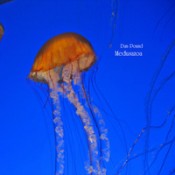 Prolific ambient composer Dan Pound sets out to capture the grace of jellyfish in his latest release, Medusazoa. He hits the mark, but don’t expect this to be just a long stretch of burbling, fluid pads of balletic invertebrate motion. They’re here, and the first three minutes of the opener, “Liquid Body,” would have you think that’s the case, but then, quietly, Pound begins to fleck the surface with pinprick hits of percussion and we’re off into interesting territory. There’s a mix of textures at play on Medusazoa. Microbeats, backbeats, sequencer rhythms, guitar work and more find way into Pound’s pieces here, and everything glides into place without rippling the waters. There’s a feeling of balance to the flow; “Liquid Body,” with its microbeats, melts slowly into the classic ambient track, “Under Her Spell,” which then opens into the tick-tock’ing sequenced start of “Living Fossil”–but under the rhythm are slow-moving pads. So each new step comes off as a sensible move and nothing is jarring. It all works. The title track contains an interesting blend of sounds. A poky piano melody one-notes its way around synth structures for a few minutes, then takes a short break while Pound gets a little dark. Watery sounds gurgle underneath. A beat rises up and the piano returns, all the elements landing in a strange but intriguing meld that eventually fades into very quiet drones. Pound breaks out his Fender Strat in the 14-minute “Tentacles,” mixing processed chord cries (very Roach-like in their feel) with patient, straightforward playing. The backdrop, shadowy and a trifle tense, offers a counterpoint. “Bioluminescence” comes back to a basic-feeling waveform ambient motif, rising and falling pads set alongside angelic chords. The closer, “Currents,” has a watery shimmer accented with electronic bubbles, a warm flow that brings the listener back around to the start. Should go without saying that Medusazoa gets played on loop. It’s a great wind-down listen, offering more than just standard ambient constructs while still packing that spacious/spacey feel. Deep listens are amply rewarded, but Medusazoa is also one that should be allowed to fill the space. Another superb outing from Pound.
 So you take two well-known names in synthesizer music, Ron Boots of the Groove Unlimited label and Michel van Osenbruggen (Synth.NL) and you send them on vacation together. Naturally they bring some gear, right? And they do a little jamming. (It’s to be expected, after all.) What comes out of it is Refuge en Verre, a robust collection of pieces with a strong retro feel, reminiscent in spots of Tangerine Dream and J-M Jarre–but not overpoweringly so. Rich, rhythmic and possessing a bit of a swaggering rock ‘n roll stride, Refuge en Verre wastes no time in hooking the listener. The first/title track spreads across 12 minutes to showcase the duo’s work in synths, keyboards and guitar. “Orage d’ete” brings in memories of early Mark Isham in its repeated motif. Percussion here carries the track. I like the way a blues-rock feel translates itself through the keyboards in “Coucher du soleil.” This will come off as a strange analogy, I’m sure, but in my head it sounds like a Scorpions tune, done on synths. Trust me when I tell you this is a good thing. And “Rosee du matin” is a slow, lush track with a little hint of Vangelis at the edges. Admittedly, it helps to have a spot in your listening heart for echoes of old-school synth music if you’re going to dive into Refuge en Verre. Because it’s here, and in spots its perceived age can be a little too pronounced; I find myself wanting to move along during “La Roche-en-Ardenne,” for example, because its 80s-ish cadence feels heavily dated. But it’s more hit than miss, certainly. The combination of styles, the chemistry between Boots and van Osenbruggen, and the love of the genre’s backstory, all come through in the music.
 Listening to Mountain Spirits, the new release from Conni St. Pierre, is like listening to several different CDs in a sitting, all of them quite good. In one moment it’s an excellent world-music-influenced disc filled with silken flute; in the next it’s a drifting ambient disc, quietly meditative; in the next it’s a New Age instrumental disc rich with emotional tone. Despite its many sides, Mountain Spirits doesn’t suffer from an identity crisis or feel like it doesn’t know where it ought to be. St. Pierre is talented enough and has spent enough time developing her own musical identity that she can pull them all off perfectly. The sad and soulful “Under the Tundra,” with its halting piano and sighing flute, is a favorite track here, a New Age work constructed almost simply–but with balance. The instruments are played with a clean, understated grace and St. Pierre shows that she knows full well the role silence plays in music. That sense of beautiful sparseness is also felt in “Orogenesis.” A stream of calm, droning pads is offset in spots with deep, breathy flute trills. Never truly a melody, though; more of a call, an expression of feeling played with a sense of insistence. “Snowfields” is a lush piece built on electric piano, the melody high and crystalline, again accented with St. Pierre’s soul-stirring flute work. This piece has an improvised feel, the piano wandering off a bit…in a good way. “Rivulet” find St. Pierre in almost purely ambient territory, a low-key wash of sounds, liquid and cool, like a stream carrying away the last of winter’s ice. This is a nicely layered piece, soothingly hypnotic yet complex and interesting.
