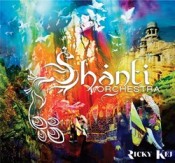
Ricky Kej: Shanti Orchestra

kej_shantiYou want happy? Ricky Kej has happy. On his feel-good New Age offering, Shanti Orchestra, the Bollywood composer and creator of the Kamasutra Lounge series meshes native Indian music with laid-back club beats and far-reaching world-music influences. The intent is to massage your soul into a state of bliss–which, if your tastes run to very light New Age, it probably will. For me, Shanti Orchestra starts strong and interesting but in the long run contains a little too much sugar for my liking. Kej grabs me at the start with “Shanti, Pt 1” and “Forever,” snaring me with the exotic flavors of saarangi and the duclimer-like santur (thank you, liner notes) on the first, short track and then the dual siren’s call of seductive sitar and soaring bansuri flute from Praveen Godkhindi on the second. Kej’s lounge-style beats and backgrounds make it all float beautifully, particularly when joined with Alexis D’Souza’s chanting vocals. So the start is very good; the world feel, the cool grooves, the fact that it avoids being, for lack of a better term, too New Agey. From there, however, for me the disc becomes something of a jump-and-skip affair. Some tracks are simply too light and airy for me. It hits me first on “Blue,” and I get it again on the piano-and-flute pastorale of “Longing.” I can see where some listeners might quite enjoy this; it’s well made, and hits all the right soothing notes. Me, I prefer Kej’s music mixed in with other albums. When a track comes up in the course of a shuffled listen to my library, I find myself paying attention. The depth of global instrumentation is excellent. I hear Gaelic pipes (uillean?) in “Longing” and bagpipes (or their like) in “Exotic Dreams.” That track is the most rock-solid piece for me here. The pipes give way to plucked strings and flute and an absolutely catchy house beat, and then Kej sweetens the pot with vocals that recall traditional Qawwali singing. I’ll listen to this souful mix all day. Shame that it’s just three and a half minutes long. “Black and White” packs a tasty jazz edge and, just to hook me more, throws in the growl of a didgeridoo. If there was more of this and less of the superlight stuff, Shanti Orchestra would sit better with me. New Age listeners will find a lot to like here, and it’s a must-hear for fans of Eastern-influenced music. Definitely worth checking out.

Available from Ricky Kej’s web site

Frore: Shadowlands

frore_shadowAt times while listening to Frore’s tribal-ambient release, Shadowlands, I could not shake the feeling that I was hearing some long-lost Steve Roach work. But Frore (aka Paul Casper) should take that as the compliment it is meant to be. Shadowlands runs as deep as any of Roach’s techno-shamanic forays with its mix of drums, shakers, drones, flute and more. Tribal is my ambient of choice, and this disc pulls me immediately into the kind of space I love–pulsing, twilight-shaded, and primal. There may be no escaping the Roach comparison, particularly when you’re enmeshed in the midst of the tellingly titled “A Fevered Sleep” (bravo, Paul!), but set that aside and just let this good medicine wash over you. Casper’s atmospheres run deep throughout the five offerings here, and he shows a strong hand at blending electronic and acoustic. Flutes whisper over classic pads as “Sky Glow” begins the voyage, matched with varied percussion. I like the contrast between the simple cloud-drift pads and the complex weave of the drums and shakers. It’s textbook tribal and a great way to open. “Terra Pulse” and the previously noted “A Fevered Sleep” pull us into that familiar territory; “Terra Pulse” is a calm and fluid thing built on shifting, sliding pads that lull the listener before a fresh rhythm insinuates itself into this misty space. In here, also, you’ll hear Casper’s expert attention to the spatial aspects of ambient, carving out a distinctly dimensional sound–to my ears (or head), it feels like a wide, round place with a lot of craggy spots to snag light echoes. “First Ray of Light” hovers in space music territory, with vocal pads and the occasional crystalline chime tracing a cleansing, meditative through-line leading to the final track. This is a nice move by Casper, taking us out of the tribal space to float after the medicine has taken hold. (Also something of a Roach hallmark.) It ups the effect of the first shadowy tones of “A Name on the Wind.” The twang of strings come as a wake up call as Casper begins to layer sounds over windy drones. Brief passages on flute accent passing moments, and the piece overall has a wonderfully lonely sensibility about it.

I have let Shadowlands loop for several hours at a time. It’s a great background piece, but it really shines in a focused listen. Frore clearly has the tribal-ambient equation locked, and as always his music rings with a deep and personal honesty. Yes, you will hear the spirit of Steve Roach lurking behind the pads and drones on Shadowlands; that just means Frore knows enough to take a cue from a master, then make the work his own.

Available from Relaxed Machinery.

Mingo: Sky Over Sea

mingo_sosOnce-dark artist Mingo continues his foray into a lighter, New Age-focused space on his new release, and it’s obvious from the first moments that he’s quite comfortable here. World flavors come through courtesy of a variety of strings, lilting flute, and blends of percussion. The grooves are laid-back and pleasant, and Mingo mixes in just the right amount of quieter ambient spaces to make the mix intriguing. “The Beach House” shows off the signature blend at play here, the aforementioned strings and flute laying down a clean, familiar melodic layer over a 1-2-3, bass-bass-snare beat and understated pads. Soothing, yet you’ll find yourself tapping your toes along with that simple rhythm. Mingo hits his stride for me in the pairing of “Rays Through the Mist” and “Terra Globa.” Here, a raga feel takes hold, spicing the air with Middle Eastern influences. Hand percussion and sharp, plucked strings lead the way as a bass drone wends hypnotically along. At just four minutes in length, “Rays…” leaves me wanting more, but it also dovetails well with “Terra Globa.” I actually catch myself whistling along with that track’s repeating hook, and I get fully caught up in the twang of a sampled oud as the piece morphs into an ecstatic folk dance. The title track is a beautiful work, a deceptively simple pairing of twinkling keyboard runs over a blend of ambient pads–a nice reminder of the artist’s past work, folded into the new. There’s a similar feel in “Equilibrium Point,” where clean, crystalline notes reminiscent of Steven Halpern’s chakra-cleansing excursions ring out in patient runs over long strings. Close your eyes and focus your breath while this one plays. Another great release from Mingo, a fresh step in this latest part of his musical journey.

Available from Mingo’s web site.

FiRES WERE SHOT: Pieces of the White Sun

fws_piecesAustin-based duo FiRES WERE SHOT run acoustic guitars through effects and looping stations to create a pleasingly hypnotic blend of warm organic sounds and deeply resonant drones on Pieces of the White Sun. John Wilkins and Clay Walton open this 11-track affair with the hum and buzz of gear turning on, and then start strumming, picking and layering. Listening to this release is a little like playing an early Windham Hill album having just enjoyed a bit of your controlled substance of choice. That familiar warm, folksy feel runs through everything, melodic, laid-back and intimate. Take that and lace it with the mind-salving effect of the repeating, near-minimalist loops and the long-held drone structures that run underneath it all, and you’ve got something that can make you simply lose track of time. Close listening is a must, as Wilkins and Walton pay  a lot of attention to the use of harmonics and resonance as ways to quietly fill a moment, and also to capture as drone elements. There’s a lot to dig into here. I like the almost clockwork cadence of “Scattered in the River,” and the way the duo chop up the sound as the piece glides to a close. There’s some smooth slide guitar howling gracefully against a fast-picked counter-melody on “In the Heavens Meadow,” and it comes off as sweetly soulful. “McElligot’s Pool” dives deep into the repetition and ups the ante with a gritty, raw edge and edge-of-feedback wails. Again, what really works here is that the honest, folk-music tone, rich in its simplicity, anchors the thing and lets the two explore the building sound. As much good as I have to say about this release, I have to add that FiRES WERE SHOT almost lost me with the abrupt ending of the first track, “Before That Time.” While I’ve come to understand it a little better as an artistic choice after repeat listens, it still doesn’t work for me. And it’s not just that it sounds like someone hit a button too soon and made a rough edit, it’s that–perhaps in my opinion only–the piece deserved to come to a better close. Sometimes you can cut a piece off in mid-statement like this and it’s fine. They do it well on “Long Match,” which is a pretty straightforward song that gets some great texture from what sounds to these ears like augmented/distorted vocals. When this piece hits its drop-out, it throws the listener into a hushed space where the drones continue to wash back and forth, carrying the echo of the melody until it all fades down. It works.  In the case of “Before That Time,” though, the sudden stop just amplifies the fact that there was more to be said, and it would have been worth hearing.

Pieces of the White Sun is a great thing to dive into, headphones-first. Wilkins and Walton exhibit complete control over their loops and layers, and play up the acoustic side. It’s got charm, and it’s got that nice experimental edge. Worth discovering.

Available at Bandcamp.

Aaron Static: Redemption

aarons_redempAaron Static’s background as a DJ definitely shines through on his new release, Redemption. In laying out the eleven tracks here, he charts a course that takes us from “exotica electronica” chillout to dubstep influences and glitch through short, mostly spoken word tracks that carry a theme through the mix. There is a lot of familiarity to the flow, but it’s so slick and hook-packed and well put-together, that’s hardly a bother. I defy you to not groove openly to”Tipping Point.” It’s a high-energy, fast-paced techno tune driven forward on a thumping drum line and iced over with a cool, soulful vocal sample to sweeten the pot. It packs a bit of an 80s electropop feel, which I love.  “Intrepid Journey” opens as a soothing space ballad with piano as its base, then laces in dubstep-style wub wubs to give it a deeper funk. The blend of styles here is excellent, and it’s got a potent emotional core that grows as it moves forward. “Laura’s Song” offers up a spacey chillout vibe with intricate glitch percussion weaving a complex backdrop. While Redemption doesn’t go out of its way to do anything overly new, what Aaron Static does here is done impeccably well. The release holds your attention, and the familiar feels just anchor the album rather than coming off as being imitative. This one needs to be turned up when played. Dive in and dig it.

Available from Soundcloud.

Hanetration: Timelapse

hanet_timelWithin two minutes you will either be totally on board with Hanetration’s Timelapse or you will be completely done with it. Guaranteed. Sharp, dissonant strings wail almost painfully over an insistently thudding beat in “Moon” as Hanetration basically tries your patience. From there, each track in this 30-minute test of wills finds its own way to challenge you. Truth is, you’ll need to be firmly in the industrial/noise camp to get anything out of this. I listen to a track like “Thought,” with a ticking sound that feels like it’s counting off its 90-second run while a speaker-rumbling bass tone vies with a test-pattern drone, and I feel like I’m missing something. Or when “Square” suddenly erupts in overamped noise and pounds on my skull for a while–where am I going with it? For me as a listener, I have to say I don’t know. I only know I’ve sat through a half-hour of somewhat random industrial noise, I feel a little lost and I may have a headache. This one is for diehard industrial fans only. Give it a listen if that’s you.

Available at Bandcamp.

Red Shifting the Oceans: Constellation

rsto_constConstellation is a very familiar-sounding album that’s rooted in an old-school style but which lacks an edge of originality that would serve to lift it beyond simple imitation. The songs here are decent, if a bit by the numbers, but there’s nothing out of the ordinary. Red Shifting the Oceans doesn’t miss any of the requisite waypoints on the journey. The New Agey piano ballad is here on “Tethys Unveiled,” with its metronomic programmed drums; the high-energy, techno-like song is here in “Glimpse of Life,” which is an admittedly fun piece before its lack of change wears out its welcome; a touch of world flavor even slips in with an Eastern-style string break in “Rosetta.” Here I must give RSTO some credit, as this prog-lite ballad is fairly catchy. But, as with many of the tracks here, it is plagued by an unpolished feel, the sense that the artist has to work well within the strictures of the genre. It’s like, this is the box and we must stay in the box. It renders the music a bit flat which, when you’re already coming across like you’re just copping styles, seems like more of a problem. It doesn’t help on the originality end that “Tethys Unveiled” and “Skies of Tethys” share the same core melody. It could very well be that the pieces are meant to be thematically linked by this (as the titles would suggest), but it mostly serves to amplify the release’s overall sense of “I’ve heard this all before.” One track does kind of stand out here: “Sibylla” manages to briefly crack the mold with hand percussion holding a steady beat while RSTO assails it with harsh-edged electronics. It’s not a great track, to be honest, but it’s a track that shows some original thought, so points for that. Unfortunately, it also cuts off oddly before dumping into the next track, which happens more than once on Constellation, so…points off there.

There’s potential in Red Shifting the Oceans’ work, but as long as it’s held in check by those self-imposed boxes, we won’t hear it. The work here is good enough that you may want to give it a listen, even if you may come away feeling that you already know these songs.

Available from the Red Shifting the Oceans web site.

Aquarelle: August Undone

aquar_augustThick tangles of guitar-based drones get mixed with distant touches of acoustic instrumentation on Aquarelle’s new release, August Undone. Sound artist Ryan Potts offers five pieces of varying density, all with a strong dynamic sense. The equation gets established straight away with “Within/Without” as piano notes push against a solid, hissing wall of noise, setting up a contrasting tone that gains ground to take the lead. The shift is handled so smoothly, you barely notice the hiss’ recession until it’s gone. From there, Potts lifts up the remnant sounds, giving them something of a pipe-organ grandeur as they push the piece to its close. As an opening track, this does a fine job of telling you what the artist has to offer and that, start of the track notwithstanding, this is not just a noise/drone work. The message comes through clearly again in “Sandpaper Winds,” with folksy acoustic guitar grounding the grittier sounds behind it. “This Is No Monument,” the longest track here at nearly 12 minutes, takes a minimalist approach, repeating phrases varying just slightly across time as the layers build. Around the 4-minute mark, Potts dials things down a touch and delivers us into a sort of meditative space, echoing piano finding a gently hypnotic pulse that flattens to a drone and then works its way back up. This is one of those pieces that you need to dive into ears-first to take in Potts’ subtle manipulations. There is a lot of harmonic work going on, so pay attention.

August Undone has grown on me as I have delved more deeply into it. Working past the noise, which I don’t mind at all, and focusing on the additional dimensions Potts works into his pieces reveals the considerable scope of thought behind it all. Even where he hits us with nearly crushing levels of static-thick noise–and I’m looking at you, “Clockless Hours”–when your ear and mind latch onto the motion and harmony at play and the strong contrast work, the depth belies the apparent simplicity of the noise genre. By modulating his sounds to give balance between approachable and inapproachable, Potts delivers a work that requires your attention.

Available from Students of Decay.

Darshan Ambient: Little Things

darshan_littleIdeally, a music reviewer will exhibit a sense of subjectivity as he or she heads into a fresh review. It’s kind of our job. But we are human, some opinions to the contrary, and not only do we end up with artists we enjoy, we also have those whose next work we truly look forward to. For me, Darshan Ambient is one such artist, which is why these last few months have been difficult for me. You see, I review strictly in order of when releases were sent to me and I don’t move people up in my queue just because I happen to quite like their work. So here is Darshan Ambient’s Little Things, which came to me back in August, and only now can I sit down and thoroughly immerse myself in Michael Allison’s latest. And let me tell you that while the wait was not easy, it was worth it.Here we have another graceful blend of contemporary instrumental pieces, lightly spiced with world and jazz flavors, laid-back and deep, with just the right amount of catchy hooks hiding in the flow. Allison notes that with this disc he has gone back to his ambient roots; you certainly hear it in the swirling washes that greet you as “UnUsual Thursday” opens the proceedings. Those washes then shift toward the back as Allison layers in a melody to take the piece in a more New Age-ish direction.  “Soft Portrait” is an Eno-esque pairing of slow and simple phrasing repeating on piano, respecting the harmonic contributions of its resonant tones, with quiet pads to sing counterpoint. Another take on this is offered up on the title track, which almost feels looped. A basal phrase begins repeating itself, gets a bit more electronic texture, then meets a similarly restating piano phrase. Allison slowly deepens the layering and the flow, and creates a piece that’s more than a bit hypnotic. What makes Little Things, outstanding, however, is its diversity. Yes, there are pieces with that ambient timbre, but then there are tracks like “W. 52nd,” which brings us more of Allison’s cool trumpet, the kind we enjoyed on his Miles Davis-themed Dream In Blue. (And it may just be me, but I always catch a hint of Mark Isham phrasing in Allison’s horn.) This is one of a few tracks with a nice world flavor to it, and that jazz edge. There is also some delicious slide guitar work throughout the album that really catches my ear. It speaks up beautifully in “Shadow Country,” over hand percussion and an understated bass riff that holds down the rhythm. I also like it in “There!,” which opens with a rush of string sounds echoing Steve Reich and then blossoms thanks to the slide, which takes on a slack guitar sound that practically has a paper umbrella sticking out of it. Little Things is a true pleasure to listen to. Allison is a craftsman and a talented multi-instrumentalist who infuses every song with tons of pure feeling. This is a pensive and personal disc, a perfect end-of-day listen that will have you in its hold down to the last perfectly hanging note of the soundtrack-worthy closing piece, “Exile.” Don’t wait like I had to; listen to this now.

Available from Spotted Peccary.