303 Commitee

303_anglesIn past encounters with Ryan Huber, posing as Olekranon and Sujo, he has fairly bludgeoned me with ultra-dense, noisy industrial drone. These were beatings I gladly accepted. Now, donning his 303 Committee mask, he takes a fresh tack and tries to insinuate his dark musings into my head by way of subtlety and hypnosis. The noise is still here, but it’s a hissing, whispering, patiently insistent thing, grey noise as opposed to black with virtually no sharp edges in sight–although rough textures abound. This self-titled release will find its strongest audience among those who like a dark and minimalist approach, but an accepting listen, working past the sometimes gritty, always moving surface, reveals Huber’s layering. A rhythm lurks in the opening crush of “Augmented”; chanting voices are buried under over-amped sound in “Junta,” coming out like a hymn in the midst of a holocaust; a faint chord progression seems to peer out of the wash in “Opium King,” always kept at a distance. When Huber decides to unleash on his listener, it’s more effective for the lack of obvious power in the tracks before it. “A Sinking Ship” slides in on a warbling drone and a slow, single beat that lulls you yet again into soft-brained complacency before it bursts like sudden anger into aggressive wallops of sound–and then they’re gone and we’re back in the big, ambient wash of “Aught.”

This disc is only half an hour long, but it’s packed. Again, if you listen, it helps if you’re amenable to very minimalist, noise-based structures. The comparative softness of the noise–that is, compared to what I’d normally think of as noise–is both surprising and engaging, and it’s not as if the work suffers in potency from it. On each subsequent listen I found myself diving more into the subtlety of Huber’s construction, the small shifts of tone and the things buried under the grit and darkness. Not for everyone, but everyone should try. There’s more here than first meets the ear.

Available from Bandcamp. (Physical discs are/were limited to 33 copies–and I believe I have number 22.)

Ocoeur: Light As A Feather

oco_lightOcoeur (aka Frank Zaragoza) takes a straightforward recipe for chill electronica, gives it a few shakes, and pours out the delicious blend that is Light As A Feather. Starting off from (and coming back to) a basic sound-set reminiscent of harp, dulcimer, and music boxes, Zaragoza melds today’s glitch styles with laid-back IDM that conjures sharp memories of its ancestry. The disc kicks off with the sparkling, high notes and energy of the first few tracks. I particularly like the segue between “Resonance” and “Reconstruction.” The first is a quiet, beat-based drift. Crunchy glitch crackles over a low-volume bass line and echoing keys. It’s a brain-massager of a thing. The second enters, sharp and bright by contrast, on ringing chimes and string pads. Shortly thereafter, the tone takes an interesting shift. “My Love” is a simple and beautiful piano solo backed with the sound of rainfall. It’s lovely, but suffers from what has to be a huge editing gaffe at the very end. I have to imagine the rain sound was intended to cross into the start of the following track, “Arret Sur Image,” but just before the end of “My Love,” it cuts out completely. There’s a half-second’s pause, and then “Arret…” jump-cuts into its start. Even a fade at the end of “My Love” would have served Zaragoza better. Getting past that, we move into the sighing flow of “Arret…” and then comes what is perhaps undeniably the best piece on a very strong release. “Astral Projection” is fantastically catchy, carrying a bit of Kruder & Dorfmeister DNA in its laid-back groove. Zaragoza even digs up the ubiquitous vinyl scratch at the start of this homage to mid-90s lounge. Thumping, steady-count bass drum and glitch percussion pave the way for cool organ chords and pads. This lays the basis for the disc to return to its glitch-and-glitter sound-set on “Feather” and “I.II.” It closes with “Envol,” a dreamy ambient piece composed in somnambulistic pads finding their way across a field recording of children’s voices. It bring the disc to a hushed close.

Light As A Feather is an easy disc to fall into repeat play with. It’s nicely constructed and stands up to deep listens. There’s a lot of dimension to each track, and the manner in which Zaragoza weaves old and new styles doubles the effectiveness of his grooves. Another excellent dose of melodic electronica from the increasingly impressive n5MD label. Check this one out asap.

Available at n5MD.

Cyberchump: Flutter and Flow

cyberc_flutterInveterate sound-tweakers Cyberchump (aka Jim Skeel and Mark G.E. Eberhage) are also apparently avid recyclers. For their new release, Flutter and Flow, the duo took existing tracks, used the PaulStretch software program to pull them out to 30 minutes, then listened for “sweet spots”–rhythmic passages that sounded ideal to jam over. The result is a seven-track, 45-minute psychedelic groove replete with wailing guitar, easy downtempo beats, and wavering washes of sound out to hypnoptize you. One of the things that immediately catches my attention is the abundance of thick, meaty bass lines courtesy of Eberhage. It’s a hefty anchor of sound, heavy on the funk, and I can’t get enough of it. I quite like it strolling its way through the title track, accompanied by a heart-pounding rush of glitchy percussion and Skeel’s guitar, or its casual lope as it anchors “When Time Was No Time.”  Skeel’s leads are another obvious attraction, alternating between gorgeously drawn-out howls and wails and fiery slashes of rock-soaked guitar joy. He fires it up on the deepest groove here, the 12-minute “China Dreaming.” It’s got something of a Berlin feel to it, roaring along on a steady low-end sequencer riff in a toe-tapping time signature. Analog-synth whooshes shoot through the backdrop. A rewinding-tape sound makes for a funky break early on. In among all this, the guitars (may I assume they’re from both of the gentlemen?) launch sustained chords and soulful riffs in equal measure. This track, particularly, is signature Cyberchump.

I like the concept at work on Flutter and Flow, and Skeel and Eberhage make it more than just a curious little experiment. The extended sound-beds give everything a floaty edge and retain hints of their melodic origins, so they are also, in a slow-motion kind of way, dynamic. The improv’d jams have an ear-pleasing rawness to them and never lose their way. Blend all that with the easy cool that pervades these tracks, and Flutter and Flow quickly locks itself into a repeat-play slot. An excellent release from Cyberchump. They just keep getting better.

Available from the Cyberchump web site.

Shane Morris: Multiverse/Omniverse/Xenoverse

You don’t have to spend three consecutive hours floating around in Shane Morris’ “Verses Trilogy” of related long-form works, MultiverseOmniverse, and Xenoverse, but I’m here to tell you that are worse ways to spend three hours. For each release, Morris took elements from live performances from his “Atmosphera” radio show and melted them into “sound collages.” Or, more to the point, created thoughtful, long-form drifts that glide in and out of darkness while they blend spacemusic breadth and the pulse of tribal. While thematically connected, each release is definitely its own excursion.
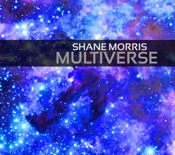
morris_multiMultiverse, the first release, wastes no time in taking the listener deep, and proceeds to escort us through a variety of feelings and spaces. After opening with a somewhat dark and spacey run, Morris cuts the sound way back and peppers the flow with little snaps of microsound. I really like this stretch. These ear-tickling bits work as light percussive elements as he bounces them around. He folds in the first of several manipulated soundbites, a nice unexpected touch and a sample (no pun) of how varied his elements are for this run. I found certain stretches to be reminiscent of Steve Roach’s Early Man, particularly in spots that feature a twanging, almost metallic sound that textures dark, droning backdrops. There are very distinct zones, if you will, as this piece moves along, and the borders between them are perfectly blurred and blended, to a point where often you become quite suddenly aware of a difference–even though you’ve been in it for a few minutes. In the closing moments, the sound is pared back to a sparse, whispering place where metallic clatters bang out an off-kilter rhythm; the sounds pare away to a windy hiss and crackling pops of static, then fade.

morris_omniOmniverse starts in a darker, edge-of-tribal space. Groaning drones and metallic percussion provide the initial drive forward. But this is not where we’ll spend most of our time. Morris softens the flow after several minutes, then nudges it into a wider, sparse and minimal space, keeping a pulse of simple taps to mark time. He’s very comfortable in places like this, using a comparatively small sound-set and pulling ample amounts of imagery and feeling out of it, and this makes up the majority of Omniverse. One phase is built on a repeating pad that swells and fades while Morris coats the background with a hiss of wind and field recordings. It gives way to a slow sequencer segment with vibraphone tones jazzing up the flow. The last third of the piece runs from an energetic, sequencer-based rush into a deeper drone-space that coasts to a close. There’s a dissonant edge, particularly in the closing minutes, that delivers the feel of open-ended story, of some slightly unresolved narrative aspect. Omniverse seems to have more distinct delineations between its identities than Multiverse. The borders are more obvious, but the shifts still work.

morris_xenoXenoverse breaks the trilogy’s long-form mold by offering three pieces–two in the 20-minute range and one under 10. It’s also the one that glides closest to a dark ambient sound.–although, again, on the two longer tracks, Morris keeps the work in constant flux so that just as you’re firmly entrenched in one sense, you’re guided into something different. Part Two is a shadow-choked drone that curls around you like cold fog. Part Three takes that and runs with it, its first section gouging out a very dark, groaning space. As Morris scrapes the sound down to a thin drone, vocal drops return (try not to jump),  giving way again to field recordings of birds and insects. Slowly, chimes fade into the mix. This is a point where Morris’ tonal shift is downright elegant, smoothly handled and seamless. It’s a shift from dark to half-light that comes on like dawn, but doesn’t quite deliver us there. Rather, we slip back to the murk as the trilogy comes to a close.

Considering that these are three separate live pieces culled from segments, the ease and consistency of flow in the “Verses Trilogy,” including across the series, is excellent. As noted, some transitions are smoother than others when looked at overall, but (for example) Omniverse‘s more obvious changes work quite well within the context of Omniverse. For live flows, even edited, there’s a distinct lack of the jumpiness that can occur in trying to keep a piece going live; there’s rarely a moment where you feel at all disrupted from the journey. (I confess to finding a couple spots; individual mileage will vary.) All in all, three very good, borderline-dark ambient chapters from Shane Morris.

Available at Shane Morris’ web site.

Ruxpin: This Time We Go Together

ruxpin_thistimeRuxpin (aka Jonas Thor Gudmundsson) adds to the flow of good melodic electronica coming out of Iceland on his new release, This Time We Go Together. This is a perfect disc to unwind to. It’s got that melty candy quality to it, and the flavors smack of glitch and breakbeat in a downtempo shell. This is not a disc that plans to challenge you. It’s just going to sit down next to you and chill out with you and occasionally refresh your drink. Gudmundsson does a good job of mixing his styles. There’s a lot of glitch-style beatwork at play, but each track shows its own identity. “Here the Sun Hardly Sets” does an amazing job of creating and continuing a feeling using little more than a set of three repeating chords and a smooth backbeat. Gudmundsson fills the backdrop with dreamy washes and funky little treatments, including a processed voice. It’s superb in its relative simplicity. I like the whimsical rush and burble of “Cloud in My Space Suit.” Gudmundsson plays with a chipset sound throughout, pulling it into decaying strands late in the track. “Love Interest” is perhaps my favorite track here, a pure chill-room throwback, replete with a jazzy feel, percolating sequencer, and vocals from Olèna Simon. You may need a quick shake of the head to ensure yourself you’re not listening to a young, non-grating Bjork. Simon has the same round, girlish tone, with a little extra silk wrapped around it. A second vocalist, Chihiro Dunn, underscores the robotic angles of “With Our Hands We Form Contact.” I’ve had This Time We Go Together looping in my headphones for literally hours during my review listen. While it never manages to wow, it does manage to infuse its laid-back sense in the listener. It’s pleasant and cool and well-made, and seems content in not shaking anything up. A great disc for a shuffle, or for repeat play when you just feel like doing not much of anything.

Available from n5MD.

Benjamin Finger: Listen to My Nerves Hum

Listen to My Nerves Hum is a selection of 11 very short but often moving blends of piano, field recordings, and vocal samples. These sonic snapshots pair Fingers’ graceful and emotional playing against more grating or interruptive elements. You’re listening to the simple piano melody of “Road to Salema,” for example, which is fine as is, and out of nowhere comes a ghostly wisp of a woman’s voice, singing for a few moments. And then gone. Or on “Año Nuevo Acid Crackers,” where the piano is increasingly interrupted by what at first sounds like footsteps, but eventually becomes firecrackers and crowd sounds. Over the distracting (or meant to distract) noise, the piano just keeps playing. Which way will you turn your attention? Finger’s structures are based on slightly deviating repetitive forms; a phrase may come around with a note out of place or played differently–just enough to pique the attention. Dissonance, both borderline and quite full-on, can be heard at work in places as well. The start of “Sevilla on Tape” pairs a jangling, dissonant and chaotic line with recordings of children’s voices and will likely test some listeners’ patience. The dissonance and augmented repetition, though, lend an interesting sense of imperfection and vulnerability. “Leaving Linjevegen” is a piece that truly captures that sense, one of the few where Finger by and large leaves the piano to its own devices, allowing the sustain of notes to intertwine as they recede. What Finger is attempting to do is square off the calmness of his straightforward playing with more challenging concepts, and in doing so creates a more active listening space. You can relax and take in his playing, but sooner or later something will shake the chair and bring you more back to the moment. It’s not a formula that will work for everyone, but between the quality of Finger’s playing and the smoothness of the overall construction, this disc may surprise some people.

It should be noted that Time Released Sound is a niche/boutique label whose focus is as much on the art of the packing as the music, and perhaps a bit more so. At the time of this writing there were only two copies of this release available, for $85 each. But for that you get, in part, “…a truly over the top, deluxe limited version form, of a hanging sculptural/skeletal bird mobile made from the parts of antique pianos. The folded and disassembled sculpture comes in a extensively modified 8.5″ x 5″ chocolate box. The box itself is collaged inside and out, with 100+ year old, educational musical strips, is painted and stamped, and comes with feet made from brass piano capstans and nuts.”  (There’s more.) Other unique releases range from $15 to $55. The site does not suggest that a simple download is available as an option.

Available from Time Released Sound.

AeTopus: Angels and Machines

aetopus_angelWith his 2012 release, Between Empires, nabbing Best Electronic Album of the Year in the Zone Music Reporter awards, AeTopus (aka Bryan Tewell Hughes) set his own bar pretty high for his next release. Angels and Machines is a quick hit, with five tracks coming in under half an hour, but it’s loaded with Hughes’ noteworthy mix of classic electronic music and world music. The title track (the first of two thus named) carries a Celtic feel with lute-like strings, high, singing flute and the rap of the bodrhan. Mid-track, Hughes hits a shift in tempo that immediately modernizes it without dropping its old-world trappings. “Reflecting in the Glass” takes on an Eastern tone; the main sound is similar to a Japanese shamisen, backed with wood-block percussion, and overall the piece reminds me of Azuma, a Private Music artist from the 80s. It’s catchy and light. Vocalist Vivian Lee offers a chant over a hurrying sequencer and drone on “Origins.” Here the tone is dramatic and a touch tribal, driven along by drums and the urgent tone of the sequencer. Hughes builds this one nicely to its sacred music-inspired conclusion. “Alley of Dust and Soul” creeps in on twanging, resonating bass strings and a plodding rhythm. Flute makes a great counterpoint, the balance of low and high, dark and light. The second “Angels and Machines” closes the disc with a similar feel to “Alley…” It’s a bit on the shadowy side at first but blossoms into a pleasing New Age tune in spots, prancing in on plucked strings reminiscent of harpsichord or duclimer before paring paring back down and snapping shut. Hughes is an extremely detail-oriented composer, and Angels and Machines is a disc that needs a close listen. There’s a rich depth at play, and the interplay between even the smallest sounds is complex and vital. I’ve enjoyed this disc not just for its diversity of approach, but for the dynamic changes that happen within each track. Hughes tells stories, and they’re quite clear. Yes, it’s something of an appetizer in length, but there’s a lot of flavor to enjoy. AeTopus is an artist to keep an ear on.

Available from 12 Ton.

Tim Risher: The Cracked Chimes

risher_chimeI’ve become familiar with Tim Risher’s music through his work with Paragaté and Claus Gahrn, but was not aware that until this release, he had not done anything solo. On The Cracked Chimes, Risher twists and folds bell sounds into innovative forms, mixing them with piano, field recordings, and more to present pieces that range from “techno” (his quotes, not mine) to borderline dark ambient. It’s a good mix of sounds and sensations, eleven quick vignettes clocking in at just over 45 minutes. As with his collaborative works, Risher’s focus is always on sonic textures, the mix of rough and smooth, familiar and hard-to-place. “Caldera” stretches the bell tones into resonating harmonics that retain a sharp metallic edge as they swell and fade; Risher places them over a gurgle of oddly echoing secondary sounds, and so gives us the dichotomy. On “Ivory,” sampled piano notes knock into one another with an almost random feel (which, of course, isn’t). The sounds gather build over a long, underlying drone and the song hiding inside it eventually becomes somewhat clear. The title track, naturally, is altered bells and chimes, but here there is very little recognizability. The flow turns uncertain and dark, or at least a little ominous, a mass of sound ringing (no pun intended) in your ears. One sound-set comes out as a clip-clop percussive element marking time; Risher snaps it off at the very end, and effectively creates a very disorienting feel. The sudden silence is potent. The “techno” tracks are pretty straightforward. “Fissure,” with Paragaté cohort Tom DePlonty, is a bass-end, percussion-driven pulse that makes use of drop-outs and sequencing. “Fluctuations,” which kicks off the disc, is a churning, almost tribal piece, but in a sort of diesel-powered, steampunk sort of way. All in all, The Cracked Chimes is an interesting set of experimental works that show how Risher creates a catalog of new sounds out of similar sources, then carves out fresh, individual spaces in which to express them.

Available at Bandcamp.

(ghost): Departure

ghost_departAnother round of well-made melodic electronica from the folks at the N5MD label. (ghost) (aka Brian Froh) brings an adept hand and a very personal touch to the overcrowded world of glitch on this debut release. It’s the very real emotional content that lifts this disc a little above similar outings.”Endless Road” is a great example of Froh’s ability to ping something inside you. A three-note phrase repeats under lazily rolling pads, and in spots Froh softly folds in a melody. Maybe it’s the hint of sadness behind the music, but this one should dredge up some feelings or at least put your head in a particular spot. You’ll know it when you get there. “Distance” has a similar effect; it feels extremely personal. Froh weaves his melody in and out of the glitchwork, and for long stretches leaves just the beats and silky pads. A straight-up piano sound later in the track is a great, unexpected touch. Froh peppers this track with a simple classic electro-music twiddle that falls in at all the right times. “Arrival, Departure” opens slow and low with minor-chord gravitas, then gently adds density in beats, distant whispers of vocals, and a nice bass line toward the end. You may hear echoes of Boards of Canada, one of Froh’s cited influences, in the half-awake drowse at play here. (Although he doesn’t note Carbon Based Lifeforms as an influence, my mind shoots over to them when I listen to “Abyss.” Something in the high notes that form the melody takes me there.) By and large, Departure is a straightforward blend of skittering beats and bass-drum thuds over stretched, laid-back pads–the usual equation for this school. It’s Froh’s super-smooth hand on the tiller, and the way he modulates the tempo of the ride, that keep the listener engaged. A strong debut. Looking forward to what comes next.

Available from N5MD.

Franck Condon: Purity Hall

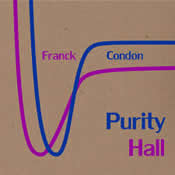
condon_purityThere is a very strong chance that you will not find another disc that takes its inspiration from classes on polymer chemistry and physics, advanced NMR spectroscopy, and nanostructured biomacromolecules. On the other hand, when you do find one, such as Franck Condon’s Purity Hall, you’ll end up with long-form drone-based flows. Wim Dehaen is the man behind Franck Condon, and in grabbing hold of ideas brought on by the aforementioned topics while working on his master’s degree in chemistry, he furthers his alternative studies in the musical application of mathematical techniques and the visual representation of sound. The five tracks here cover a deeply hypnotic hour’s time and while each shows a bit of its own character, across the board it’s fairly straightforward drone. I like the almost church-organ-like sound at the front of “Deceptive Simplicity,” and the way it has a slight organic waver to it. Dehean makes a smooth transition mid-track to a rougher and more complex sound. “Umplong” is the deepest drift here. It’s soft and hissing, with good dynamics within its slow and calm movement.

Those who like drone will find a lot to dig into on Purity Hall. For the most part it’s fairly low-dynamic, without a lot of easily perceptible change going on. As a sort of mind-salving, time-stretching listen, however, it’s quite good; Dehaen doesn’t put any bumps or sudden stops in the flow, so the listener gets an hour of deep listening.

Available from Runningonair.