
 Mingo’s music comes from a place where the world is shrouded in a state of constant half-light, never entirely out of shadow, filled with moments that swell with expectation then pass with a sigh. A place where it’s enough to be present, watching sonic vistas rise from mist and crumble back without remorse. On his newest release, The Light That Bends, Mingo takes that feel and pairs it intermittently with beats that range from slow post-rock drums to ritualistic tribal clatter, never raising his music’s voice above a dusky whisper, because he doesn’t need to. Ambient constructs drift and shift, curving gently around the beats; the movement between the two is sublime. After the rising-dawn softness of “First Light,” Mingo places his first beat–that lazy post-rock count-off–in the title track, sliding it in place next to a charmingly clumsy one-note-at-a-time piano melody. In the background, hazy colors of sound wash through. Halfway through, the beats and melody clear out to make space for a thoughtful, twinkling drift. Mingo shifts to the tribal side with “Reflections of Apprehension,” the drums pulsing over another calmly moving driftbank. A very nice treat, especially if you’ve been with Mingo from the start, is when he reaches back to his first album to pull the essential tones from “Hollow Ascension” and reworks them into “Second Ascension.” Here again the centerpiece is a hesitant melody, accented with echo and played over arcing voice pads and a steady 3-count beat. “Translation of Lost Consciousness” begins the movement toward a more ambient sound, its swirling depth punctuated with the last of the beats (for a while)–a slowly fading blend of electronic claps and drums. Things turn toward darkness with “Erosion As the Day,” imparting a certain hold-your-breath suspense with long, rising pads that feel like they’re striving hard to find light. Church bells peal in counter to the rattle of collapsing metal. The final two tracks, “Resplendent Descent” and “Last Light,” land squarely in that half-lit realm. The first is filled with chirping birdsong, as if they’re trying to urge along dawn that never quite arrives. Darker tones sit immovably at the lower end of the sound, vestiges of night that refuse to go until the final hopeful chord. The second is driven by a twanging sequencer line, underscored by a low hiss (also heard in “First Light”). The potential energy of the sequencer always feels ready to take off and yet–remains just potential. This is the last light and no one’s going anywhere. The shadows reform around us, and it’s time to begin again.
The Light That Bends is another superb release from Mingo that showcases the depth of his ambient ideas.
Available at the Mingosphere.
 Obsil’s Vicino opens with a high, twinkling sound like a music box–a sound that becomes a motif throughout the disc but which, although initially charming, manages to wear out its thematic welcome before the disc’s over. Which, for me, more or less describes Vicino. Interesting at first, but rapidly wearing thin. Which is unfortunate because overall Obsil (aka Giulio Aldinucci) culls a mix of fairly interesting, if not always consistent, ideas out of field recordings and miniscule clips of sound. The disc is built on an aggregation of moments, quick glimpses of sonic somethings that flash past and leave their afterimage turning in your head. Sometimes those afterimages are worth thinking about; just as often, however, they can leave you scratching your head and wondering what you were supposed to get out of it. While I usually enjoy discs that take the listener through shifts of identity or concept, Vicino at times seems more aimless than changing. The randomness of the sounds and the way they’re pulled together can seem abrupt and slapdash in spots. It feels like the further into the disc you go, the less cohesive it becomes. Tracks devolve into experiments that don’t always work. Fans of abstract and experimental music might find more points to latch onto here. For me, Vicino just leaves me wondering what it is I’m not understanding.
 Bob Holroyd’s new release, Afterglow, is quite simply the gentlest, most emotionally potent, enveloping piece of electro-acoustic ambient music I’ve heard in a very long time. From the first whispering cello notes in “Half Light,” the all-too-human element that fills this disc takes firm hold. It sets the tone for a suite of works whose strength comes in part from their open emotional vulnerability and their heat-pouring-forth lyricism. That mix, along with Holroyd’s graceful playing, particularly on piano and cello, hook the listener immediately. Afterglow has a story it needs tell, and it’s softly asking you to hear it out. And you will. “Ambient Like Snow” has a metronomic rhythm picked out in simple piano notes played with syllabic intent. High notes drop in, their resonance turning to hushed, vibrating echoes. “Empty Vessel” begins with Holroyd’s guitar speaking in a slow, folk-tinged voice, then builds in layered statements as soft drones roll under the mix. Restrained outbursts of electronic burble speak up in spots to add texture. The guarded use of electronics is part of what makes Afterglow shine. Holroyd slides understated electronic washes, virtually unnoticed, in the background of most tracks, a layer of subtle tone that seems to give the organic instruments an even stronger presence. I really enjoy his treatment in “27 Words,” where a warble of sound plays against more of Holroyd’s simple-yet-solid piano. And in the one place where the electronics take more of a starring role, “In the Time We Have Left,” Holroyd shows that he can handle that, too. A loop of sequencer patiently walks its pattern as a piano melody takes its time getting ready and strings ease their way into the blend. Holroyd’s ability to hook immediately into your emotional response centers becomes quite apparent in the three shortest tracks on the disc, each just over two minutes. As noted earlier, “Half Light” wastes no time hitting you in the heart; “Fragments” finds the cello crying again, layered in a weeping choir of rich sound; and “Moment” offers a melancholic pairing of guitar over strings–the guitar line repeats in the background as the cellos morph and wail. Much of the draw of Afterglow, for me, is the way in which Holroyd takes apparently simple phrasings and lets them be just that. He recognizes that they have a certain strength of their own, that the spaces between notes are as vital as the notes themselves in creating a response, and he lets the mathematics of this simplicity find their way to very listenable, touching equations. It’s in our quieter moments that our truest feelings arise; Afterglow is filled, start to finish, with those moments. Afterglow is a Hypnagogue Highly Recommended CD.
 I was a couple of hours into looping Chris Conway’s elegant suite of ambient drifts, Guiding Light, before I realized I’d been listening to it for a couple of hours. Then again, it’s subtitled “Music for Meditation,” so no surprise there. Conway’s music is soft and light, an easy flow of arcing synth pads blended with guitar, zither, Irish whistles and more, coming together in a classic New Age/healing music style. While it’s good of Conway to list these instruments in his liner notes, by and large they’re not distinct as instruments; they’re stretched and smoothed to textures and sensations of sound defining his theme of a journey toward the light. The base for the music was laid down in an inspired 55-minute improvisation on keys which Conway went back over to embellish and further texture with his additional instruments. Although Conway has his tracks broken out into 11 offerings, this is a seamless disc that moves easily through its 55 minutes, never giving you a reason to come up for air. As promised, this is music for meditation–deep meditation. In fact, you may go so deep you lose track of time. I know I did. This disc loops perfectly, quieting and warming the space around you and truly bringing a sense of calm. A gorgeous and engaging offering from Chris Conway.
 With steam-engine hisses and the begrudging grind and squeal of well-rusted gears, Grindlestone’s Tone escorts listeners along a path of dark industrial ambient. Taking sound sources ranging from “normal” instruments to field recordings of construction equipment and an MRI, the duo of Douglas Erickson and Don Falcone churn their way noisily through spaces that are minimal in structure but abrasively textured. While Tone never quite reaches the level of brain-crushing density common to the usual dark ambient, it’s definitely cloaked in thick shadows and makes a good run at alienating the listener. However, you’re kept in place by pulses of rhythm, sighing drones washing through the background and enough space between elements to make you want to hear what else is going on in there and where you’re going next. In “Pictures We Almost Take,” a repeating five-note rise and fall acts an an anchor in a sea of pulsing electronics and scraping sounds before Erickson and Falcone briefly clean out the space with wavering synth tones–and then let those five notes whisper at you from under the flow. It’s not gone, and it’s still watching you. “Once There Was Only” is the smoothest track, a quite-ambient flow of pads that, coming later in the disc after you’ve been trained to wait for a harshness of sound, spools out a line of expectancy for you to follow. Sounds that lift above the droning wash make you jump just a bit–because that may be the moment where it all turns. And then, brilliantly, it just doesn’t. This is where Tone finds its core: the rasp and snarl of the industrial tones in most tracks mix with drones and moments of phrasing to leave a distant emotional sense in their wake, and that sense can carry over as the disc moves forward. These two musicians know their way around sound manipulation; they’ve been at it, in various guises, for a number of years. Grindlestone is just one expression of their output. At times bordering on inaccessible but capable of suddenly turning up a moment that fully captures the listener, Tone will be better received by fans of abstract expression and grim soundscapes. But even if that’s not your usual taste, I guarantee that if you take the time to listen to it once, it won’t be the only time you listen. Give Tone a chance to take hold.
 Because it is my policy not to review music I buy for myself, I have never had a chance to write about Patrick O’Hearn. Which is a shame, because I enjoyed his work back in the Private Music days, before losing track of him for a number of years, only rediscovering his superb and gentle art when I bought Beautiful World and Slow Time. But, again, it hadn’t been sent for review, so I didn’t write about them. (They’re excellent discs. Go find them.) Which made me all the more pleased when Transitions arrived in my mailbox and I could finally review some Patrick O’Hearn.
 It seems that when you bring two experimental music collectives together, it’s not just a matter of doubling the amount of experimental. Rather, it’s an exponential growth with endless possible outcomes. Brooklyn-based sound and video aritsts PAS traveled to Toruń, Poland for a music festival and there hooked up with two members of Poland’s HATI. When the festival was canceled due to a national tragedy, the teams took the studio, christened themselves P.H.A.S.T.I., and churned out The Stages of Sleep.
 Although Funeral in An Empty Room adheres largely to what one would expect in a dark ambient work, and although at times in my own listening experiences I bordered heavily on a “yes, yes, let’s get on with it” mindset, I also found that I couldn’t stop listening. Perhaps it’s the effect of having Michael JV Hensley at the helm; this former member of well-known dark ambient group Yen Pox clearly knows his way around the dynamics of getting grim. Funeral is a well-modulated bit of darkness. Hensley knows when and how to thin out the density of his barbed and scraping sonic walls in order to make the next round of buildup that much more effective. That way, the disc shifts from lengthy stretches of soul-crushing weight to brief and, at times, almost beautiful reprieves. When Hensley eases off to give you breathing room, his dirge-like pads exhibit real grace and feel melodic and reverent. (Hey, it’s a funeral after all.)
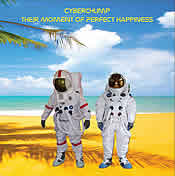 The gentlemen of Cyberchump know that your musical mood tends to fluctuate. That’s why their new release, Their Moment of Perfect Happiness, gives you two discs–one for those times when you need it uptempo and loud and another for your darker, more contemplative moments. The first disc, the upbeat one, is also for those of you who, like me, are suckers for a sexy, thick and chunky dose of window-rattling bass. With heavy dub influence entwined with ripping prog-rock guitar, this disc wastes no time in getting its funk on. “Every1” wah-wahs its way into your face and gets you moving while guitarist Jim Skeel unleashes a stinging swarm of notes. From there, he and Mark G.E. refuse to relinquish their hold. “Learning to Breathe,” which is so pleasantly trippy it should be called “Learning to Inhale,” offers harmonics pinging over a reggae bass line amid a butterfly stampede of electronics. And really, how can you miss with a track called “Interstellar Dub Station Freakout”? This one solidifies the duo’s dub cred, complete with scratchy guitar, a beat you can’t refuse and perfectly executed drops where the sudden silence just echoes through your head. The lads pull a nice tonal switch with “In Tension,” curving the flow into a Middle Eastern groove. Familiar territory for them, it must be said, and they hit it neatly here.
 Hypnagogue Music Reviews