
 When a press release drops terms like “granular synthesis” and “mathematical analysis” to reference how music is made and the artist talks about “cellular automaton” and “visual complexity,” it’s a fair bet that the reviewer’s not in for a simple listen. Guy Birkin’s software-and-theory-driven Symmetry-Breaking is such a CD and, as predicted, can be a trifle dense to get into. Paradoxically, once you find your way in, it’s easy to get taken away in the underlying harmonics. Much of the work here comes off with a raw, almost unfiltered sound and feeling. You can almost hear the numbers at work as they pull found and instrument sounds into semi-specific shapes. At other times Birkin’s higher math solves for x in cool, accessible flows. “Bass Loop b3” resonates with a rich low-end twang and an organic rasp of the string laid over a trickle of swirling electronics. “Gravity’s Rainbow” is a quiet ambient piece that Birkin’s software ripples, folds and deconstructs; as we listen the sounds get smaller and sparser, but our own calm inner response to it remains and is rewarded when Birkin lets the numbers ease the pieces back to wholeness. “Bramble” is a pastoral keyboard piece that speaks its story as pads and electronic passages walk through the background. These stand in effective counterpoint to more challenging pieces like the opener, “Fourier-Gabor,” where Birkin grinds sounds against one another and lets the underlying protocol rend them down into a crackling, static statement, or the near-white-noise wall created in “Ice Cloud Ten.” Even here, under the washed-through sound, a semblance of chord progression can be heard. The density at work in “Sneinton Elements” makes “Ice Cloud” seem lightweight by comparison, and feels like a field recording of the titular neighborhood, stretched, manipulated and coursed through with a long drone.
In addition to all this, because of the unpredictable way in which the music is created, the Runningonair label is releasing 100 numbered versions of the disc; a second disc included with the release has three tracks rendered in a way that is unique to that version. (Did that make sense?)
So, yes, there’s some heady academic thinking at work behind the scenes on Symmetry-Breaking, but Birkin gets a passing grade for making it understandable to the ear. Listen up. You might learn something.
Available from Runningonair.
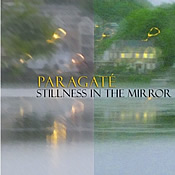 If you’re not thinking while you listen to Paragaté’s new release, Stillness in the Mirror, then chances are you’re not actually listening. Doing so in a Paragaté release is not a passive activity; it’s just not designed that way. The music here is improvised, following a specific set of rules like a particular chord structure and/or changing rhythms. From that stepping-off point, the pieces that develop vary drastically in approach, each one its own study in structure and concept, each one demanding an attentive listen. On the one hand you have a piece like “Lord of Stones,” which will have you wondering how many pianos you’re hearing or if you’re hearing one that’s overdubbed or if it’s just the way the sounds are placed spatially. Whichever it is, the sounds build as patterns cross and weave. The tempo is up and the mix borders delightfully on chaotic until it’s reined back to the point where it sounds simply like a rich New Age piano piece–but still with that ear-defying layering. On another hand there’s the dusky drones and grumbling textures of “Still Day.” Field recordings whisper in the background; a crunch of leaves, perhaps, and a trickle of water. But it’s all quite ominous, coiled around the thickness of the drone. Roughly midway through the tone shifts; it begins with a short stretch of near-silence that shows Paragaté know the importance of a pause. For a minute we’re left with just the field recordings, nothing but atmosphere. The drone returns, lightened but still bolstered on the low end. And on another hand there’s the final track, “Dreaming,” the longest offering on the disc, a piece that starts out like a standard ambient piece before Paragaté begin dissecting and shifting the sound images. The feel stays soft while an array of sounds populate the background. Multiple thoughts blend and shift. While Stillness in the Mirror largely holds my attention, for me as a listener there are a couple of missteps. I think it’s part of my evolving aural relationship with Paragaté. They fascinate me for several tracks before putting me in a place where I feel like I just don’t get it. Here, the first of those moments comes with the clamorous opening notes of “Tafelmusik.” The piece never feels like it untangles itself enough for me to find a way to latch onto it. Then there’s “To One in Bedlam,” where the titular poem by Ernest Dowson is haltingly recited over a glacial drone accented by piano. For me it suffers from the heavily echoed reading of the verse in a tone that sounds more like the voiceover for the intro of a sword & sorcery movie. For the most part, however, Stillness in the Mirror does what it should; it makes me think about what I’m listening to, challenges my musical perceptions, but also allows me to simply take it in and enjoy what Paragaté have created.
 Hypnagogue Music Reviews