
 Paulina Cassidy doesn’t waste time. On her new release, Girl in a Moonbeam Cloak, she floats 18 tracks through your head in the course of 42 minutes. Seems like that wouldn’t be enough time to do things right, or too much to do effectively, but Cassidy’s half-whispered dreamscapes don’t need a lot of time to work their way into your mind and soul. The allure here is the way Cassidy weaves together her mist-shrouded romance, tinged in spots with a bit of neo-classical influence, and lilting, keening vocals that call to mind Loreena McKennit, sans lyrics. Tracks like “We Are” and “A Gathering of Ghosts” stand on a potent piano foundation and let Cassidy’s spirit helpers of sound course around them. “4:44 a.m.” is beautifully sad, a song borne of the kind of heartbreak that keeps you from sleeping. Clocking in at under 90 seconds, it’s like a final sad expression before surrender. The simple repetition of a scale feels like indecision in its simplicity. Oddly affecting for so short a thought. Cassidy also has a real feel for creating haunted landscapes. “Peppermint Fox Bats” carves right up to the edge of weird discomfort with a suspense-movie-theme piano melody repeating itself on and off while wispy, processed voices haunt the background. “Somewhere in the Night” sounds like lost cries echoing back toward the real world from across the void. Superb use of echo in this, and touches of half-heard words up the sense of the arcane. But Girl in a Moonbeam Cloak isn’t all keening and wailing. Cassidy mixes up the flow a couple of times and actually rolls in an upbeat direction. “Skyrunning” thumps along with a bit of an electro-pop-style beat, played off against floaty vocals. “Secret Passage” is bright, particularly against the foggy backdrop of many of the other tracks. Beneath the sound, a sequencer-like pulse keeps the beat. Once again, Ms. Cassidy offers up a work that’s enchanting in several senses of the word, a little weird and a lot of lovely, short enough to enjoy in a quick sitting, and very well worth going back to over and over. She’s rapidly becoming one of my preferred artists.
Available from Paulina Cassidy’s web site.
 When “Eltanin and the Old Memories,” the opening track of Inner Trip’s debut release, Somewhere Near the Pulse, glides into a bit of spy-movie-theme song cool, complete with that ever-present twangy guitar sound that apparently accompanies anyone engaged in espionage, it’s clear where the inspiration is coming from and what Inner Trip has planned. Although the Fluttery Records web site notes Somewhere Near the Pulse as post-rock with influences of modern classical and trip hop, I think it’s more contemporary instrumental, and distinctly pushed in the direction of soundtrack material. The stories are very strong here. Inner Trip’s tones and emotions are evocative, and you may find yourself setting up scenes in your head. My mental camera eases across a snow-coated wood when I hear “The Pulse of Nature”; “Moonlight and Her Shoulders” moves from contemplation to reconciliation; “Labyrinth” paces a small, untidy room, knowing something is about to happen–and expecting the worst. Iranian artist Saman N. handles all his instrumentation, whether acoustic or electronic, superbly. The mix is seamless and the range is impressive. He gets bonus points for closing out the disc with the scaled-back atmosphere of “Eternity.” After six larger and bolder pieces, he lays out a sparse, tenuous stretch of sound on the edge of ambient, again showing that mix of solid and synthetic–and once more loading it with feeling. A single, well-spaced and understated thump of percussion ominously marks the passage of time. Somewhere Near the Pulse is a very good debut that speaks of more good work to come from Inner Trip.
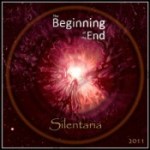 If you appreciate old-school electronic music, Silentaria’s The Beginning of the End will likely bring you a feeling of warm familiarity, but may also wear out its welcome quickly. The disc comes off less as an homage to Rixa White’s stated influences–Jarre and Vangelis among them, not surprisingly–and more as a follow-the-textbook exercise. There are marks of either amateurism or lack of attention to polish on a few tracks, and that doesn’t help the verdict any. The title track starts out sounding like the initial tone was edited too close to its start–there’s a 1-second pause and then it drops in. I get it–it’s supposed to be like a gong. It’s not. It’s like a “whoops.” The 41-second “Beyond Destiny” has an obvious flaw at the outset–like a false start that was left in. Not to sound like I’m being harsh, it must be said that there are a couple of promising spots. They also happen to be the spots where White isn’t striving to sound like someone else. “Lament of Being” has a nice striding cadence. A good sequencer line runs along the bottom as White lays down a sort of film noir soundtrack. It’s catchy, and builds up nicely. “Farewell” is fueled by a Berlin-school feel and charges along at a good clip. The melody soars and surges. The best track here. My main problem with The Beginning of the End is twofold. First, it rarely feels like it aspires to be more than an imitation of White’s influences. Many musicians tip their hat to their musical core; the good ones then find a way to make it theirs. I don’t come away with that here. Second, it doesn’t feel ready. Outside of the gaffes noted above, it just carries–to my ears, anyway–less confidence than it needs in order to out among listeners. I couldn’t shake the feeling that White was holding back a bit. All in all, not something I’ll come back to. As always, I invite you to check the music out for yourself.
 Recording as AeTopus, Bryan Tewell Hughes finds a shady spot between New Age, tribal and world music, and settles in to tell his story, Between Empires. And a fine story it is, moving from the familiar to the exotic, well paced and descriptive in its tones. Hughes stretches to hit a number of borders here, and pulls them all off nicely. The opener, “Face of the Past,” kicks in with a strong tribal feel courtesy of potent drumming from Michael Bajuk. (His percussion work underscores many of the tracks here and is instrumental in switching up the feel of the pieces.) Snaky drones, reminiscent of didgeridoo, and long-exhaling hisses and pads curl in the background before Hughes widens and lightens the space and the piece takes on the feel of a dance. “Enshrined” presents itself like a madrigal, cello-like string sounds humming a melody over plucked strings. There’s an interesting rustic, folksy tone to it that’s very catchy. Hughes cites 80s New Age icon Ray Lynch as an influence, and you’ll hear that loud and strong in the kalimba-like chimes that bounce in the background of “Vast” as sequencers and synth strings come together to craft a strong cinematic feel. (Although I have to say that the watery, creaky atmospherics at the end don’t work for me–it pulled me out of the pure listening experience, and I thought I’d moved on to another track.) For straight-up cool, head directly to “Coaster.” Laid-back rhythms and a slow-boil beat blend in a dark brew, Bajuk’s percussion making a perfect mold for Hughes to fill with sound. “The Gate” is the best balance of electronic and organic here, a starshine sequencer line repeating itself over percussion. This is one of those gets-in-your-bloodstream pieces, and may be my favorite here. Drama meets flavor. The closer, “Smiling in the Park,” all but belongs to Bajuk, his mix of hand drums, shakers and shells dancing over the ambient wash of warm, liquid synth pads. Field recordings bring us to the end of the story.
 During my initial listens to Geosynchron, the new release from Access to Arasaka, I began to get the impression that what I experiencing was something like a glitch “concept” album. You remember concept albums, right? Big, proggy things usually spread over two discs, telling a story through music and lyrics? Well, cut it down to one disc, drop 99% of the lyrics and what you’re left with is the underlying story, told in sound. Imagine my surprise when I wandered over to the Tympanik Audio site and read this: “In the final chapter of his quasi-trilogy, Access To Arasaka’s Geosynchron offers a full conclusion to what began earlier this year with the Orbitus and Aleph EPs.” Although I haven’t heard either of the previous chapters, I still found myself caught up in AtA’s dark narrative. Geosynchron shouldn’t be confused with your standard glitch disc, one that’s focused simply on high-RPM beats and flashy edits. This is about using noise to create atmosphere. The beats and the masterful glitchwork are still there, but they exist in service to something larger, which makes it stand out. “Iixion” finds the artist swirling together chaotic mashes of sound, a jagged beat pulsing uncertainly through the tangle. Listen to “Naos,” where the two sides of the working equation combine fantastically. Grinding and crunching stretches of noise fight over a slowly metered-out melody like a crawling pan across a darkened cityscape, interrupted by flashes of static. And then into this mix comes Jamie Blacker’s opiated, mournful vocals in “Lysithea.” A sense of black surrender runs through this track, dirge-like passages punctuating Blacker asking, “Are you ready to be alone?” (My ears also pick up a very slight echo from “Welcome to the Machine” at times.) Geosynchron stands out from typical glitch discs for the potent mass of emotion at work. This is a smart disc, not in an IDM way, but structurally and tonally. AtA knows what he’d doing, he knows how his story ends, and he delivers it in pure feel. There’s not a lot of this type of music I can sit through–Geosynchron is a superb exception, standing out in a field marked by commonality.
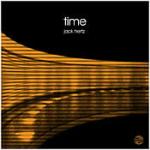 Time passes slowly. Jack Hertz’s four long, minimalist, drone-based pieces are not at all interested in hurrying along, and that’s fine. Hertz’s hypnotic flows are built on wavering layers of sound in a classic ambient style, moments pulled out to thinness then released to fade. His lines wrap and weave their way around one another before quietly unfolding to go their own way. There’s a lot of warmth to his tones, and the long-f0rm structure of each piece–the shortest is over 13 minutes and the longest almost hits the half-hour mark–makes it easy to just get lost in, both as a whole and in the individual pieces. Time gains its allure by adhering to the Eno-dictated function of ambient music; it can be listened to deeply (there’s certainly enough going on to make it worthwhile) or it can be passively taken in as it seeps osmotically from the speakers and fills the space. It raises its voice above a whisper only infrequently, and only where it matters or makes sense–in the last track, “Yesterday,” for example, where Hertz hunkers down for a bit more concerted knob-twisting and waveform-manipulating. Even here, though, he maintains an easy-rolling backdrop. The spell is never broken once Time begins. It may actually be a little too passive for some; but having looped it for literally more than six hours in a sitting without considering that maybe I’d like to listen to something else, I think it’s exactly as passive as it needs to be.
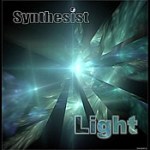 On his second outing, Synthesist presents 10 tracks that switch between calm spacemusic and New Age-tinged synth songs. On the spacier side, composer Christopher Pearre hits all the genre-right memes. His flows are calm filled with with layers of stellar-twinkle electronics. The title track nails it spot on, from the deep drifts to the rain stick accents. The must-listen track here is “Tibetan Bells,” a meditative wash of sound that rolls in like a subtle tide. About midway through the track, Pearre weaves in a low-volume bass that tracks like an understated beat. Wisely, he keeps it down there, leaving you to wonder if it might morph into something else–but no, it’s just there, as present as a pulse. Great track. There are spots on Light, however, that stray a little far into a formulaic, new-Age-lite sound. “Air Wave” and “Ascension” are the culprits here, but it may only be that the better pieces surrounding them make their heavier hand stand out. “Air Wave” made me feel like I was patiently waiting for the next available representative. And the thing is, Pearre can straddle the line between beatless constructs and more traditional melodic structures. It’s there on the excellent track, “Pareidolia.” Here, he keeps his melody half-submerged in a catchy sequencer line and threads a little tension through the air. It’s laid back yet really rich in feeling. “Morning Light” also finds itself in this kind of space, gingerly skirting the New Age edge. It swells with romance in spots, but never overflows or gets sappy. This, I think, is Pearre’s sweet spot and when he hits it, it’s very much a pleasure to listen to. While this disc runs about 60/40 for me, its strong suit is that every track is filled with passion and feeling. Well worth checking out.
 I freely confess that when it comes to glitch-based discs, I all too often find myself in the “didn’t I just hear this?’ mode as yet another track snaps, crackles and pops past on its way to being less than memorable. I gladly advise you that I never entered this mode while listening to …At the End of It All from C.Db.Sn. Chase Dobson infuses his textbook glitchwork with strong melodic elements, cinematic vistas and laid-back tonal elements. All the flurry and flutter of glitch is there, pinned down in spots with the coarsely ground bass of a dubstep influence, but Dobson can also cut loose and soar unfettered by the traditional elements. The break in “Airport (Never Land)” is smooth and relaxing as Dobson drops the heavy electronics in favor of an echo-rich piano melody. The title track cruises with top-down-convertible cool on lounge-worthy vibraphone tones. There’s a quick drop where most might throw in a frenzy of glitch and a truckload of bass, but Dobson just ups the vibes and sets a course for more ahhh. I could listen to this track all day. It’s a piece that I distinctly feel as it moves along. “A Silent Sea” carries a backdrop that feels like a cross between an old-school sequencer line and an electronic version of The Edge’s “firestorm guitar.” Dobson melts a big chunk of drama into the quite-dubsteppy “Seven Days Warning.” This tracks stalks you, taking slow and menacing steps, a constant wub-wub heartbeat throbbing in your ears. Great atmosphere. …At the End of It All is one of the rare glitch-based discs that stays in my personal rotation. It’s smart–and smart enough to know when to lay off the standard-issue stuff. Great work from C.Db.Sn.
 Joe Evans’ Runningonair label is in the middle of churning out some very interesting and often challenging releases that, while they may not be easily accessible, have a deep (and often mathematical) back-story to them. There’s something about knowing that back-story that has helped me find entry into discs that might otherwise fall outside my comfortable listening parameters. (See my review of Guy Birkin’s Symmetry-Breaking.) This leads us to Return Written Arrange by Daniel WJ Mackenize. While I hate to resort to cutting and pasting PR material as part of a review, I think you need to follow along with this: “The core of Return Written Arrange uses input from a variety of musicians who were asked to provide sound recordings of their choice from a selection of musical pitches and durations of Mackenzie’s own design. These were arranged in the order of when they were sent back and the resulting sequence was duplicated in a way that corresponded with the Fibonacci sequence, subjected to minimal production and compositional enhancements and left as semi-aleatoric pieces, as much constructed by chance and choice as they are bound by the rigidity of the sequence.” Still with us? Okay. This concept accounts for two of the six tracks on this 40-minute outing. The first is the shorter of the two, but Mackenize maximized the effect of his equation quickly. You can hear the elements layer themselves in, rapidly building to create a strange, slightly unnerving atmosphere. A woman’s voice recites a repeating list of words in a halting cadence, just echoed enough to give it an otherwordly feel. The components range from staticky crackles to high chimes. The whole thing feels like the soundtrack for a performance art piece. The visuals will undoubtedly create themselves in your head. The second installment is the longer/longest on the disc, taking up 16 of the overall 40 minutes. It begins like a dirge, somber tones in yawning chords, smaller elements glistening at the edges. It feels less “chancy” than the first part, and benefits from its structured tone. This one, too, rises to an impressive density of sound, a dark monolith carved in compelling tones. It has a very pensive feel, less unnerving than the first but no less deep, emotionally. Arranged around these two pieces are shorter, piano-based improvisations and experiments where the keys wrestle for space with barbed electronics. These pieces have a more frenetic feel, as if they’re trying to say as much as possible in the short time they’re allotted.
 Hypnagogue Music Reviews