Worms of the Earth: Azal’ucel

worms_azalWith a hefty hand on the thematic tiller, Worms of the Earth launches into the ritualistic and arcane work, Azal’ucel. Falling between dark ambient and industrial, and laced throughout with chants “delivering rites in foreign tongues,” the disc delivers a ton of atmosphere and varies enough throughout to keep it from stagnating as just another dark ambient work. I’ll admit that I rolled my eyes a bit upon first seeing track titles such as “Wandering Cadaverous Fields Toward the Citadel at Topheth” and “A Pestilent Fog Descends Upon the Empyreal Throne,” but looking past that and diving into the sounds and feelings here and letting myself be taken along with the sonic narrative, I quickly understood that there’s substance behind the bombast and a lot to dig into. The theme descends right from the start, with “Disgraced at the Foot of the Throne of God” throwing windy drones and rattling chains at you while the first chant soars with sacred energy behind it. It’s a nice balance of density and lightness, and it gains more power and presence when heavy drum beats thunder into the mix. That’s largely the equation at work here–big, shadowy drones and pads, lots of small background sounds, aggressive drums, and the chanting, which ranges from the high cries of the female voices to a threatening, throaty sound from the males. The gentlemen are at their best on the grinding, densely packed “Fork-Tongued Priests at Black Gehanna Again Speak My Name,” where their Gregorian-sounding intonations harmonize with deep-bass synth and hover over layers of industrial clatter that wander around your headspace. This track also exemplifies the range at play here, as mid-track, quite unexpectedly, a light melodic line slots into place. Well, before it gets eaten alive by more of the grind, that is. Even more mold-breaking is “Of Statues And The Sacred Gardens,” a straightforward melodic piece that slowly balances off with a rising wash of sound. The EM beat is refreshing after all the weightier sounds. The disc comes around with the final track, “Tearing Down the Christian Pantheon,” opening with funereal chords and breaking into uptempo–but no less thunderous–percussion. The female chants re-enter, uplifting and cleansing.

Azal’ucel surprised me, quite frankly. I was ready for it to be all grind and ponderosity, and instead I encountered an engaging and effective suite of work that carries its intention perfectly. It’s varied enough that it doesn’t wear thin, knows when to lay off the weight, and neatly walks the line of dark and not-quite-dark. A great experience in sonic storytelling, and a ritual I will gladly be a part of again.

Available from Industry Eight.

Chris Russell: Portal

russell_portalChris Russell turns toward the dark side and gets sonically spare on his deep new release, Portal. This is another release I’d put more in the grey ambient category rather than flat-out dark. It’s got its fair share of it, doled out in groaning bass pads and tortured electronics, but Russell also infuses it with a lot of breadth, a lot of openness that sets it apart from its more cloying cousin, isolationist ambient. It feels like exploring dark physical spaces as opposed to grim mental states A track like “Dolmen” takes it power from its geological movement and simple interaction of pads. With it slow pace, it pulls the listener in and down without any real edges to disturb the flow. The opening track, “Abyss,” takes a similar route but does carry a bit of sonic serration, nice gritty textures around the edges and sound-warbles that ramp up the dark sensibility. Russell tempers his flow in spots with percussive elements that have a muted industrial clamor to them. Listen to “Enceladus,” where that sound clatters and reverberates against sparse, haunted sounds and wavering tremolo winds. “Outlands” is full of sudden sounds, from chimes to snarls to rattles. Russell paints a rich picture here of some abandoned somewhere that has retained its share of ghosts, a place you know you probably shouldn’t be but can’t move away from. Portal is one of those discs that has the power to soothe while it unsettles–not that the unsettling aspect is all that pronounced. But it’s there in touches of dissonance and the urgings of the low end, and it gets to you. Yet it’s never something you consciously fight against. The disc’s landscape is much too engaging for that. This is a definite headphone listen; Russell is playing with a lot of small sounds to texture his strong flows. So get the phones on, settle in, and drop into Portal.

Available from Relaxed Machinery.

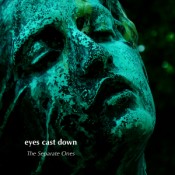
Eyes Cast Down: The Separate Ones

ecd_separateGiven that the recording of The Separate Ones, the debut full-length release from Eyes Cast Down, took place over seven years of part-time work, it’s no wonder that the finished product comes off as very intimate and personal. Surprisingly, considering its spread-out pedigree, it also manages to feel like a sensible, continuous narrative. Through six tracks, composer Gregg Moorcroft moves his work from warm, straightforward guitar ambient to fever-dream ruminations graced with Sanskrit chant. The journey runs, by turns, from calming to halluncinatory, but keeps the listener engaged throughout. Starting as it does with the quiet ambient structures of “First Day Apart,” it would be easy to dismiss this within the first five minutes as simply that–quiet ambient. As much as I enjoy the rich guitar tones here, it’s when Moorcroft begins imbuing the work with more texture and drama that things get even more interesting. “Rebuild from Memory” retains the sighing notes at first, with Moorcroft rippling their surface with wavering treatments. It’s a very classic sound, broad and calming. “Knife of Karma” glides in on rich waveform pads, then adds a metallic clatter, creating moments of percussion that come and go. Mid-track it turns slightly toward a dissonant feel, like shadows falling across the sound. Sharp guitar notes cleave through the mix. Echoing, chanting vocals from singer Alannah drive “Expanse of Heart.” There’s a wonderful, gut-shaking bass chord that comes and goes throughout the piece, a great counter to the skyward-reaching vocals. And then there is the centerpiece here, “Like A Riven Cloud,” a piece composed of improvised parts, used as a conduit for Moorcroft’s feelings about a friend’s suicide. This is a bared-soul piece of work, extremely vulnerable, with the feel of an unsettled dream. Moorcroft’s wife Dasi recites part of a Sanksrit prayer for protection in the middle of a scattered wash of sounds, and the raw sadness in her voice, at times sounding quite on the verge of tears, cuts straight into you. Violin from Ezra Azmon–whom Moorcroft found busking on the street in Toronto–cries and calls from the distance and adds a fiery anger in spots. At 21 minutes, this is a long time to spend washed over with someone else’s potent emotions, and it’s hard not to come away a little changed from the experience. The disc ends with “Radha’s Tears,” pairing a solo processed guitar with vocals from Dasi. The guitar sounds swirl and resonate, and I find it interesting that the vocals come off as the sharper element here, not interruptive, but at times almost boldly challenging the instrument.

Quite honestly, I struggled to find words for this review. I have probably listened to this disc more than 20 times in the past couple of weeks, and it has lost none of its potency for the repetition. While all music is personal at its core, The Separate Ones stands out for the extreme intimacy it conveys and the remarkable depth of effect it carries. It is profoundly intense in its honesty. I highly recommend reading Moorcroft’s extensive background notes on his pieces. The very good news is that while this disc was seven years in the making, Moorcroft says cracking this ice has opened the flow, and there will be several more Eyes Cast Down releases in 2013. This is quite a good thing for ambient music fans.

Available the Eyes Cast Down web site.

Nils Quak: Infinite Folds

quak_foldsNils Quak hits his listeners with minimalist drone constructs based in granular and modular synthesis on his new release, Infinite Folds. Two of the three tracks were performed live, running 41 and 39 minutes respectively; the third is a four-minute intermission between the main attractions. The first and longest track, “Hamburg,” may test the patience of those who enjoy neither minimalism nor the micro-sound approach of granular synthesis. A good two-thirds of the track is a long, softly undulating, near-static wash of borderline white sound. It possesses a calming hiss, and the drones feel warm and innocuous, but it’s over 20 minutes before a noticeable shift in feel occurs. Quak eventually allows  dirge-like chords to rise out of the mist, and toward the very end of the track, he flips the switch and plays with jerky, deteriorating electronic sounds. “Cologne,” the modular work, starts out in a sparse, experimental mode that also requires a patient listener. Quak takes his gear through several shifts of tone, from foggy drifts to a blaring monotone to rasping drones. It’s more of a challenge to stay with than “Hamburg,” and feels more like Quak is testing listening limits. Between these two pieces is “Simmern,” four minutes of quiet reflection that churns a little impatiently below the surface.

Infinite Folds comes off as a study in structural contrast, pairing soft against sharp, reflective against aggressive. Bring a ready-to-experiment mindset with you when you listen.

Available at Bandcamp.

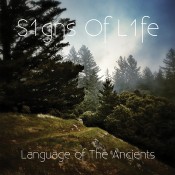
S1gns of L1fe: Language of the Ancients

s1gn_langLanguage of the Ancients, the debut from S1gns of L1fe, offers up spacey, melodic electronica with an attitude so chill it’s got frost on it. I hear in its crisp, easy beats and funky bass anchors echoes of Carbon Based Lifeforms and the laid-back “exotic electronica” that used to come out of Waveform Records. Loaded with hooks and some nice “oh, yeah” moments, this is a disc to drop into and stay with. The opener, “Aphelion,” lays down the equation for most of the tracks, with its wispy backdrops and instantly infectious rhythm–part straight-out beat, part glitch. This one hits cruising altitude pretty quickly, and then it’s smooth flying from there into the cool glide of the title track. This one has some nice breaks in it, spots where musician Chris Bryant strips his sounds down to a minimum. “Symbiosis” carries an excellent retro feel via simple sequencer lines paired with glistening pads. This is another track with that pare-it-back/build-it-up construction, and it hits a nice stride coming back in. But it’s not all beats and bloops here. Bryant can dial it down to lay out very workable ambient-side musings. “Catalyst” doesn’t speak much above a whisper, nor does it really need to. Its hushed tones and quietly pulsing beat work perfectly, laid out over thin, stretched pads. “Saros (Interlude 2)” puts together low-volume, drifting pads and a mid-paced sequencer that Bailey modulates in and out. The base flow is simple and calming; the sequencer adds vibrancy without disturbing the hush. “Metamorphosis” comes in on a drone that Bailey spreads toward the horizon. A very light pulse works its way in, just enough to waver the surface. And just to be well-rounded, on “Imminence” Bryant  goes the abstract route, filling the space with misty, crawling sounds that gurgle around before a light-as-sunrise pad pushes back the borders for the second half. The transition is smooth and very effective.

Language of the Ancients is a very pleasing disc on a lot of levels. It’s easy to take in, it’s quite engaging, it’s a perfect wind-down groove, and it has just enough retro edge in spots to ping those particular pleasure centers. There are one or two places where I found Bailey’s bass phrases a little too static for me across the course of a track (“Cell Theory,” for example), but that’s a minor quibble in a disc I’ve enjoyed as much as this. There’s a lot of depth and detail at work here. Expect this one to get a lot of repeat listens. A very promising debut from S1gns of L1fe.

Available at Bandcamp.

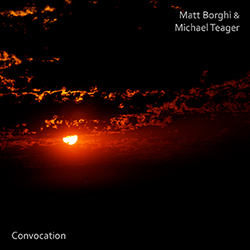
Matt Borghi & Michael Teager: Convocation

borghi_convocIn improvised sessions employing just guitar and saxophone that make up Convocation, Matt Borghi and Michael Teager have created a fantastically soothing, jazz-oriented space I’ve come to think of as lounge ambient. Not lounge in the standard sense of downtempo, but in the sense of how Teager’s supersmooth sax conjures John Klemmer and Jan Garabarek as it glides over Borghi’s processed guitar sound. Lounge in the sense of Borghi’s classic jazz guitar noodling having its say or trading leads with the sax, everything coming in quiet and wrapped in silk, just lulling you for an hour. There are five tracks here, but they neatly melt together as time slides past, with several attention-grabbing moments along the way. Teager’s fiery solo in “Constant Apex” is pure jazz joy, and his contributions to “Nebula Divide” ooze with a touch of R&B sensuality–the sax’s ever-so seductive sound in full effect. Borghi hits stride in “Precipice,” firing off runs of notes punctuated with simple, high chords he lets ring into the air. What works best here is the pure sense of balance. Both players spend time at the forefront, their time offering up both the simple and the complex. The moments of energy are well offset by long stretches of gentle calm. Borghi’s washes are warm, pillowy and deep, played to the understated side and integral as breath. This is a disc I could leave on all day. Its ambient side is textbook, unobstrusive and purely relaxing; the jazz aspects bring a rich solidity to the space, and just the right edge of funkiness. I’m going to be very surprised if this doesn’t end up on a lot of “Best Of” lists this year. You have to hear Convocation.

Available at Matt Borghi’s web site.

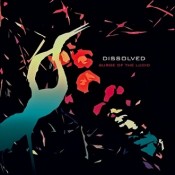
Dissolved: Surge of the Lucid

disslvd_lucidAccording to the press release, Surge of the Lucid is UK soundmeister Dissolved’s 50th release. It’s only the third to which I’ve been exposed, but my appreciation for the artist’s sounds-and-beats-in-a-blender approach has grown each time out, and Surge of the Lucid stands out, for me, as the most accessible I’ve heard while still offering an intelligent challenge to the listener. Here, Dissolved has more elegantly folded his wayward sounds into a melodic sauce instead of having them occasionally jump out the bushes at you. After the two-minute opener, “Heart of the Well,” serves as a sort of narrative opener, Dissolved brings in beats, glitch, and song-style elements. But of course it’s not straight-ahead. The wonderfully titled “Your Age in Shark Years” starts with thick, rumbling drum kicks, crunchy layers of bass and lightly overamped glitch. Vocal samples and sudden blurts of chip-set sing-song poke out of the mix. “Selmentrasm” takes a fairly textbook post-rock glitch format and warps it with curved distortions of the sound, giving it just a bit of a wobbly edge. (If you’re of the right age, think of the sound you’d get from slightly warped vinyl.) “Stickleback Red” and “Ski Run in the Distance” show off their proud chill-out heritage, with the former buoyed up on dreamy synth structures and scattered across its face with a shifting, skittering menagerie of noise. The latter sets up a short phrase as its bottom line, a simple slope that the melody gently glides down as the depth of sound ramps up. The two long tracks on this disc are worth calling out. Most of the pieces here run in the three- to five-minute range, but on “Forgotten Processes” and the closing track, “On Board The Deuterium Arc,” he stretches out to tell bigger stories. “Forgotten Processes” is downright catchy, sliding its tempo back and forth from a hurried chorus to a more plodding pace in metered moments, the whole thing haunted by vocal drop-ins and sudden stops and starts. The closer is fifteen minutes of thick and twisted glitch, snapping across the top of a drawn-out melodic line. I like the way Dissolved modulates his elements, giving more prominence to this or that as he moves the ride along. Tonal and tempo changes keep it engaging. There’ s a great stretch that’s almost entirely percussion mid-track, and Dissolved rides it perfectly down to the way he eases out of it and slides other elements back in. It must be said that there is, of course,  the bit of necessary Dissolved weirdness. “Lenslock” sounds like a classical mass for pipe organ on Quaaludes, the tones turned even more ponderous and a bit unnerving. Aside from that–and even including it, really–Surge of the Lucid is a great way to get familiar with Dissolved (if you haven’t been along for the entire 50-release ride).

Surge of the Lucid is a great release from Dissolved. Discover this musician now. You’re already 50 discs behind.

Available from Daddy Tank.

Zoid: Selected Zoidworks 05-12

zoid_selectI’m not sure how easy it will be for some listeners to get into and stay with the churning, jazz-informed, bass-synth-driven electronica on Zoid’s Selected Zoidworks 05-12. My first few listens were a little on the off-putting side, trying to catch hold of Daniel Jacobson’s unlikely tempos and unnatural musical angles as I was being repeatedly punched by the low-end force of a 303 synth. And, to be honest, I can’t say I’ve entirely invested in it. But I’ve kept going back to it. It’s like standing back and watching an experiment you’re not sure you comfortable with, but in which the results keep you watching more than they drive you out of the lab. Jacobson lures you in with the reasonably accessible “Aerosoul,” where a smooth jazz guitar vies for your attention with an in-and-out tide of whooshing electronic sound. The contrast is excellent, and it takes a lot of potency from its deceptively simple appearance. Then things get trickier. “Phorph” dials down the obvious jazz influence and puts an almost-minimal rhythm against very quiet synth chords. The pulsing overtones read very retro, and the underlay is content to mind its business back there. The track takes on a slightly hypnotic quality through a repetition some may find grating. “Acid Leaves” tears up the scene with on-fire glitch snaps highlighting Jacobson’s use of non-standard–which is to say, non-electronic music-standard–time signatures. Along with mentor Bruce Morley, he manages to slide a funky guitar take of the standard “Autumn Leaves” into this semi-tamed tangle. This is one of the things that kept me checking out Zoidworks–the well-practiced pairing of the “norm” with the twisted and how well Jacobson, who is jazz-trained, makes it fit into a whole. But it does take some time to wrap your head around it. Try diving into “Obelisk,” another pairing of textbook jazz guitar playing underneath a rush of chittering, rapid-fire microsounds. Or submit to the grinding, over-modulated bass sounds powering “Cember” before a chipset-style melody creeps innocuously into the mix. A funky drum riff in the back makes it catchy even as it’s pounding away at your head. Drums take the forefront in “jwrong,” a twist of complex signatures snapping out over slow-paced bass. Sighs of sound and more of the guitar come in to find their own place in it.

Selected Zoidworks 05-12 won’t sit well with everyone. It takes some work and some patience, but through repeated sessions the method behind Jacobson’s sometimes overwhelming madness becomes clearer. It’s a tricky blend to pull off, this skidding collision of electronica and jazz, but in the hands of Zoid, it tends to work.

Available from Invisible Agent.

Toaster: Sariel

toaster_sarielThree tracks, three different approaches, and just 32 minutes long. Sariel makes for a good, quick take from Toaster (aka Todd Elliott). After a short burble of tones, “Is Born” works itself into a moody ambient drift. It’s a straightforward, relaxing piece. “Variant IV” was recorded live, as many of Elliott’s “Variant” pieces are. This one is a long and dark-edged dronespace that opens with processed groans and eerie, misty chords. Over the course of 18 minutes the flow varies in depth, but tends to keep its weighty edge. Vocal samples sweep through behind the sound, and Elliott slowly modulates the drift toward a wider, more open sound and a subtle arcing toward a lighter tone without fully delving into it. The closer, “Ophanim,” is a plodding, mutated electro-pop tune weighted down at the bass end of the keyboard but lacking none of the groove. Muffled thumps and industrial clanks serve for beats, and a strangled vocal sample mutters below the mix. It’s quick and catchy in its off-kilter way. A good sampler from Toaster.

Available at Bandcamp.

Peter DiPhillips: Midnight Sun

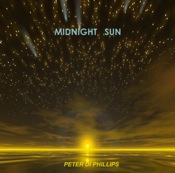
diphil_midnightBetween his last release, Mystic River Reflections, and his new work, Midnight Sun, Peter DiPhillips has placed himself firmly in my sights as an artist to keep an eye and both ears on. The music here ranges from spacey explorations to tribal-touched pulses, with DiPhillips giving himself plenty of time in the five tracks to fully realize his visions. “Tromso” and “Soroya” start the journey with wide, spacey drifts. “Soroya” is the softer of the two, a cloud of ambient pads and soft-edged textures that spends much of its time floating in higher registers, then takes a subtle turn toward the dramatic late in the track. It’s a nicely told story and a superb piece of quiet music. DiPhillips skims along the borders of the darker side with “Mageroya,” opening with electronic gurgles and clattering curls of sound over ominous pads. He plays with a shifting sense, now bringing in beats and a rhythm metered out with a shaker, now cutting you loose in an ambient drift, now corralling wayward sounds in one small space and letting them mix. This is where the tribal sense slides in, with the shakers and slightly warbling drums, and the whole affair takes on a waking dream (one might say hypnagogic) sensibility. And just when you think DiPhillips has packed in enough sound, you’re touched by straightforward guitar notes. It’s a very cool moment. This 17-minute track is, without doubt, the centerpiece of the disc. The last two tracks, “Vadsa” and “White Night,” head back to spacier environs. The fluttering tones in “Vadsa” capture the feel of the cover photo, a glistening celestial display. DiPhillips eases a melody through the pads. There are lovely shifts of tone in here, and pads that rush up to fill the space. Halfway in it takes a slight Berlin-style turn, a sequencer line coming in to call out a subtle shift in energy. “White Night” is another deep drift, 14 minutes of intermingling spacemusic washes and passages of tribal percussion, an ideal pairing of soothing and invigorating sounds. Look at this as the lighter-side counterpart to “Mageroya,” every bit as immersive as that earlier track, and a great ending to an excellent disc. In my opinion, this is DiPhillips at his very best, and it speaks of more good things to come. Start listening to Peter DiPhillips now.

Available at Happy Puppy Records.