
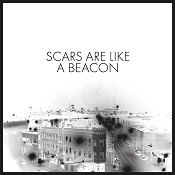
 As a writer, I’ve always been a proponent of putting away a finished piece of work for a stretch of time, then coming back to reconsider it when its freshness has left my mind. (As artists, we are typically too close to our newest children to have any kind of unbiased view.) To some degree, Andrew Howie has done that with Scars Are Like A Beacon. The sources for the seven tracks here come from the release before it, The Great Divide. I will take him at his word that this “bears no sonic resemblance to its source material,” because rather than compare I’d sooner just jump into his languid, endlessly stretching lines, packed in places with a distorted, over-amped edge and a near-constant undercurrent of somewhat sad melody. He can float out a wavering ambient line as he does on the gentle “Tremble,” and then grace it with the simple concrete sound of slow guitar notes. He can build the kind of hissing, solid, sonic wall that rises in “Disarm.” Howie pings me here by infusing the structure with a hint of my much-loved pipe organ sound, that touch of sacred music some of us can’t help but resonate to. He can lay in the thumping beat of “Beacon,” cut through with razor-edge guitar notes to skirt the border of post-rock territory as it glistens past. And he can thread a beautiful acoustic guitar song like “Found” with streams and currents of lightly buzzing electronics and rising string tones in a melancholic blend that truly tugs at the soul. Did I mention that he does this all in 37 minutes, makes it feel like a pleasantly longer listening time, and makes it all absolutely stick with you?
For a short listen, Scars Are Like A Beacon has a lot of impact, and a good amount to say. Howie his repurposed his initial inspirations into tracks that beg a deep listen. No small sound is wasted, and the flow between passive and active pieces is perfectly managed. A solid release I’ll be coming back to often.
Available at Bandcamp.
 As a young man involved in Dungeons & Dragons, I once astonished friends by admitting that I’d never read The Hobbit. “How can you play D&D if you’ve never read The Hobbit?” they said. I had the same feeling when David Arkenstone’s Beneath A Darkening Sky showed up at my door. I listen to and review a lot of New Age music, but I’ve never really dug into Arkenstone’s work. How? He’s a pretty vital genre name. To some degree, it’s a partially blind bias I’ve had that placed him within the “puffy shirt” category of New Age, which I’m obviously not all that fond of. But in listening to Beneath A Darkening Sky I find myself drawn in to a storyteller’s tale, its soundtrack packed with sonic narrative and distinct scenery. And while there are spots where it gets a touch trope-laden for my tastes, overall it’s also a pretty gripping listen. Arkenstone’s scope here is global. Celtic influences, sonorous Gregorian chant, tribal-style rhythms, all this and more come into play. I find that I’m most engaged when the music goes as dark as the title suggests–which actually makes up a fair part of the album. We’re not talking dark ambient in the strictest sense, but pieces with notes the color of lowering clouds, of endless nights, of a mysterious uncertainty. The church bells and chant of “The Deep Desolation,” laid over long, mournful string pads, are a massive dose of pure atmosphere. A sadness drips from it like tears, reminding me of the work of classical composer Henryk Górecki. “The Moonless Midnight” follows suit quite closely, adding the ominous snarl of low pads. Offset vocals and choral voices trail through this gloom like a ritualistic recitation. It turns at a point to lace in hang-drum tones that lighten its appearance just slightly, and its pace lifts briefly. I shiver quite gleefully at the power of the pipe organ sounds Arkenstone nails as “The Wind from the North” heads toward it conclusion and the album’s close. (I happen to be a sucker for pipe organ, so that thumb was on the scale.) What a fantastic, gothic tone and potency it has. Where Arkenstone loses me a bit is in the more bombastic later parts of “The Storm,” which starts off more subdued before it rises up to drama, and in the dancing brightness that “The Ice Forest” gets to. Even as a lover of Celtic music, that latter track just gets too light for me in comparison to other tracks–though it must be said that “The ice Forest” moves into an intensity that can be quite gripping. But this minor quibble stems from two places. One, I’m not a big fan of this edge of the New Age spectrum and two, I so enjoy the darker, more directly atmospheric work on this album that the drama and brightness throw me off my grim groove a bit.
 Chords of Orion (Bill Vencil) packs a dozen ambient guitar pieces into an hour on his evening-hued album, Nightfall. Along with contributions from pianist Abigail Beavin, Vencil turns these sketches into an immersive listening experience full of melted melodies. While the accompanied pieces bring a refreshing touch of lightness, I find I’m most involved with Vencil’s straight-up drone/ambient pieces. The thick layers of “The Last Green Field,” laced with a coarse edge of distortion, wrap themselves around you. Listen to Vencil coax each new thread up out of the guitar and let it decay, softening as it goes. “Air and Angels” issues forth in slow yawns and long sustain, an especially effective mix at lower volume. “Fading Into the West” has a romantic feel to it, its drawn-out melody given a distinct voice that fits its title. Grittier in tone is “Things Which Are Not,” where sharp lines cut across distorted field recordings. Skirting the grey edge of darkness, it’s eerie and mildly unsettling. All of this discussion of the solo pieces is not meant to take away from the duets; other than acting as well-placed breaks of solidity between Vencil’s ghostly ambience, they showcase another side of his compositional work. Beavin’s piano on “My Faith Burns Low, My Hope Burns Low” finds a spot between homey and homily, rich with feeling against Vencil’s supporting drones. “Immanuel’s Ground” has a soft New Age feel to the piano, bright and hopeful. Vencil offers softer string-like tones beneath. The chemistry is clear and effective.
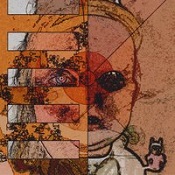 So there’s this blender. It sits in the studio where the collective called Radio Free Clear Light make music. Into this blender go all manner of things: noise, jazz, glitch, downtempo grooves, found sounds…and then they hit “Pulse” and bring it all together. That can be the only explanation for the odd, funky coolness of Joyful Noise Vol 3: Image of the Invisible Unknown. Sure, it can get weird, like the squiggly, shrieking gurgles, sax squelches, and fairly indescribable (and borderline annoying) grunts and cries of “Ovum Gnosis,” but in large part these six tracks chart a path through ear-friendly spaces. To its credit, it whirls into the equally dizzying but mostly less grating title track. Driven by a growly, almost cartoonish voice, it becomes a madly stacked pile of parts clambering all over each other, underlaid with a crunchy groove. That’s something of a hallmark of RFCL’s outsider sound–it always cleaves to some kind of glitch-loaded beat that takes hold and guides you through the jigsaw of sound around you. Sometimes much of the focus is on that, like the bare beat of “The Sound and the Process.” Yes, the weird blender concoction still spews around the room in disembodied vocal drops, twisting lines of avant-garde jazz sax, and splashes of wayward electro-sound, but that beat cuts a followable through-line straight down the center.
 Until 2016, Tom Eaton’s music was a secret he largely kept to himself. Then came Abendromen, and the secret was out–Tom Eaton makes beautiful work that balances impeccably on the edge between New Age and ambient. It’s quieting yet commands your attention, and is ever so listenable. He returns with Indesterren, doubling down perfectly on the truth that you should be listening to Tom Eaton. Indesterren picks up from its predecessor by putting piano up front and at the center, but here Eaton also opts to give his electronics more voice. So you get the New Age flair of a piece like “Vervagen,” which has the sort of implied country music honesty that struck me on “Friday/Patience” on the last album (come on, listen to that sweet lap steel slide), set in a sonic drawing of a glimmering night sky. Perfect. “Midnight Clouds and the Great Bear” hits a super-silky downtempo note, backed with the sigh and shine of cosmic pads and notes. More slide gets sprinkled like sugar over it–I just dig that sound. The beat walks itself in slowly and settles into place. Jeff Oster and his flugelhorn join Eaton for “Venus,” bringing a smooth jazz flow. Eaton’s guitar work here stands out, and Oster, as always, lays out beautifully voiced leads and accents. The chemistry between these two is superb and has me mentally begging for more of that mix. Strip the extra sounds from “The False Cross” and you’d have an excellent New Age solo piece. Add in Eaton’s airy electronics and a light, tapping beat, and it takes on a deeper richness. In the last two minutes or so, Eaton cuts everything back to a breath-thin drift and tiny whispers from the piano. It feels like he’s moved into a new track, but it’s just the well-planned, organic path the piece takes to its completion. Its fade dovetails into the gentle rise of the spacey “Eridanus.” This is where the album shifts a touch more to the ambient/space side. The pads carry the pieces and hints of piano sing out of the glittering distance. We go even further out on “Spica,” a warm float with the assistance of guitar nebulae.
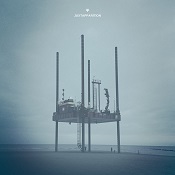 When I last reviewed Understated Theory, I noted that their 2015 EP, Critical Drift, left me looking forward to more. More arrived a few months later in the form of their full length release, Juxtapparition, and it turns our my anticipation was rewarded. Colin Crighton and Tom Moore pick up where they left off, carving out stories in a fog-shrouded blend of half-dreaming ambient and mutated post-rock. The places we are shown are strange, glimpsed through a constant roll of smoke, indistinct in form but distinct in feeling. Ghostly voices meet backward echoes meet strong guitar lines meet fluttering snippets of found sound. And it all gels together into a cohesive whole. The album is at its most vaporous at the outset. “Where Chaos Sleeps” is a pure primer on the Understated Theory sound, a tiered blend of elements that curls and shifts like oil on water. Tremolo guitar notes and a bass drum thump nudge their way to the surface. “White Fields” grabs some reverse echo and random, clanking sounds as it lurches up into a sonic wall of processed guitar. With “Look Right Through You,” we get the first appearance of a distinct melodic approach. It emerges out of another dreamy wash of fog and stays only briefly, a hint of clearer post-rock expression in the midst of more ambient, experimental work. “Mirrors” builds from a low hiss accented with a vocal hum to a churn of distorted guitar. On “Sepia,” dirty slide guitar straight off a ramshackle front porch in the Delta plays beneath field recordings and a rising drone. The slide reappears on the closer, “See the Sun Within,” accompanying slurring vocals in perfect woozy harmony. It’s like looking at the scene through the wavering air of a humid day.
 Apparently, all it takes to make misty, thoughtful post-rock that skews more to the ambient side is one guitar, one bass guitar, and some effects. That’s the gear list at play on Rise from Stratosphere (Ronald Mariën). The seven tracks here feature spiraling loops that build and thicken, almost but not quite hiding their melodies behind walls of sound. What distinctly comes through that wall is feeling, pure and human and touching. The title-perfect “Melancholy” sets the tone, and also delivers the message that you need to throw on those headphones to take this all in. Mariën’s layers run deep, and it’s a pleasure to hear each one being smoothly slotted into place. “Hypnotic” wafts up slowly, grabbing long chords as it comes. Single notes ring out, opening the way for the more distinct melody line to come through. “Enmity” follows with long drones led along by sliding bass notes before breaking into a post-rock line. After the melody’s had its say, Mariën folds it back down into wavering pads and one final bass note. “Duality” seems like the first track to let its post-rock side take the forefront over the pads and mist. Late in the track, a big, potent wall of chords lifts up, its insistent buzz leading a shift in intensity. The last couple of minutes hit hard, and I like it. The album closes with “Explore.” This is eight blissful minutes of a long, layered drone peppered with small, almost chiming pings. (Again, get those headphones on!) It’s one of those tracks that doesn’t appear to have a lot going on, but its ambient voice and mind-massaging texture are super effective, and they bring the album to a meditative close.
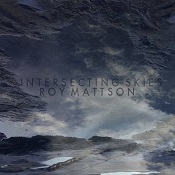 I have to honestly ask myself if I like Intersecting Skies just for its deep flows, or for how much it pings the Steve Roach reference points in my head. From the first few moments of this release I was finding analogues, no pun intended. In his efforts to capture the essence of summer weather in the northeastern US, Roy Mattson relies on a lot of Roach-esque sounds and styles. I felt like I picked up a hint of the grating stone sounds from Early Man on “Transitory Season,” caught some familiar tones in the tribal-style grooves of “Respective Realities,” and the tiny analog scritches and insectile burbles in “Unstable Atmosphere” launched me into memories of Possible Planet. Fact is, a lot of ambient artists draw on similar sound libraries or find ways to create familiar sounds in their own gear, so I’m not suggesting Intersecting Skies is derivative–it’s just not unusual for me to hear reference points in this music because of how much I listen to. It just seems like here, there’s a lot. Considering it regardless of its sonic waypoints, this release finds Mattson in his signature territory, a place where cloud-like pads hang out with field recordings and most everything moves at the pace of a comforting breeze. It’s a bit more active at the outset on “Transitory Season” as Mattson throws a bucket of sound sources out to play amongst each other. A sequencer line chugs along through the middle of it all. After “The Calling” slips down from its burbling start into a more distinct ambient space, we get a hushed flow that runs for several tracks. The title track and “Lichen Lattice” hit some very deep spots. Mattson increases his atmospheric colorings starting with “Humid Heat (Barometric Depression).” Field recordings of birds and wind play against the slow pads and super-light touches of percussion. This one moves lazily, the perfect feel for conveying the thick air of a humid summer. Crickets chirp on “Slate Clouds in Granite Skies” and the pads start to take on an almost watery hue. With “Electro-Static Release” a summer storm arrives, complete with thunderclaps and rain. This is what the album–and the weather–has been building to, and I like that Mattson doesn’t take this as his cue to make it all dramatic and over the top. He lets the field recording convey the storm, and keeps his pads going with cloud-motion grace. The final movement of the album, “Clearing Summer,” is loaded with the hopeful tones of a rain-washed sky, the way it always seems cleaner and brighter once the storm has passed.
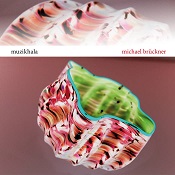 Quite frankly, it’s all but impossible for me to go into the idea of reviewing four hours of anyone’s music with a hopeful frame of mind. It’s not that I don’t want to listen to it, it’s just a lot to try to subjectively encapsulate. But after much back and forth with Michael Brückner, a prolific artist who was asking for a review, I ended up with Muzikhala because at the time it was his latest release. (I prefer not to review old/back catalog material.) So what did I get for my four hours (minimum) of listening time?
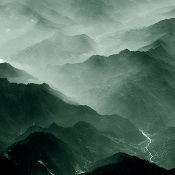 Three brief sketches covering about 20 minutes make up Namkwan Cho’s Green Mountain. It kicks off with a bit of an abrupt start on “La Belle Dame Sans Merci,” which quickly ramps up into a buzzing wall of distortion. It’s like Cho took the latter part of a post-rock song, that point where everything is big, slammy chords, and turned the levels up. (On the artist’s Bandcamp site, this mantra is posted: Build, repeat, decay.) “On Silent Haunches” sets up a three-note phrase that’s a bit like a large clock chiming the hour, then surrounds it with its own resonant sound. It’s rather static outside of the constantly growing backdrop, and I have to confess that the phrase wears on me before the track’s half over. The title track is the best of three, working off a guitar phrase and again laying on distortion and light noise washes. Again, it helps to like the repetition that comes with a minimalist mindset.
 Hypnagogue Music Reviews