Disparition: Madoc

dispar_madocA three-part suite of long-form techno-industrial pieces inspired by Madeleine L’Engle’s A Wrinkle in Time series? Yes, please. On Madoc, Disparition (aka Jon Bernstein) uses the repetitive structures of minimalism and the driving beats of techno/trance music to wrap the listener in a heavy density of sound. Which would be pretty good in and of itself, but instead of stopping there, Bernstein sets your head spinning with his hypno-spirals, then laces in some surprising turns. For example, there’s an acoustic guitar, with a delicious Spanish flair, that pops up after a steady storm of drone in “Charles Wallace.” In the 40-minute epic “Echthroi,” a rush of piano sparkles in the flow for a few minutes, a hustling minimalism that sounds like what would happen if Phillip Glass felt it was time for a little jazz-flecked house music. The title track begins and ends with ambient structures that are comparatively calm–though still edgy, particularly at the end. They roll on, hushed and floating and whispering their way to the finish. Throughout, Madoc is driven along by a thick, techno-style beat that, it seems to my ears, doesn’t change tempo that much, if at all. And this is a good thing. It comes and goes, sometimes altering its identity slightly in terms of what it sounds like, but the pace of it remains steady. When it drops or fades out you continue to feel its influence for a bit, and when it resurfaces, it’s like picking up where you left off. This really comes across in “Echthroi,” where Bernstein has plenty of time to shift and re-shift, to pull us in and out of mutations of the concept. However he morphs the general structure, from those raspy drones to bass-drum-loaded pulses to one great stretch that speeds along on vibraphone-like chimes, the beat comes back as the constant. It’s this, combined with the come-and-go from acoustic elements as identifiable anchors in the swirl of drone, that has allowed Madoc to absolutely hypnotize me on quite a few repeat listens. I keep coming back to it because I’m sure that the inevitable mental haze it induces, I’m probably missing something–and I want to hear it all. You will, too.

Available from the Disparition web site.

Siddhartha Barnhoorn: Antichamber

barnh_antichI’m sure it’s not uncommon in the instrumental-music world these days, but Siddhartha Barnhoorn’s Antichamber is the first game soundtrack I’ve ever been asked to review. Based on the award-winning video game of the same name, Antichamber offers up 90 minutes of music that ranges from straightforward ambient drifts to electro-acoustic blends. Barnhoorn notes that “Inside the game itself the music is made up of layers which cross-fade into each other, creating an evolving piece of ambient music which never has the same elements / layers on top of each other.” I have to assume that sounds quite interesting, since these nine pieces are very engaging on their own. To sort of simulate the concept, I have listened to the disc straight through and on shuffle, and also played with having the music open in both Winamp and iTunes, working myself through admittedly clumsy cross-fades. The cross-fading was an excellent exercise, as it pointed up how Barnhoorn keeps most of these pieces tonally similar to enhance the flow regardless of how they’re heard, while still providing them their own identity. The result is a multifaceted piece that can redefine itself with each listen. Both sides of Barnhoorn’s musical equation works. “Antichamber Suite I” and “The Final Puzzle” are the showcase pieces for the softer side, perfect ambient constructs content to glide through the space, shifting tone carefully across time. “The Final Puzzle” is the more melodic of the two, with Barnhoorn pulling a melody out to develop at a graceful, dreamy pace. The electro-acoustic side is exemplified by the centerpiece of the release, “Antichamber Suite II,” a 22-minute work that eases in and out of a hushed tribal tint. As he guides the piece through its several passages, Barnhoorn underscores his drifts with hand percussion that comes and goes, and floats in flute and piano. It creates distinction between moments, and each transition is smooth and simple. “Black Tile” picks up the echoes of that long piece and pumps along on a delicious overload of percussion. The sharp rap of the tabla carry the high end against throbbing bass lows. To close out, “Dying World” is as dark as the title suggests. growling its way along on heavy industrial pads that crunch down until the closing, post-death-quiet pads. I must say I could do without the bonus track, “The Garden,” that’s tacked on after this. Here, Barnhoorn plays with a chop-up scheme that comes off sounding less like a planned effect and more like my download went horribly wrong and I’m missing data. It’s the only thing that takes me out of the pure, shifting flow that comes before it. Antichamber overall is a deeply engaging work from a very skilled composer who understands how to cull feelings from sound.

Available from Bandcamp.

Ian Morris: Parking Lot Manuscripts

morris_parking Six quick hits clocking in at under a half-hour total make up the pleasant and catchy jaunt that is Ian Morris’ Parking Lot Manuscripts. This is pop electronica, accessible and (for the most part) upbeat. “A Functioning Hemingway” packs a nostalgic punch, the whistling synth lead feeling quite like an old New Romantic song. (Anyone else remember Classix Nouveaux?) A whump-thump beat on bass drum gets the toes tapping. Probably the best piece here for me, and although I like the way it dovetails perfectly into “Policy on Submissions,” the two feel almost too close in style–I had to check to see if I’d moved on to the next track. The issue may be that Morris is apparently fond of a trilling run on piano, which he either speeds up or slows down; which is fine until it appears in three songs in a row (I catch a glimpse of it in “I Like the Way We Whisper Even When No One is Around”) and suggests less of a unifying thematic device than “Oh, you’re doing that again.” By way of departure, the closing track, “Van Gogh’s Dangerous Gamble,” brings us a quiet and thoughtful melody on acoustic guitars. Morris works a nice depth of sound through the guitars’ resonance, and it amplifies the track’s raw honesty. Morris notes on his Bandcamp page that the release is intended as a “multimedia experience,” with each song paired with a poem and a photograph. I’m not comfortable commenting on those aspects, but it makes for an interesting addition to the music. There’s quite a but to enjoy here, least of which is the potential for more good music from Ian Morris.

Available from Bandcamp.


Erik Wøllo: Silent Currents 3

wollo_sc3As with 2011’s double-disc release, Silent Currents 1 & 2, Erik Wøllo’s new digital-only release comes from a live performance. But whereas the first two parts were just archival presentations of a live set, Silent Currents 3 differs in that Wøllo took the material back to his studio to edit and remix it. While I could not tell you what’s been added here or how, I can say this release is an hour’s worth of signature Wøllo flows and formations. While this results in some familiarity of sound, the journey is still deep, smooth, and nicely modulated. Wøllo shifts the listener easily from quiet drifts at the edge of space into bubbling, sequencer-fronted passages, and passes briefly through some darker, uncertain zones. And, as always, there is that wonderful, sighing and crying guitar rising up out of the mists of sound. What makes this set stand out is how is highlights Wøllo’s ability to make unobtrusive transitions from one space to the next. He might immerse the listener in one of those smooth, lightly energetic sequencer-and-guitar passages, then ease his way out of it and melt the tone into something built on soft pads. The cool thing, for me, is that I’m usually a minute or two into the new space before I register the shift, and it feels like I’ve been in the current vibe the whole time. The sections, for lack of a better word, are fairly brief, keeping the piece dynamic and engaging. I particularly like one beautiful stretch near the middle where a shadowy, abstract drone and a mechanical beat unfold into a sparkle of sequencer notes. These rapid, glistening runs are given the spotlight for a few moments as Wøllo strips back the other sounds. A shift of scene then takes the tone out into spacemusic territory and onward.

If you haven’t listened to Erik Wøllo before, Silent Currents 3 makes for a very good introduction, as it does run through his signature styles. His incredible touch on guitar, the way a melody and emotion slowly ooze off the strings, is worth the listen alone. For those who are familiar with his work, this is another good example of how well he pulls together a piece in real time, and also turns a bit of light on his studio skills. All in all, an hour well spent with an ambient master.

Available from Projekt.

The Pure Heart Ensemble: Bliss of Being

pureheart_blissIf you have small children, particularly ones who are troublesome at bedtime, I recommend grabbing a copy of The Pure Heart Ensemble’s Bliss of Being. Beyond that, you’ll like this if your tastes run to quietly soporific music falling somewhere between lullaby and chamber music. Individually, the 12 pieces presented here are lovely enough; the quintet of pianist Richard Shulman, cellist Adriana Contino, flutist Kate Steinbeck, crystal bowl artist Bob Hinkle, and vocalist Dielle Ciesco come together beautifully, and the simple, un-augmented sounds of their instruments ring with feeling and honesty. It’s across the expanse of the hour, however, that the music begins to feel repetitious. As lovely as the pairing of Shulman’s piano and Cieso’s wordless coo’ing may be, and despite how beautifully it feels at first like a mother singing softly to her child, it soon becomes a matter of “Didn’t I just hear this?” as the pattern repeats. The other instruments certainly add depth–Contino’s cello is especially affecting in the long track “Heading Home” and Steinbeck’s flute is the whispering, soaring mate to Shulman’s earthy, grounded piano throughout the disc–but it’s not enough to outweigh the sameness after a while. As much as Bliss of Being is a true ensemble work, Shulman’s piano is certainly its focal point and anchor. His playing is rich and elegant, whether he’s patiently spacing notes within a melody or, as in parts of “New Openings,” he’s running through glissandi that sparkle like sunlight on water. The solo song, “Resting in God,” is an absolute showcase piece that makes me want to hear more just of Shulman’s piano. This quick tune flows nicely into “Loving All,” where he again takes the forefront before the rest of the group ease into place.

Bliss of Being faces something of a weighted scale with me as a listener. The music here is much lighter, much more bookstore-ish, than I typically prefer, and there’s never a marked shift in tone or tempo. That certainly factors in to my problem with its sameness. And yet, given plenty of space apart from one another, these songs are outstanding from a quality point of view. The players are impeccable; they play with emotion and meaning, and you can feel their connection to what they’re doing. But coming at it as a straight-on, one-hour listen, I find myself wanting to move along. That being said, New Age music lovers will likely find a lot to enjoy here. Plus, as I suggest, it’s absolutely fine shuffled into your daily rotation. Give it a try,

Available from Rich Heart Music.

Meg Bowles: The Shimmering Land

bowles_shimElegant, calming spacemusic awaits in your journey to Meg Bowles’ The Shimmering Land. This is Bowles’ sixth release, and her second in two years following a long hiatus, and it reinforces that she is an important voice in the genre. Across six tracks, Bowles barely raises her musical voice above a whisper, opting instead to make its impression via depth and dimension. With a practiced hand, she places airy layers one atop the next, mixing the pure simplicity of ambient structures with nicely understated melodic elements. “Nightwalk Across the Isle of Dreams” showcases that blend, the melody drifting in via woodwind and plucked-string sounds. When she opts to add rhythm to her flows, it’s with subtle pulses from the sequencer; they arrive not to intrude but to lightly amplify the sensation. You hear it in “Beneath the Radiant Stars,” a present but distant ripple in her spacey, panoramic drifts. On the lush and serene “Venus Rising,” the sequencer heads into a higher register, casting star-shine glimmer across long string pads. This has a classic spacemusic feel to it, a bit of nostalgia pinging at your long-time-listener pleasure centers.

The Shimmering Land quietly invites itself into your listening space. It makes no demands as it patiently fills your head and works its soothing, aural-imagery magic. The feel is always warm and utterly calm as Bowles spreads out her vistas before you and floats you through them. This is a wonderful disc to have playing at the end of the day and into the evening, helping you wind down and re-center. An absolute must-hear from this (quietly) powerful voice. Let it loop.

Available from Kumatone.

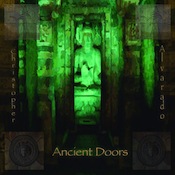
Christopher Alvarado: Ancient Doors

alvar_ancientChristopher Alvarado taps into the mysteries and rituals of primitive cultures on his new release, Ancient Doors. While not a “tribal” release per se, these twelve tracks definitely delve into a primal space, pushing forward on varied percussion and atmospheres thick with incense smoke, but also weave in some new-world grooves for an original glide. The balance is the strength here, and Alvarado is clearly at ease working both sides of the equation, alone or together. “Dakini (Sky Goer)” is a great example of this mix, rising out of misty drifts before it starts pumping along, catching hold with its chugging rhythm. There’s something pleasantly raw about the sounds forming that rhythm, and they way they counter the fluidity of the pads. “Jewel of the Jackal” is another, a Mediterranean fantasy where sharp raps of the tabla and flavorful strings like sitars melt into a hypnotic sway. Alvarado builds up to a frenzy, then just fades it away like a breath. Probably my favorite track here. On the more tribal/primal side, “The Lock of Past” is a great atmospheric track. Drums distantly hammer out a dance as Alvarado ramps up the drama. Static-washed hisses and chant samples blend into the sound. On the more ethereal and sometimes dark side of the equation is  “Dunes,” pairing long ambient pads with a keening vocal sample and more of the Middle Eastern flavor that runs through the disc. Later, that voice gets a different treatment in this tune’s “Drifting Wave Mix.” There, it’s  clipped and chopped and used as a rhythmic element for a glitchy feel. It plays nicely against a meaty bass line and cool strings for a silky overall flow. Meanwhile, back on the quiet side, “Andromeda at Dusk” is a slow-moving ambient piece with a calm-breath movement. It’s a perfect closer that mixes its hush with just the right amount of shadow.

There’s a lot of visual imagery at play on Ancient Doors, and several of the tracks have a soundtrack-ready sensibility to them. (Understandable, what with this release coming from Aural Films, whose motto is “Soundtracks for films that do not exist.”) Alvarado’s sounds run very deep, creating fully described spaces that evoke a lot of emotion. As I said before, it’s the mix of modern feels with old-world sounds that works best for me here. It makes the music easy to get caught up in and a pleasure to come back to. Check it out for sure.

Available from Aural Films.


Audio Cologne Project: 2911

audio_2911 See those guys jumping on the cover of Audio Cologne Project’s 2911 ? They’re jumping because they just got a jolt of this prog-drenched, Krautrock-influenced musical adrenalin. ACP, if I may call them that, are a power trio consisting of keyboardist Dave Pearson, aka Computerchemist, guitarist Uwe Cremer, aka Level Pi, and drummer Zsolt Galántai, who played with Pearson on last year’s Signatures release. This is a flat-out fun, turn-it-up offering that kickstarts with the wild ride of “Chemist’s Bike” and doesn’t much let up on the gas until the last note. While all three players are rock-solid, it’s Cremer who acts as your sonic tour guide for most of the release. It’s obvious to me that before playing, he soaks his guitar overnight in serious blues, then proceeds to wring every sweet drop out of it while he plays. And by blues I mean thundering 70s-style blues-rock blues, equal parts fire and gritty emotion. He absolutely crushes it on “Chemist’s Bike,” and later lightly smokes his riffs in Middle Eastern flavors on the 20-minute epic, “Spieluhr.” Throw in some guitar effects, and things get nicely trippy. In the latter half of “Spieluhr,” he again lets fly with more aggressive lines, hitting the wah-wah good and hard to slide the notes right into you. Of course, all this praise for Cremer is not meant to short the other players, because this is a big batch of effective chemistry. Galántai anchors the trio with his massive fills, driving the frenzy from the rhythmic side. Pearson, as ever, contributes masterful sequencer lines to support Cremer’s flights and lend a crisp and not-too-nostalgic Berlin School feel to the proceedings. In addition, he handles bass guitar duties, most notably the fast-running riff that kicks off and then underscores “Grobmotorik.” (And also, a nice break in “Chemist…”) On “Mind the Gap,” he serves up a sweet, jazzy electric piano solo, its creamy smoothness standing in contrast to the raw guitar licks coming from the other side. This another great long track, which the trio modulate through several tempo and tone changes. Along with its rock bombast and jazz, it also has some fairly Floyd-like moments, quiet passages where Cremer shows his soulful side. Listen carefully for Pearson’s sequencer bubbling under the surface of his keyboard solo as the piece draws to a close. Great attention to detail.

While Cremer and Galántai have worked effectively with Pearson before on their own, the decision to bring everyone into the fold was a very, very good one. The three mesh perfectly, and this release is just full of pure musical joy. I have been a Computerchemist fan for quite a while, and for me, Audio Cologne Project is Computerchemist on steroids. Everything I’ve enjoyed about Pearson’s work just gets amped up here. I have taken the 2911 ride many times since I received it, and I expect it to stay in heavy rotation at Hypnagogue HQ. Like I said, it’s just damned fun. Grab this, and enjoy yourself.

Available from the Computerchemist Bandcamp site.

Steve Brand: The Great Hoop

brand_hoopMy biggest problem with writing a review of Steve Brand’s The Great Hoop is that, having done so, now I have to stop listening to it and move on to other discs. Easier said than done, because this is a disc I have deeply enjoyed. On this release Brand pulls inspiration from Native American culture and the landscape of the American Plains (in particular, the Cahokia Mounds in Illinois), but does not set out to make a Native American music disc per se. It’s more the artist’s interpretation of how his own interest in and connection to the subject manifests in music. So, yes, there are flutes, shakers and rattling bones that call up the impression and which also lend an air of ritual in places as the five pieces here move along, but their role is to act as a perfectly placed accent to Brand’s big, deep ambient soundscapes. The flute, particularly, works as a tether for your floating spirit. Brand’s playing is elegant and spirited, and I like the way he varies between full-voiced playing and occasional wispy, breathy whistlings. The latter brings a bit of a ghostly touch, especially in a darker piece like “Hoop of the Earth.” It’s wisely played against low-end pads, the thrum of a frame drum, and the crisp sound of the rattles. The drama gets ramped up on this track as Brand alternately thickens and thins his sounds in superb measure. It’s an interesting blend of potency and peacefulness. This is something I really enjoy about Brand’s work; he knows how to create impact either with a minimal amount of sound or a heavy dose of it, so his more hushed passages still leave an impression. Definitely the case here. Fans of Steve Roach are sure to hear echoes of his influence throughout The Great Hoop, and perhaps nowhere more so than in the fantastic “Medicine Bag Ghosts,” with collaborator Frore. This is the centerpiece for me. It’s seriously powerful medicine that’s ready to take you very, very deep. Layers of flute swirl and spiral, echoing off into the distance; throaty drones beckon from somewhere below; a whisper of wind eases through the sound. Halfway into it we enter into Roach’s established territory, marked by slow tribal beats and a humid sonic atmosphere. This is pure ritual in action, evoking a primal, gut-level response. This track alone is worth the price of admission. When I first listened to The Great Hoop, I felt like the last track, “Suspension Vision,” had something of a mis-step. Brand whistles on this track, a sort of wayward, almost haphazard whistling. It struck me as odd at first, but after some repeat listens I came to see it as a very personal, connecting touch. It echoes the songs of the flute we’ve been hearing across the disc, but this is the song without the external instrument. This is the breath that makes it happen. This is a reminder that, in the end, all of our music begins with us and in us.

The Great Hoop is a brilliant release. It may very well be Brand’s best. It digs into the listener and doesn’t let go. Its organic parts are wonderful, down to the simplest shaker. It manages to embrace tribal and Native American musical themes, but they’re always tied directly to the ambient spaces Brand is known for–vast, moving, and impressive. Steve Brand is a genuine force in the ambient sphere, and this disc helps to solidify that position.

Available from Relaxed Machinery.

George Wallace: Soul Ascending from the Primal to the Celestial

wallace_soulSoul Ascending from the Primal to the Celestial presents a variety of vistas with a nearly equal number of styles. Veteran composer George Wallace offers up spacey ambient, semi-dark tribal, and touches of world music in these 12 tracks. It’s a mind’s-eye sort of affair, as Wallace shows a solid feel for setting a scene and telling a story within the few minutes he allows each song. His ambient work is suitably quiet and leans toward the spacemusic side of things, that sense of vastness that comes from big, well-layered pads. “Celestia Aeterna”is one such piece, building up from the soft call of chimes (of which, it must be said, there are many on this album). It gracefully floats outward, a very classic-sounding bit of work, light and promising, anchored with a nice bass drone. Its followup, “Mystery Unfolding,” drifts along as well, but is infused with a dramatic chord structure that raises the narrative ante. (And it has chimes.) As noted, however, it’s not all ambient here. “In-Betweenland” recalls Windham Hill combos with it rolling fretless bass. Hand percussion sets the groove, and a lightly applied jazzy feel weaves its way over washes and pads. “Speaking in Tongues” rams forward on tribal percussion and widens out into a world-music groove. “Ecstatica” (which falls under the “Speaking in Tongues” storyline of the disc–see Wallace’s web site for info) opens as a dark, drifty piece, then drops in bouncy didge and a shuffling beat that takes it to a cool new place. There’s almost too much added for my preference–for example, a high, Eastern- style flute comes in here and there, but it feels it walked into the wrong room yet decided to stick around. This happens here and there on Soul Ascending; spots where it seems that Wallace is trying to do too much, throwing too many frames of reference at us. It only stands out for me because other songs where Wallace embraces less density work very well. “Tibetan Moon Behind Clouds,” for example, is a lush drift that makes the most of its simplicity and still packs a distinct emotional core. Or “The Primordial Chord,” where pads mix with acoustic strings (and chimes, of course) in a very affecting, hypnotic blend.

Soul Ascending is a pleasure to listen to. It’s diverse without straining; each piece is strong on its own and moves the whole forward. While, as noted, I prefer the simpler side of Wallace’s work, pretty much everything here hits. Be sure to check this one out.

Available from Airborn Music.