Off Land: Tidewater Pulse

offland_tideSoft and every bit as fluid as its title suggests, Tidewater Pulse, the new release from Off Land, is classic deep ambient. Structurally simple on the surface, the music here employs minimal movement, field recordings and well-planned depth to be both relaxing and intriguing. Musician Tim Dwyer fully involves the listener in his interpretation of “the water cycle, as well as the expectations and excitement of travel.” This is definitely a headphone listen; Dwyer uses a lot of small sounds, light accents that texture the edges of his warm drifts. It may be a simple crackling sound or something as full as a crowd of voices. They act as well-placed waypoints, attention-getters that do their job with subtlety. The mix works very well across these nine tracks. “Precipitation” is a gorgeous, dreamy piece opening with long-echoing piano and a wispy voice easing out of a misty backdrop. Repetition is key here; the piano phrases–a chord and two descending notes–remain steady in their cadence, allowing things to change around them. “Never Been” is comforting and slow, easing its way to conclusion with a recording of water–and, again to catch your ear, dogs barking in the distance. (At least that’s what it sounds like to me.) There are, obviously, water sounds in Tidewater Pulse, but Dwyer never uses them in an up-front way. They appear, they recede. This is not a “sounds of the ocean” relaxation disc, it’s just a set of work inspired by it. Dwyer also mixes up the feel in places. “Drift Ice” has a keen edge of uncertainty. Scratching and cracking sounds fill the space and another voice sings in a sort of a drowsy, disaffected way. The track comes off colder than the ones around it, but is effective in doing so. A stretch late in the track, with little more than the scratching sounds and long chords with a bit of a pipe-organ tone to them, is beautiful in the way it impacts with minimal elements. “Petrichor” hovers near the nexus of dark and tribal. A steady thrum on frame drum and a ritual-ready clatter of shakers carry the tone. The pace is very slow and deliberate, sound-pieces slotting strictly into their assigned places. “Permafrost” and “Wait” introduce light, more active rhythms into the mix. “Wait” offers a rain-spatter sequencer line traipsing over pads before giving way to them. “Permafrost” pushes along on an insistent thump that underscores swelling textbook-ambient pads and a rich bass drone.

Tidewater Pulse is one of those quiet-companion albums, the thing you listen to on loop when a reflective mood strikes. But it’s also a companion you want to know intimately, one you want to understand in each and every sound, and it rewards that intimacy. A great release from Off Land.

Available from Psychonavigation.

Christopher Alvarado and Ari Porki: Menagerie of Clouds

alv_porki_menagOver the course of the four albums from him that I have reviewed, Christopher Alvarado has become a musician I keep an ear on. Between releases under his own name and those he puts out as Twilight Transmissions, he has demonstrated a real knack for crafting work that’s wrapped in shadow and uncertainty but which can suddenly shift into a strong groove. On this new album with Finnish sound artist Ari Porki, he nails it yet again. Menagerie of Clouds is a deep ambient ride that skirts the edge of darkness, giving listeners just enough of a glimpse of what’s going on over there in the murk. Borrowed tribal rhythms and field recordings flesh out the flow, and the duo nicely balance rhythmic tracks with mistier amorphous constructs. The rhythmic pieces are absolutely coated with hooks. “Cape Isthmus” blossoms into a wash-and-pulse flow with recognizable Steve Roach influences. Strong percussion drives it forward and a sweet sequencer line bobs and weaves through the sound. “Land of Nothing” lifts up out of swishing layers of sound to resonate with deep electro-pop echoes–like Yaz or New Order with a heavier ambient undercurrent. A beefy bass line punctuates the washes and finds its way into you. The beatless pieces, or those with minimal beats, are equally effective. “Inception of Stillness” finds its center in broad pads with hints of Porki’s field recordings lurking at the edges. The sound surges in places, taking on mass and intensity, driving upward and filling the space with expectation. On the darker side is “Valley of Winds,” which dwells in a far more abstract space, haunted by echoing vocal samples. The sound here bends toward Alvarado’s Twilight Transmissions side in its timbre, and picks up dimension from tribal-style percussion and shakers. I do have a minor complaint on one track, and it exists only because the remainder of Menagerie of Clouds is such a seamless ride. “Mesas” has a rough edit at the end that cuts out abruptly, creating a moment that rips me out of a good flow. I wondered if I’d accidentally shifted to “shuffle” and there was meant to be a smoother transition into the next track. Apparently not. While this is a very minor thing to point out, it is the one huh? moment in an otherwise completely immersive flow.

Menagerie of Clouds catches me with its near-dark atmosphere, tribal touches, and richly dimensional feel. It’s superb on a close listen as Alvarado and Porki load their layers. Many feel whisper-thin, but stacked and infused with a little mystery, that take on a deeper effectiveness. It’s a great blend that works well. You need to hear this one.

Available from Aural FIlms.

Toss Power Traps: Earth Rot II: Music for Iceland

tpt_earth Paying homage to the eco-aware 1970 David Axlerod album Earth Rot in both name and intent, Toss Power Traps’ Earth Rot II: Music for Iceland is set forth as “a musical love letter to the country and its mysteries” and as a musical screed on environmental caution. Musically, it ranges from blasts of electronic noise and gritty industrial tones to quiet, thoughtful pieces hovering on the edge of post-rock. There are 10 short vignettes here, the longest clocking in at under six minutes, so composer Brendan Coon jams a lot into a very short timeframe. There is a well-thought of shift of sound across these tracks that, for me, somewhat salvages the release. I don’t find much to grab onto in the first couple of tracks but midway through “Aluminium Smelter v. Hallgrímur’s Klais,” when Coon drops out his heavily abrasive sonic attack and moves into a very light minimalist near-drone, a simple repeating set of tones over a white-noise backdrop, he’s grabbed my attention. From here the music gets more interesting. The repetition-and-drone framework gets shuffled a bit moving into “Audun, Let the Bear Roam Free,” where chimes form the phrase and ambient-style pads roll beneath. “Even Vatnajökull Can Melt (Ragnarok)” feels like a Kraftwerk nod, but with more grit and deconstructionist attitude. “Bassaltaurorica” is a whisper of a thing, soft electric piano-style notes picking out a slow melody that rings and resonates, giving off a chill-out vibe. The closer, “The Portal at Grímsey,” nails you immediately with its catchy glitch hook and thumping club beat. Again, Coon lets a simple repeating phrase carry the piece, letting it speak across layers of cool texture. Big strings come in at the end to carry it all upward, and where we end up is vastly different from where we began.

That distinct journey is what made Earth Rot II: Music for Iceland a pleasant surprise to me. I wasn’t crazy about it at the outset; it felt like noise for noise’s sake, a big tangle of experimental chaos. But Coon has a through-line here, a theme that plays out, and it works. I happen to prefer the more accessible side here, but the gritty stuff, in relation to other such work, is handled well. It has gravity, and I think that’s what Coon wants there. A very interesting release from Toss Power Traps.

Available from Gogoyoko.

David Downing: Cosmic Conspiracy

downing_ccArmed with just his cello and a looping station, David Downing bridges classical, post-rock, New Age and a bit of experimental music on his second release, Cosmic Conspiracy. The cellist takes a real chance straight out of the gates with “Whale Song” by rasping near-dissonant harmonics out of his strings to quite effectively simulate said sound. As the piece settles and rectifies itself into a beautiful set of descant tones over a rising drone, it becomes more accessible–but I can see unadventurous listeners heading for the exits before Downing can fully have his say, and that would be a mistake. Getting through these somewhat harsh sounds is well rewarded halfway through the track when it shifts into a more accessible rhythm-and-melody mode, introducing itself on pizzicato notes. Dan Kane lends assistance with beats and keys and the piece settles into a pleasant New Age groove. This is the first taste we get of Downing’s unadulterated playing and it is smooth, rich and emotive. This becomes the overarching tone for the rest of the disc, a fresh space that mixes an identifiable New Age timbre with the vivacity of modern classical music. “The Storm” and “Mérida” represent the latter. “The Storm” wraps the listener in a Steve Reich-like haze of rapid-fire repetition, a showcase of Downing’s technical playing.  Hard shifts of tempo jump in and out of these flurries, punctuated by a deep bass note–they’re like reminders to take a breath. “Mérida” is something of the darker cousin, coming in all melodrama and fiery passion, spinning its own sometimes challenging take on the rush-and-break structure. Late in the track it exudes a sad romance, high, crying lines carrying over a brusque and raw rhythm. Very affecting. “Sarah’s Song” heads in the opposite direction, a post-rock ballad composed in loops. Again Downing’s lyrical plucking takes the fore, and his silky bowed sounds sing gorgeous counter. Very accessible, and my favorite piece here. Great crossover potential.  The title track falls in the middle, wrapping all the elements we’ve heard into a single theme. It opens as a slow ballad, then picks up pace as the composer begins to lay in his loops. It feels quite like an intimate chamber group exploring a new canon infused with a soul-lifting exuberance.

Cosmic Conspiracy has grown on me over repeat listens to become a release I quite appreciate on a number of levels. It may have been “Sarah’s Song” that hooked me first and foremost, but each of these five tracks has left its mark. Downing is a passionate, skilled player who’s quite at home with looping. There are no hard jumps here, no glitches of timing. Just rich acoustic music that needs to be heard. Give this one a try.

Available from Russian Winter Records.

Dylan Raine: Defining Light

raine_definingI probably wouldn’t normally review a two-track release that doesn’t even crest half an hour but whereas half the proceeds from the sale of this one go to guinea pig rescue efforts (no, really), how could I say no? Defining Light is Dylan Raine’s fifth release but the first I’ve heard of him. Here he provides two tracks, one about 20 minutes long and the other a shade over six. The longer one, “Journey Into the Light,” almost loses me, but seems to keep barely salvaging itself. Early on, its blend of nature sounds and an operatic sort of voice keening and crooning make me wonder if I want to listen. A sudden–perhaps too sudden–stop, and the track shifts into a different place, something darker, full of clattering sounds. It’s interesting for a short stretch but never sheds an uncertain feeling. Raine hits his stride halfway into the thing when he clicks over to a straightforward, sequence-driven stretch with a classic EM feel. I could do with fewer bird sounds here, but at last I feel like I want to stick around for the ride. It almost feels like Raine stuck two (or three, depending) very different thoughts together and it’s only the last one that’s fully realized. Although it wouldn’t be right to tell you to skip to the eight-minute mark here…you may want to think about it. The second track, “Forest of the Innocents,” is more accessible right off the bat, though I feel Raine could have dialed down the water and animal sounds here.This is a happy piece of work, burbling and light in tone as it tells its tale with a New Age tint to its palette.

If you feel like saving a guinea pig or two, Defining Light is worth checking out.

Available at Dylan Raine’s web site.

Phillip Wilkerson: Sojourner

wilk_sojoPhillip Wilkerson gave himself a dictum when he set out to create Sojourner: “Go as slow as you can go.” Turns out this was a very good suggestion, since it lead to a time-stretching suite of six classic ambient pieces that, in coursing along as slowly as they do, allow us as listeners to slow down as well. Wilkerson follows the well-visited template of placing rise-and-fall pads in each other’s paths to weave and intersect, creating richly layered washes of sound in constant, graceful motion. In places, the long-held notes border on drone, blends of single tones reaching off into the distance and pulling your mind with it. That drone feel may be at its strongest on “Sunlit Drift.” Wilkerson pulls and holds his notes, a resonant low end holding up higher washes of sound. The motion is minimal but present, shifts happening in their own good time. While everything here is soft, warm and meditative, each piece has its own distinct tone. “Epiphany” is just a bit shadowy, the sounds packing a viscous density. “Sanctuary,” appropriately enough, builds from a pipe-organ tone that hangs gorgeously in mid-air. Wilkerson’s nod to sacred music here is pleasantly obvious, softly draping the piece in reverence. “Gates of Mercy” evokes a sense of drama as it patiently nudges its way into spacemusic territory. Listen carefully-there’s a very underplayed bass line whispering beneath the flow, adding just enough texture to catch the ear in places. The long closing track, “The Awaiting Presence,” becomes a big, full and densely layered mass, even bordering for a brief time on the edge of dissonance. Wilkerson pilots it back toward a calming drift, creating a feeling of having passed through something tenuous and into, if I may be so bombastic in my language, a state of subtle grace. Here again, late in the piece, he sets a quiet rhythmic passage against his pads. It’s something you slowly become aware of, a slight shift of focus without breaking the flow. It’s a very nice touch.

It may go without saying, but Sojourner is a superb headphones-on experience. Wilkerson’s layers and sense of pacing really come to life in a deep, focused listen. However, as is always the case with good ambient, it also works beautifully as a passive, open-air listen. Letting this release loop is highly recommended. I have literally had it going on for a full work day, having it catch my attention here and there but turning to a relaxing mist most of the time. This is a beautiful release, another must-hear from Mr. Wilkerson.

Available from Bandcamp.

Moonlets / Ben Q Best

moon_benThis split release from Hel Audio is divided, more or less, into one part glitchy ambient and one part experimental quirk. Moonlets and Ben Q Best are both Utah Valley electronic musicians, each offering up a half-hour’s worth of material. Of the two, I prefer the Moonlets “side,” if only because it’s more straightforward. Andrew Aguilera heads into hushed, glitchy spaces right off the bat and spends most of his stretch laying down easy grooves. The first couple of tracks take a minimalist/techno-trance kind of direction, with long drones offset by beats and layers of electronic warble. It’s trippy and dreamy, particularly on “Current Ripple,” where at times it’s almost like the funkiest test pattern ever, a steady tone peppered with a beat. On “DA14,” we shift into a full-on, brain-massaging drone that gets an extra, effective layer of hypnotic goodness from a simple repeating descant. It’s also the longest track at a whopping five minutes, and nicely showcases what Aguilera can do with a little extra time. (Tracks here range from just under two minutes to just over four.) It’s not all drone, however. “Natural Satellite” is a fairly straight-up downtempo piece with a thumping beat pushing its way through misty washes. “Depart” overflows with a speedy, bubbling sequencer line matched with a slowed-down beat and lazily rising pads. All in all, a nice laid-back listen with just enough energy in just the right spots.

The difference between the two sides of this release, and why it might be better served in its cassette format than a digital release, really hits home when you go from the soft close of Moonlet’s “Telos” into the more sonically tangled spaces of Ben Q Best. While the first track, “Seancing With Ben,” isn’t too aggressive at first, coming in on concentric spirals of sound, it finds its way there by the end of its 90 seconds, unfolding into a churning wall of sound. This heads into the chop-and-slash approach of “To Anglicize This,” and now we’re firmly in experiment land. Best’s work is described as lo-fi, so it’s got that raw, pulpy feel to it. That part is fine with me. It’s the sharp, unexpected edits that don’t work for me, that sense of semi-controlled randomness. I find the diversity of Best’s sound set interesting. Guitars, tape loops, bits that feel like found sound drop-ins. But don’t put me in the middle of the shiny, arcing sounds that form “Roofaller” and give me something that really catches my ear, then snap it off like a dry twig at what feels like a totally arbitrary moment. Best gets my true attention when, beginning with “Smiling Omnivert,” he suddenly softens up the sound. There’s still an edge to it as it swirls around, but the jarring moves seem to take a backseat in favor of gelling the sounds together. “For Based God” is a guitar-based piece with a folksy twang. Echoes and reverb play around the backdrop. The ending brings us back into that slice-and-dice territory, but here it feels like it works better–an accent rather than a mindset. I find the last 15 or so minutes of this easier to take than the first 10, and those last 15 make me reasonably glad I stayed with Best’s approach. This “side” will sit better with those whose tastes are a little more eclectic.

Available from Hel Audio.

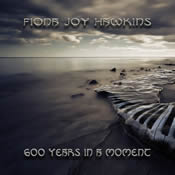
Fiona Joy Hawkins: 600 Years in a Moment

hawkins_600In presenting an “exploration into time and history” to her listeners, Fiona Joy Hawkins employs a broad, global array of instruments and an all-star roster of contemporary instrumental talent. Will Ackerman (who also produced the disc), Philip Aaberg, Eugue Friesen, Todd Boston, Tony Levin, Charlie Bisharat and others accompany Hawkins, who steers the voyage from behind a handcrafted Australian piano. Celtic influences weave through most of the work, but all the world flavors come through clearly, courtesy of flutes, whistles, strings, didgeridoo, a shaman’s dream’s worth of percussion, woodwinds, and guitars from just about every point on the planet. These 12 tracks are washed through with equal parts melancholy and romance; they are vivid, heartfelt songs full of imagery and emotion. Hawkins’ piano playing is elegant as always; the sound of the Stuart & Sons piano she plays is rich and full, gently taking command of the ensemble but making sure each contributor shines through in the parts. When it plays alone, as on “Earthbound,” or more lightly accompanied, as on “Forgiveness” where Paul Jarman softly lays in lines from a Chinese bawu, the instrument’s simple beauty and soul-touching resonance is highlighted. But it’s the ensemble pieces that set your spirit flying here. I particularly like the tracks that heavily feature the strings, so I’m in heaven when Hawkins is surrounded by violinist Rebecca Daniels, Dave Ellis’s double bass, and deep cello from longtime Paul Winter Consort member Eugene Friesen on “Antarctica” and again on “Ancient Albatross.” I like the way “Running On Joy” appropriately alters the mood, swinging into an uptempo space. Michael Jackson barks out didge notes while Levin and Ackerman take double duty on bass guitar.  Heather Rankin’s vocals here are smooth as silk and sweet as sugar. (Dear Athletic Footwear Companies: Here is the music for your next commercial.)

600 Years in a Moment is a breathtaking New Age-style album that will surely end up topping every Best Of list in that genre this year. With Ackerman handling the production, the sound is flawless. This is a vibrant, breathing album that’s the perfect accompaniment for every sunset or quiet evening. It flows seamlessly, shuffles itself nicely, and finds a new way to move you with each song. A genuinely brilliant work.

Available from Fiona Joy Hawkins’ web site.

Bronsense: Bronsense

bron_bronOn his quick-hit debut, Bronsense (aka Bron Halpin) churns out five minimalist experimental electronic pieces. The sense is of a guy and his gear creating in the moment, of the twisting of knobs and tapping of laptops, of giving genesis to odd sounds and tying them together. In spots, it’s cacophonous. In others, it comes across as comparatively more thought out–even if it’s still a bit jangly and odd.  The first track, “Introducing,” isn’t truly representative of what follows. It’s 50 seconds of garble, basically. But then Halpin kicks into the first of two long tracks (“long,” at seven minutes, being a relative term) and shows what this is really about. Resonant bass tones, long droning pads and endlessly looping samples blend with a wide selection of electronic squawk, and the mess takes on its own distinct groove. Further along, “Taps” wraps the listener in swirling drones in Bronsense’s closest approximation of an ambient piece. “Xmas Pud,” the other long piece, is a warped landscape carved out of distorted vocal samples and more random electro-clatter. Again we get something that’s a bit crazed, bordering on random, but which works itself into a hypnotic form with the essence of a catchy hook. Odd but effective. On the other side, there are those more noise-oriented things that don’t resolve themselves quite as satisfactorily, like “Plucks,” which wanders aimlessly by over the course of two minutes. It’s a bit like watching a drunk guy stumble down your street. Or the even shorter “Freak Out,” which simply lives up to its name and, really, seems to only exist to fill up two minutes. Luckily, these are the exception rather than the rule. Bronsense is never entirely accessible, and it’s firmly tethered to its experimental mindset, but given a chance, its weirdness and noisiness can work themselves into a pretty interesting listen. Not for everyone, but it will probably surprise a lot of people.

Available from Bandcamp.

Tom DePlonty: Music for Michael Skrtic

deplonty_skrticI will be honest: the tangly, jittery, avant-garde “fanfare in an unconventional tuning” that opens Music for Michael Skrtic almost had me running for cover. Here, obviously, was another of those albums that make me feel that I don’t understand the first thing about contemporary composition. Luckily, this was about as far afield as Tom DePlonty gets on his latest release and the five remaining tracks, while employing some interesting sound-sources and built on somewhat experimental structural choices, feel more approachable. Coming out of that first track, DePlonty heads in the extreme opposite direction with “La Petit Sonnerie.” Barely audible at first and never raising above a whisper, these stretched and looped recordings of “harmonics and other mostly unconventional sounds” from the piano form a graceful drone. At eight minutes it’s the longest track here, and it’s eight fully meditative minutes. I find myself turning the volume up in order to more fully catch the slow shifts and light layering at play. And I’ll be a nice reviewer and warn you that you will jump when “On A Phrase by Brahms” leaps out of the closet at you while you’re still in your Sonnerie reverie. Backwards samples spin into a hypnotic wash. Spatial processing toward the end gives it a slightly vertiginous edge. “Flame Hand,” with just three instruments, presents a hushed palate-cleanser of sound, a surprisingly simple piece of work amidst the more challenging thoughts. “Letter and Word” churns dreamily toward the closing track, “La Grande Sonnerie,” where DePlonty creates a musical visual of the inner workings of a watch, “gears of different sizes, spinning in different directions at different speeds.” Here he heads back into more a complicated structure of intersecting tones and rhythms, recalling the first track in its glitter and clatter but possessing a more controlled character. Though the piano lines swirl around your head, there’s more of a sense of them all heading in a similar direction, the interdependency of precision clockwork.

Music for Michael Skrtic is inspired by the surrealist painting, by Mr. Skrtic, shown on its cover. Appropriately, the music here skips through several dreamscape-style concepts, taking those random-yet-connected leaps of thought our subconscious mind is prone to. DePlonty advises on his site that there are connective threads running throughout; of this I have no doubt, though it would take a more compositon-oriented mind than mine to tell you what they are. As a casual listener, once I’m past that first track (and I’ve gotten more used to it), I find the diversity of this release very engaging. DePlonty always has interesting things to say in his music, and I am always willing to listen–even if I can be a little tentative at first.

Available from Camerata.