
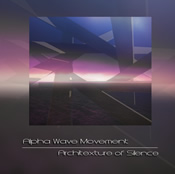
 Alpha Wave Movement (aka Greg Kyryluk) has been a consistent yet consistently quiet name in the ambient/spacemusic scene since the mid-90s. I feel like AWM slips under most listeners’ radar, and this is a shame because he’s an artist who should not be missed–and that is firmly proven on his new release, Architexture of Silence. Doled out in five mid-length movements, this release serves up classic spacemusic with Berlin School undertones to take the listener on a quite comfortable, very laid-back voyage. Kyryluk’s sound is warm and soft throughout. His graceful pads and silky arpeggios trace glowing lines across your mind’s eye, laying out arcs which he then anchors with solid bass sequences. Tempo shifts are handled with the utmost skill as Kyryluk gently guides the throttle without a hint of hurry or turbulence, and the balance is superb. There are long, hushed and thoughtful passages where we drift through space; there are brightly twinkling, wonderfully analog-feeling spaces, exemplified Movements II and IV; and there are hefty, sequencer loaded runs such as Movement V, which rises out of calm pads to pick up a dose of pure energy and ends up playing out like a perfect homage to the EM pioneers of yore who first charted these spaceways and described their vistas.
Architexture of Silence is one of those releases that reminds me why I fell in love with this music in the first place. I like its subtlety; Kyryluk keeps things on the quiet side, letting the simplest rhythmic elements nudge the intensity of a piece to take it from ambient drift to light, spacey groove. The flow is impeccable, and turns the disc into a seamless voyage that you just don’t want to end. When he does opt to actually ramp it up in the middle of Movement V and heads into solid Berlin territory, it’s loaded with a great nostalgic resonance, every metallic, twanging sequencer angle and low-end bass thrum firing like memory. He builds to this point throughout the disc, and when it arrives as the payoff, it’s excellent. I’ve had this release looping for hours during my review listens, and it’s a pure pleasure to hear again and again. It’s full of dimension, it’s technically gorgeous, and it showcases the absolute talent that is Alpha Wave Movement. Go get this.
Available from Harmonic Resonance.







 A three-part suite of long-form techno-industrial pieces inspired by Madeleine L’Engle’s A Wrinkle in Time series? Yes, please. On Madoc, Disparition (aka Jon Bernstein) uses the repetitive structures of minimalism and the driving beats of techno/trance music to wrap the listener in a heavy density of sound. Which would be pretty good in and of itself, but instead of stopping there, Bernstein sets your head spinning with his hypno-spirals, then laces in some surprising turns. For example, there’s an acoustic guitar, with a delicious Spanish flair, that pops up after a steady storm of drone in “Charles Wallace.” In the 40-minute epic “Echthroi,” a rush of piano sparkles in the flow for a few minutes, a hustling minimalism that sounds like what would happen if Phillip Glass felt it was time for a little jazz-flecked house music. The title track begins and ends with ambient structures that are comparatively calm–though still edgy, particularly at the end. They roll on, hushed and floating and whispering their way to the finish. Throughout, Madoc is driven along by a thick, techno-style beat that, it seems to my ears, doesn’t change tempo that much, if at all. And this is a good thing. It comes and goes, sometimes altering its identity slightly in terms of what it sounds like, but the pace of it remains steady. When it drops or fades out you continue to feel its influence for a bit, and when it resurfaces, it’s like picking up where you left off. This really comes across in “Echthroi,” where Bernstein has plenty of time to shift and re-shift, to pull us in and out of mutations of the concept. However he morphs the general structure, from those raspy drones to bass-drum-loaded pulses to one great stretch that speeds along on vibraphone-like chimes, the beat comes back as the constant. It’s this, combined with the come-and-go from acoustic elements as identifiable anchors in the swirl of drone, that has allowed Madoc to absolutely hypnotize me on quite a few repeat listens. I keep coming back to it because I’m sure that the inevitable mental haze it induces, I’m probably missing something–and I want to hear it all. You will, too.
