
 The first words that come to mind regarding Songs from Unknown Territory are: sparse beauty. Steve Brand uses a quiet voice as he lays out these six tracks that describe places that are vast, alone, abandoned, and perhaps just a touch desolate—yet still retain their own uniquely fascinating quality. In capturing them, Brand sticks largely to a very airy kind of structure, relying on whispering pads, slow tonal changes, and a sonic focus that nudges almost everything toward the background. Cinematically, it’s a series of wide shots that embrace the scope of the landscape and, rather than moving, use a static focal point to allow us to stare and fix our gaze on whichever parts of it pique our attention. Much of the album has a cloudy pall over it, a suggestion of nascent darkness that never fully arrives. It is the sense of being alone in these places and thinking of their ghosts. Deep, exhaling pads push a chill wind over the opening of “When I’ve Left Behind All That I Was,” with Brand allowing them to stretch and shift patiently. The tone changes, more than once, bringing in brighter tones, like a wash of unexpected sunlight between the clouds tracing its way across the landscape, before turning back through weighty bass sounds that rumble and hiss. To me, it speaks of passage. Brand throws in an interesting turn mid-album, when “Some Are Things of Substance, Some Are Not” suddenly offers up guitar tones. I don’t think it’s a coincidence that they enter pretty much in the middle-most part of the middle-most track. Just a small melody, played among the pads, but a real ear-catcher—and nicely placed. It fades into a rising tide of tone and texture in a passage that makes me need to stop and listen deeply. Darkness falls at the outset of “The Pause Just Before the Great Exhalation,”
expressed in heavy, rolling low-end tones and a kind of dank-cavern atmosphere. Sit tight, though—it’s another track where light arrives in higher registers and a broader openness of sound. Of course, not Brand album is complete without flute. We get just a touch of it in its unaugmented form, coming in on the title track, which opens the album. I like the style of playing he’s come to favor, which skews toward being sharp and breathy, with a sense of urgency behind it.On this track it heightens that sense of being slightly unsure about coming to this abandoned place, and sets an overall tone for the songs that follow.
Songs From Unknown Territory is a deep-listening album. Though it ventures toward weight and shadow, it remains quiet meditative. Brand’s flows are richly layered, shifting constantly and gracefully. Another superb addition to a growing and always impressive catalog.
Available at Bandcamp.
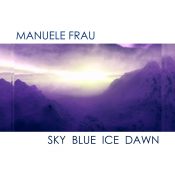 In under half an hour, Maneule Frau manages to tap, ping, and punch every old-school electronic-music pleasure center I have in my brain. With star-vista drifts, high-energy constructs, lattice-work sequencing, and every textbook genre example firmly in place, Sky Blue Ice Dawn is a seamless joyride through well-trodden musical realms. There are four tracks, one for each word in the title. “Sky” takes a minimalist route, layering and re-layering a repeating phrase into a hefty sonic wall. The build is reasonably slow, but very potent, and by track’s end you are completely immersed in it. Seemingly simple, but effective. “Blue” is the album’s most Tangerine-ish track, a pleasure cruise of a thing with bouncing, shiny sequencers that rise up from a very subdued pulse. It’s picture-perfect Berlin style, and all your favorite tropes are here. When it hits full stride, it’s got energy to spare—it’s just good old-school fun. On “Ice,” Frau begins with airy drifts, then taps the throttle a little to energize a groove that finds high, sighing synth lines circling over muscular sequencer structures and electronic percussion. He throws in a touch of distortion to give the lower end a hint of rawness and aggression. “Dawn” also opens with long ambient pads, then spreads out into sequenced territory. This piece is anchored with fantastic blobs of low-end notes that remind me of Giles Reaves’ work. Their spreading, liquid character contrasts nicely with the bubbling lines above them for more of that fast-and-slow dynamic. It kind of sums up the things I have long loved about this style.
 Just based on time and circumstance, I have listened to the debut release from 21st Century Bard (aka Sam Bardin) somewhat more than I usually do for a review. And while I haven’t minded the multiple listens, I also find that it’s never left a deep impact on me. It cruises along from the spacey churn of “125.36±0.41GeV,” and while it could be considered a good thing from an ambient music standpoint, this fairly hushed track melts into a back-of-mind thing before too long and it’s not until I’m a few minutes into “Dali-esque Tundra in Darkness” that I become aware that I’ve moved on. That second track suffers from a bit of an identity crisis. It starts out wanting to be a guitar piece — or at least one that takes a lot of interest from its guitar lines — then eschews that and focuses on its undercurrent of warbling synth notes and abundant electronic twinkle. And while the latter half is fine, the sharp rawness of the guitar sounds are what work to make this piece stand out. Bardin locks me in for a while beginning with the slow floater “Influx of Waves.” It’s straight-up spacemusic, built on oblong pads and ample spatters of electronic starlight. It eases into the catchy minimalist groove of “Quantum Escher.” This charming piece chugs along on a repeating line, with vocal-sample song lines rising to the surface here and there. I like that those moments are kept brief, and just lift the emotion and deepen the experience for a few moments.”Liquid Dynamics” brings me in with appropriately watery, wavering weaves of sound. Bardin uses light clattering noises, hollow like glass spheres tapping against each other, to add texture.
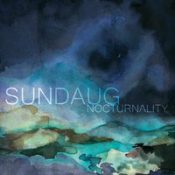 Take the clean, honest, up-close-and-personal feel and technical playing excellence of your favorite Windham Hill-era acoustic guitarists and add a light touch of electronic strings. Now you have Nocturnality from Philadelphia-based artist Sundaug (aka Stephen Bonitatibus). On his second outing, Bonitatibus lays down pieces that just make me want to kick back with a Sauvignon Blanc and watch the sun go down. He’s found a great, relaxing match-up here, keeping the crisp fingerstyle guitar front and center, as it should be, and relegating the other sounds to the background where they become a smoothly shifting scrim for our mental imagery. Comparisons are naturally going to arise, so let me suggest that Sundaug’s style blends the laid-back, rocker-on-the-porch folksiness of Will Ackerman with moments of Michael Hedges’ “let’s use the whole guitar” approach. Harmonics ring and body taps bring in moments of well-placed percussion. Piano finds its way into the mix here and there, as on the bright and cheerful “Chasing Angels.” The piano is given a couple of spots to come toward the front, but never takes over. It just adds its voice, says what it needs to say, then steps back. It plays a solid role in “Desert Oasis” as well, a song that has a rich ensemble feel to it while showing off Bonitatibus’ ability to nail the flairs and flurries of this style. On “Mount Olympus,” we get a feel for his hand at crafting big, full pieces that take advantage of the symphonic side of the electronic part of the equation. It swells in spots to fill the air, and the guitar rises in intensity to meet it. The real joy in this album is listening for the trills and runs and acoustic pyrotechnics of a talented artist at play–like the little twisting scales and the punctuating ping of harmonics that made me smile when listening to “Summer Rain.”
 In my previous outings into the sound worlds of Off Land (aka Tim Dwyer), I saw him as a purveyor of quiet drone-sculpted spaces and deep textures. Which is part of what makes Afterglow such a surprise and an excellent release. Here we get a somewhat different Off Land, or at the very least an Off Land who’s decided to go play in a different sandbox for a bit. Which is not to say it’s better than his beatless works. Rather, it’s another great case of an artist stretching his craft and hitting a fresh mark. The difference sets in straight away, with the world-music overtone of “Zodiacal Light.” Its easy groove, gently tapped percussion, and well-placed bird-like squawks create a cool tropical feel, somewhere green and shady and gloriously overgrown. Dwyer also plays with classic EM and Berlin School styles several times on Afterglow. “Subtypes” locks down a low-volume sequencer line, then traces floating melodics over the top. Chime tones sparkle across the space, and a heavily echoed and subdued vocal drop slips in for extra interest. “Pulsar” sets up a swirling spiral of sound, then slyly slips in a beat and a sequencer line. The build on this track is excellent and evolutionary, with each new element really ramping the piece. It leads into “Radiance,” which matches a chugging sequencer with round chime tones and rise-and-fall pads. The contrast works well, with the chimes never trying to match the pace of their accompaniment. The ambient and spacemusic side of things gets its moment on “Photosphere” as Dwyer lays down long, large-scope pads with a distinct dramatic flair. A manipulated vocal comes in, raw and distorted, as if to denote the point here he starts to smoothly nudge the piece into a slightly different shape. Without leaving the spacey side of it behind, Dwyer folds in new textures to keep your attention focused. (It’s easy to lose your way in such a hypnotic vista…)
 Let me start by confessing that I tried reading Joe Evans’ explanation of what’s going on in Elemental States, and it got a little music theory-ish for this simple reviewer. He notes that he’s interested in “…the idea that intervals based on the same prime number may have similar characteristics in the way that they are interpreted by the mind. For example 5ths, 4ths and 9ths sound similar, having a structural or even an architectural quality and all share 3 as a common factor.” Still with us? Okay, then you may be ready to dig in to this blend of sounds created with metal or glass household objects, paired with field recordings made over the last 30 years, fitted into this mathematical framework. From my earlier encounters with Evans when he was recording as Runningonair, I’ve understood that he always comes at the work from a mathematical/theoretical side, then uses his findings to create something both challenging and listenable. On Elemental States, I wonder how well he’s hit that second mark. It’s challenging, but for me, not entirely listenable. Relying heavily on soft chime tones and field recordings, the work does take on a drone-like quality. But, as on “Water – 5- Liquid,” which has the chimes and, as one might guess, the sound of a running stream, it also becomes a bit too repetitive. For me it feels like from a the standpoint of supporting Evans’ theorem it’s probably going well, but I can’t escape the thought that I’m listening to my garden wind chimes. It doesn’t abate as the album moves into “Air – 3 – Gas”; instead, it trades the water sounds for a rush of wind that I initially mistook for some kind of quieted-down industrial clamor. “Aether – 11 – Virtual” works best for me. It’s the one track here created “synthetically” as opposed to using those analog household sources. It is a quiet, humming ambient piece that warbles slightly to create a warm and misty flow. Ripples in the flow rise up as it goes, the agitated curl of an electronic wave. It may very well f0llow the same path of repetition as its kin, but it may be that whereas it’s already a drone as opposed to a more organic tone, the pattern becomes less obvious.
 Joe Frawley uses music to show us visions through a fragmented lens and tell us stories where the pages have been torn and put back together in more or less the right way. On Cartomancer, the subject of the story is 19th century American astrologer and mathematician Olney H. Richmond, who devised a complicated methodology of using a deck of playing cards as a divination tool. Cartomancy has its followers to this day. Frawley interprets the tale via piano, mostly unaccompanied but placed in the midst of an atmosphere of manipulated sounds and his signature vocal snippets. The work is beautiful and haunting.”Arline’s Dream” opens the album firmly in familiar Frawley territory: bright piano, a moment of a woman’s voice, a snippet popping in as punctuation, a bold, heavy strum across piano strings. The narrative gets set here as we hear the woman turning our cards and explaining what they mean. (As one note of dissent, as is often the case, I could really have done without the sound of a crying baby.) The changeover to the lonely sound of the echoing piano in the title track, which follows, is particularly effective for the way its open, simple sound contrasts with the clutter of impressions that preceded it. Frawley plays with a core of one phrase and works in spirals around it. It’s a lovely solo piece that uses the instrument’s own resonant sound as fill. Frawley does a lot here with just the piano, or barely accompanied piano. On “The Magus” it pairs in a dramatic duet with ambient guitar textures from Greg Conte. The piece has a nice, improvised feel in places as the two trade phrases. The piano part feels like a sonata that takes on the occasional jazz frill. Each new chapter in this story gives us a new texture. “Trident and Pearl” has an Asian undertone, with plucked strings like a slowly played shamisen. Heavy, dramatic chords open “Upon this Rock…” and Frawley throws in a ringing hum like someone running their finger along the rim of a crystal glass, the jarring thud of something hitting the floor and bouncing, and an insectile buzz of string sounds. It’s ominous and weird and thematically potent. The kaleidoscopic dreamscape feeling returns for “The Mystic Test Book, or the Magic of the Playing Cards,” with more vocal drops and snippets coming in and out, and the piano speaking in short phrases. “Leda and the Swan” comes in honking and flapping courtesy of field recordings. We get more of Kay Pere’s melodic, almost ghostly humming, and Conte streams in his lines to add a slightly discordant edge.
 Hello, math. I mean the equations, algorithms, and conceptual thinking of prog rock. Once you’re about a minute and a half into the first track from SONAR’s Black Light, the notes start getting algebraic, multiplied by funky time signatures and raised to the power of King Crimson. From there the numbers remain fairly the same with a few variables thrown into the mix, and if you’re very into a Fripp-esque angularity and complexity, you’ll likely devour this album. Guitarists Stephan Whelan and Bernhard Wagner trade licks and leads while Christian Kuntner on bass and Manuel Pasquinelli on drums form a tight rhythm section. Much of the album sticks to a similar pace, relying on technique rather than pyrotechnics to try to hold your attention. “Enneagram” ramps up slowly, and is constantly in danger of seeming too static. It runs nine minutes, and spends a lot of that on large chunks of repetition. The way the individual lines are brought together is interesting, but not for all nine minutes. The title track kicks off with a bit more energy, but soon falls into the same situation. I know that there’s higher compositional thinking at play here and I might be missing some subtleties of music theory, but by mid-track I find myself wishing they’d get on with it. “Orbit 5.7” makes for a nice departure, slowing the pace down further and bringing the jazz feel up. It’s a carefully metered piece, mostly lacking flash but making up for it in the super-tight adherence to its crisp underlying angles. It’s like an exercise in how intense the ensemble can make something without straying too far from a distinct line of thought. One thing that stands out for me on Black Light is the way Kuntner’s stalking, bestial bassline puts an incredible amount of weight into the closing track, “Critical Mass.” Late in the track he uses it to set up a pulse-like thump and has a conversation with Pasquinelli—but again, as much as I like the moment when it arrives and although it does change up as it goes, it wears out its welcome.
 Some albums are worth waiting 10 years for. When Manitou’s All Points North came out around 2005, I was smitten with its washed-out, unhurried textures, stretched melodies, and overall sense of thoughtful calm. Plus, there was an air of mystery about it, as the label insisted that Manitou did not wish to be identified. Ten years on, it’s more of a known thing that Manitou is an alter ego of the very talented Matt Borghi. In this guise, he creates lush guitar ambient paeans to the memories of a Detroit long gone, captured here as Landscape Histories and Sentiments. The Manitou sound is like the whisperings of a ghost, breathy and melancholic. It is both warm and misty, and holds closely to the Eno-esque ideal of being engaging whether you’re actively listening or not. Borghi streams long, patient lines out of his gear and molds sets of textures. It could be the dark, metallic droning of “Zum Island Hums Beneath the River’s Current,” the hypnotic steadiness of “Last Cry of the Seven Sisters,” or the haunting keen and distant bell-like tones of “Keep the Lake Francis Light Burning for Me.” Although each feel similar on the surface—that hushed, stretched, airiness—each has its own distinct character. There’s definitely a minimalist mindset at play, that deceptive surface-level simplicity that drone work can show, but which goes away in a focused listen. Borghi builds and layers and deepens everything here, but does it with without rippling the surface. From the first note to the last, Landscape Histories and Sentiment is content to tell you its story in a low, assuring voice. I have mostly listened to this as an open-air loop, happy to let it change the atmosphere and mood, but pop on the headphones to really appreciate the slow-motion construction at work.
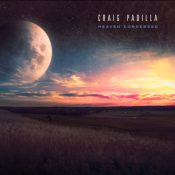 Two short pieces and two long excursions make up the floating, flying, edge-of-space pleasure that is Craig Padilla’s Heaven Condensed. Packing more than its share of pedigree-worthy old-school style blended with the ethereal, twinkling tropes of classic spacemusic, this is an album to put on and get lost in. These are the kinds of vistas Padilla explored in his superb trio of discs with Zero Ohms, and for me it’s become a release I put on quietly and just let it cruise around me. Which is not to say you shouldn’t be diving as deeply as possible into it; quite the contrary. Padilla skillfully piles and weaves his layers, and laces in a considerable amount of tiny detail work, so headphone listening reaps delicious rewards. There’s a balance at wotk on the album. The shorter pieces are more dynamic, driven onward by meaty, twanging, low-end sequencer pulses. These are where Padilla revs up the engines a little, getting us to escape velocity. It’s a comparative dynamic; we’re not talking about high BPMs or loudness, it’s just more beat-based than the long tracks. Those, both clocking in at about 28 minutes, are the points where we gape out the windows at the universe around us and try to take in the amazing view. The title track winds its way down to an incredible softness, nearly subliminal in places. Padilla gracefully lays in melodic elements in chime tones and electric spirals, creating moments of absolute beauty. I find myself stopping whatever I’m doing to just close my eyes and listen. “Heavenly Sails” opens with twisting skeins of analog sound launching across the space before settling in. Later in the track, piano arpeggios gleam brightly against the starscape, augmented with a complementary bass phrase and bolstered with angelic pads. Bordering on symphonic electronic, it adds an extra shot of romance to an already vivid scene. Both of the longer tracks have their own internal dynamic; they’re not just big, spacey pad outings. They change form, add some sequencer here and there, rise slightly in density and intensity, and settle back into the hush of a stellar wind. And it all happens smoothly and naturally, courtesy of your pilot.
 Hypnagogue Music Reviews