
 As I was listening to WAsteland ElectronicAH Vol. Too ~ Ambient(esque) Musics for Your Lucid Coma, I found myself constantly wondering if the tinny and slightly clumsy construction of some of the pieces were on purpose or the sign of someone perhaps less adept at the craft than a listener might hope. So I headed over to Micah Cone’s Bandcamp page where I read that these songs were “Created on a 2009 MacBook Pro utilizing Garageband and its Musical Typing feature.” Mystery solved, and now I better understand why I’m not overly interested. There’s nothing all that objectionable here, but I find that the pieces hold my attention for a couple minutes at most before I want to move on. There are very listenable moments—Cone hits it squarely on “A.% (Gravitational Intolerance)” with a blend of wobbly, lonely bass notes and a quietly singing synth line placed over the sound of a Rhodes electric piano. I like the way he metes it out slowly, with the synth taking a more vibrant line. He sends the Rhodes bouncing between left and right in a way that’s mildly dizzying but acceptably so. “A.# (150,000-Light-Year-Long-Lightning-Bolt)” grabs my attention at first. It’s very subtle, with a catchy melody over humming electronics. It loses me a bit when the tone switches up and Cone brings a sort of silly-sounding synth to chirp out a passage. “A.^ (The Low-Hanging Fruit of Knowledge)” is addictively fun—again, at first—but unless you’re a huge fan of chipset and video game theme songs from the 80s, the fascination will probably wear off well before it runs its almost-10-minute course. For those first few minutes, though, its jaunty tone and meaty bits of bass are engaging.
I understand that the whole old computer and musical typing thing is meant to be the hip draw here, but irony only goes so far. If the music doesn’t hold my attention once we’re past the curiosity stage, what’s left? I hear a lot of elements I like on this release, but the approach and Cone’s tendency to spend more time on a piece than it needs just makes me shrug. Give it a listen for yourself.
Available at Bandcamp.
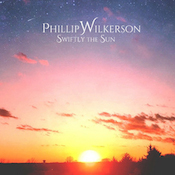 I admire artists who choose to challenge themselves, who don’t allow themselves to sit in the same spot doing the same thing. It can be a risk, but there’s also a strong chance of a fresh new reward—for the listener as well as the artist. Phillip Wilkerson’s Swiftly the Sun represents an artist taking that kind of chance. Looking to explore new modes of electronic expression, he says, “I simply cast my creative True Self adrift to produce whatever came of its own making.” We, along with Wilkerson, now get to enjoy the rewards of his risk. Swiftly the Sun doesn’t seem to go too far afield of the artist’s general motif. He has always been one for soft pads and slow melodies packed with emotion, and that plays out here. But there are moments of experimentation, some subtle and some not, that will take long-time Wilkerson fans (such as myself) into interesting new concepts. Jumping straight to the front of that line is the standout track “Calm.” The title is a lie, by the way—this song has kinetic energy to spare, doled out in chunky doses of spiraling, dervish-like synth lines. Whether this is Wilkerson playing his trills straight and then manipulating them or it is him fiddling with the knobs to spin and twist these lines, it’s absolutely captivating. It works its way up into a feel almost like a jazz combo where the rhythm section lays down a steady, unchanging melodic base while the synth lead just goes gorgeously off into an inspired jam. I could plug this one into my head all day and be happy. It hits me spot-freaking-on. Maybe it’s because I love an old-school sound, but it’s also probably because it just works. “Vanishing” plays with chime tones that ring out over a quiet base. It’s a familiar juxtaposition, and here, between the lush drones and the repetitive nature of the chimes, it has a light hypnotic effect. There are plenty of quiet spots here as well, and Wilkerson nails them, as usual. The opener, “And Lilacs Too,” offers a piano melody that walks past misty pads. It is patient and emotionally descriptive. “Ways of Forgetting” is 25 minutes of pure ambient immersion. Long pads mingle like clouds and nothing is raised much above a confident whisper. Like meditating? Here’s your soundtrack. It’s full-on calming, slows the breath, and sets time aside. It’s not one of the out-of-character track here, but it’s a track that reinforces why I enjoy this guy’s music so much. The release closes with “Beyond the Farthest Horizon,” another slow-motion drift with a faint touch of melancholy. It has a certain spacemusic mentality to it, but feels more grounded, more like a captured quiet moment stretched out for us to examine in our good time.


 Hypnagogue Music Reviews