
 Troubled Mystic is a deck of musical cards, each one its own kind of cool. Overall the tone cleaves closely to an EDM/downtempo motif. You’ll hear distinct elements of house music, jazz-infused drum licks, a touch of glitch, and club-worthy drops. Right from the opener, “A Love Song for Ghosts,” Liminal Drifter (aka Dr. Simon Order) grabs the listener by managing to mix a jangly sound like a Japanese biwa with a little bit of spy-movie vibe and making it sound like it all belongs there. The mix of styles shows when “Subway Dream” follows with a watery burble and soft, cool edges. This one gets deeper and more intense as it goes along, the sound thickening up with a wide variety of elements. “Verterons Ambo Flow Cut” introduces some electronic minimalism, loops of repeating phrases interspersed with sequencer. Its slowly shifting, just-enough-movement dynamic works in its favor. Hypnotic and yet able to hold your direct interest. “Japanese Devotion” is a bit of playful weirdness. Boppy notes bounce along, accented with reverse-echo phrases that put me in mind of the 80s band New Musik. (Yes, I may be very much alone in that reference.) Speaking of the past, “Adventures Beyond the Body” will pique your old IDM memory banks. Field recordings and dubbed-up vocal snips are the canvas for a melody that plays out in metallic-spring tones and shiny sequencer runs. Irresistible stuff. Throughout the album you’ll enjoy an extra dose of mellow courtesy of dreampop vocalist Chloë March. Her smoked-satin voice slides and glides through the club-ready “Heartbeat of Your Soul.” Order wraps her voice in light, effective echoes and puts drops in spots where the last element you get is her voice fading. She sing-talks her way through the title track and pulls up welcome thoughts of Moorcheeba. Again, Order pulls spots and phrases out of the main vocals and uses them the spice the background. There have been times, in my several listens, when I become too aware of the looping/repeating motif that forms the basis for much of the work here. Why it occurs to me sometimes but not every time is a mystery to me. All I can suggest is that sometimes I’m drawn more into the smooth hypnotic lull, which is the point after all. It certainly hasn’t kept me from digging on this release every time I’ve listened. It’s varied enough to hold my interest and certainly doesn’t lack for cool. The production work is also excellent; the sound is full and in constant motion, with plenty of small detail work to keep your head happily busy. Get this, get cool.
Available from Hidden Shoal.



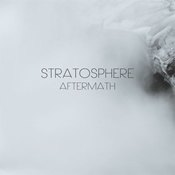 I think that the term “post-rock” tends to be overused sometimes in reference to melodic instrumental music with an edge—as if tossing vocals into the mix would let the piece shed its “post” manacles and just be rock. Aftermath from Stratosphere (aka Ronald Mariën) would certainly fall into that category. But if this is rock, it is rock at a slowed tempo, pulled into a soporific laze, like a patch of sun moving across the floor late in the afternoon, and occasionally shaken up with jagged lines. The guitars come in big layers here, piled into humming strata in varying degrees of distortion and texture. Singular elements, phrases just a note or two long, quiety assert themselves in loops against the droning atmospheres. Overall, the feel is warm and calm. Lush chords fill the air, gentle pick-sweeps across the body to send the notes shimmering off. That begins right in the early moments of “Accepting the Aftermath,” and forms a major part of the album’s sonic palette. In places, as on “The Search for Normality (Reprise),” Mariën brings in the sound of bowed strings. It adds a light orchestral tone and a pulsing rhythm to play against the washes. There is also gritty energy here. Toothy distortion spews off the guitar in “The Search for Normality” (not to be confused with its reprise!). It feels like Mariën is twisting his axe’s neck to wring the notes out of it, the resultant throttled noise buzzing in our ears. (You, like me, may find yourself checking your media player at the end of this track. I’ll leave you to see why.) “Confusion” changes the feel, entering on tapped notes that bounce back and forth and showing a certain tension at play in the harmonies and in the way the washes rise and shift, everything grabbing hold of the emotional power of minor chords. The closing track, “When You Think Everything Is Alright,” is surprisingly bright. Not that everything else is gloomy, but there’s an optimism in its voice that caught me a little off guard when I first heard it—and which I came to look forward to in later listens. The melody is very strong here, elements coming together in a sing-along tone and everything simply shining. Some might call it post-rock, but by the generalities of that term and the way this piece feels, I’d lean more toward post-folk. It’s homey and welcoming, then makes an effortless shift back toward distortion to create a great closing vignette for this hour-long ride.


 Hypnagogue Music Reviews