Algol, Goldilocks Zone

algol_goldi“On this album, we dream about extraterrestrial oceans,” says Algol, aka Daniil Kazantsev, and dream we do as we venture into his guitar-based ambient release, Goldilocks Zone. This is a weightless, glittering drift through spacemusic territory, coasting through Kazantsev’s slow-moving vistas. I find that I like this release more as a background listen than I do up close. Kazantsev’s layering is lighter than I usually prefer in works like this, but the feeling he conveys on each track is splendid, and the journey is deep and unbroken. For many of my listens, I have simply set it going quietly, whether in ‘phones or through speakers, and allowed it to just fill the space. Overall, the tone is warm as the artists explores his interpretation of that perfect spot in a star system, the Goldilocks Zone, where life (as we know it) might flourish. Expectedly, the imagery that comes through is lush and full of promise, consistently light and calm. And it’s all drift and drone, save for “Gilese 581e” where he gives us a more solid version of his guitar work, picking up the standard trope of a phrase repeating quietly over clouds of sound. Perhaps needless to say, Goldilocks Zone loops seamlessly. I could see this being used as a backdrop for meditation or for playing while sleeping. Personally, I’ve let it take me through an entire workday, and gladly so. No bumps, no rough edges, just an hour spent dreaming of the quiet lap of waves on those so-distant oceans.

It’s also worth noting that this release is the first to arrive on the freshly revived EarthMantra label. This off-shoot of Relaxed Machinery, under the guidance of Geoff Small, is off to a very good relaunch and its first releases are firmly in keeping with the quality lineup of Darrel Burgan’s original label.

Available at Earth Mantra.
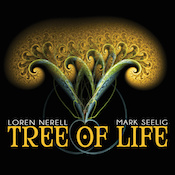
Loren Nerell & Mark Seelig, Tree of Life

nerell_treeDrawing heavily on Eastern influence and instrumentation, Loren Nerell and Mark Seelig’s Tree of Life wastes no time in sending its listener into a blissfully transcendental state. And a fine state it is. Over six mid-length tracks, the shortest running a touch over eight minutes, your mind is salved and soothed by bansuri flute, sarangi, tanbura, gamelan, overtone singing, and more. It is Seelig’s gorgeous overtone work that starts the process, rising out of a backdrop of nature sounds and a misty drone on “Wacah Chan.” This track runs 20 minutes deep and I would almost be content just to leave it looping. After Seelig’s voice has opened the space, he shifts to flute, accented by the crisp snap of tabla from percussionist Max Link. Link’s contributions are essential here, grounding the proceedings as the listener falls further inward. It glides perfectly into “Cintinmani,” the first few minutes of which are a showcase for more of Seelig’s elegant flute work. The sound here is clean and stripped back–nothing but an underlying drone, the flute and the drum, and the simplicity of it is where its strength comes from. When the overtone returns, it just vibrates your soul and moves you into a personal and sacred space. The tone shifts a bit on “Yggdrasil,” growing a touch more shadowy and earthy. Here we dig down to the depths of the spirit, the roots of consciousness, and it is warm and dark and genuine. The nature sounds return here and Link’s percussion takes the front. It’s more bass-oriented, harder and more primitive. Heavy drones, roughened at the edges, take on an animalistic feel. For me, this is the place I like my tribal music to take me–straight to the deepest parts of my primal mind. Sarangi from Pankaj Mishra comes in on this track, the vibrant cry of the bowed strings sharp against the thickness of the sounds around it. There is just so much dimension to this track as it builds in layer after layer. It grows to a savage crescendo, then literally crashes to an absolutely perfect segue. “Kayon” arrives on the calming sound of waves, a stunning juxtaposition coming out of “Yggdrasil,” but one that’s instantly effective. Our breathing slows, we welcome the softness, we are called by the chant that rises in prayer. Now it’s Nerell’s turn to step forward; as “Kayon” sways and floats, the crystalline chimes of the gamelan ring out, falling soon into a steady cadence–high, low, high, low–and shimmering with vibatro. It becomes a clockwork rhythm, a metronomic pulse for us to focus on as our breathing comes in line. This track will keep you well-hypnotized. I have always loved the near-dissonant voice of the gamelan, and it’s in full effect here. Mishra’s sarangi returns in a more prominent role on “Acacia.” It feels like it takes over that shimmer from the gamelan; the instrument’s wailing, ululating voice is a signature sound of Eastern music. Nerell anchors it with what sounds like the drawn-out tone of a harmonium, then secures it further with a drone on tanbura. This is the soundtrack to every film you’ve seen that opens on a wide shot of the desert–and it’s beautiful. Mishra draws out emotion with every pull of bow across strings. This is an incredibly spiritual track. It melts into the closer, “Arbor Vitae,” where we are caressed by Seelig’s flute singing a lullaby over the plush warmth of the tanbura and soothing nightsounds–crickets and (perhaps?) tree frogs. Seelig’s playing is impeccable here, a smooth dance infused with the joy of life. As the track closes, the urge to let this journey arc back around once more is undeniable.

It is completely without hesitation that I tell you that Tree of Life is THE best album I have heard in quite a while. It is a release I don’t want to stop listening to. It is superbly constructed and expertly produced. It is deep and true and organic and intimate and moving. Nerell and company give themselves ample space in which to lay out these gorgeous ideas, and then execute them flawlessly. Where it is energizing, it is completely so; where it is soothing, it is utterly so. Listening to this truly engages mind, body and spirit as one, and the journey is stunning. This is an album you cannot miss. A masterpiece.

Available from Projekt.

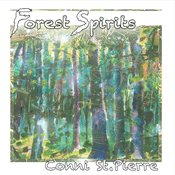
Connie St. Pierre, Forest Spirits

conni_forestSitting down to write about Forest Spirits, the third release in Conni St. Pierre’s “Nature Spirits” series, the first word that comes to mind is, appropriately enough, “organic.” I mean this partially in the way of the album flows, from the simplicity of unadorned flute on “Forest Light” through more complex arrangements featuring a variety of global instrumentation and then returns to the simplicity of the flute on “Roots Breathing Down.” But also, and particularly in the case of the flute pieces, I mean organic in a beautifully raw, wabi sabi kind of sense. On “Forest Light,” and later in “Snow Covered Branches,” we are given St. Pierre’s playing, miked very close and intimate. We hear and almost feel the drawing of breath and the hard puffs across and into the mouthpiece. Not every note is clean and perfect, particularly on “Forest Light,” and that in itself (to me, at least) makes it perfect. The feeling is bare and honest and elemental and hard-focused on the organic nature of the instrument. Across the rest off the release St. Pierre and some friends branch out, pun only slightly intended, to explore other themes. “The Clearing” uses a tremolo effect, like sunlight shimmering through the forest canopy, to underscore a gentle procession of flute with guitar from Pat Malla. This is my favorite track on this release, for its casual glide and lightly hypnotic air. Running a close second is “Branches Up.” This is a light, airy song driven by hand percussion and acoustic guitar. Phil Poirier contributes guitar and some gorgeous overtone singing to the mix. It’s just a smooth bit of feel-good groove. The guitar comes back in a heavier guise on “Lycopodium,” as Ted St. Pierre wrenches out big bass chords with a cool metallic resonance. They’re balanced nicely against a simple wash of drone, warm and quiet. Piano takes the forefront on “Leaf Shadowing,” its dramatic melody getting occasional assists from flute and Eastern-style strings. There is also a bit of Eastern flair on the delicate “Bend in the Wind,” which feels like a walk through a Zen garden on a chilly day. St. Pierre’s shakuhachi flute shares the lead with what I believe is a harp, doing its best koto impersonation. The way they dance around each other carries a hint of improvisation. Again, there is an interesting sense of intentional imperfection in some moments, the feel of two things just a moment apart from one another. Far from sounding sloppy, it’s integral to the soul of the piece. It’s a wonderful rawness, the moment accepted as it is. (I do recognize that this is probably a well-rehearsed and intentional aspect of the piece, but to my ears it has that roughened charm.) St. Pierre takes something of a risk with the closing piece, “Roots Breathing Down.” Here again is the flute, alone and up close in a long meditation. St. Pierre plays with dissonance and long-held notes. There are aggressive, low-end tones that drill straight into you to pull out a response. The feeling is intensely personal; this is her playing straight from her center, connecting breath to instrument to soul. It’s not easy to take in at first, but I find myself once more drawn deeply into the truthful rawness of the sound, the deep earthiness that ties so strongly to the theme of the release. It may not be for some, but the more I have listened to it, the more I’ve come to appreciate what St. Pierre is doing. Also, as noted above, this closes the circle nicely, bringing us back to the solo flute.

Forest Spirits is a fantastic piece of work. I love the way it moves from simplicity to complexity and back. St. Pierre is a gifted musician whose sound is full of soul and spirit. A must-hear release.

Available from Conni St. Pierre’s web site.

Mark Tamea, Atomism

tamea_atomI am going to have to assume that I am not in Mark Tamea’s target audience. His “electroacoustical experiments,” something of a mix of musique concrete and plunderphonics, have their moments but overall I get the impression that I am meant to stand back and observe the music rather than being involved in it. And then there’s that sense that I just don’t get it. Never comfortable with that. The sound-set in play is diverse, from clattering electronics to patient strings to manipulated field recordings. Tamea brings them together in what seem to be, and surely must be, deliberate motions, but the tendency to abruptly switch from one thought to the next, to create a hard juxtaposition to make a point, makes it difficult to stay with. That being said, the patient construction of “Niuafo’ou Soujourn,” where Tamea strikes hard chords and rides out the resonance, is excellent–perhaps because it doesn’t overplay its disparity. “Kitsunetsuki” catches my ear by feeling like the soundtrack for a butoh performance, dark yet rhythmic, shot through with bursts of frenetic movement and then lapsing into quiet.

Atomism is a challenging listen, and will only appeal to those whose tastes run deeply into the experimental. In listening to it, I can get the sense of Tamea’s compositional mindset and I like the depth of sound sources, but the execution doesn’t sit with me. I keep asking myself what I’m supposed to get from it, and I can’t answer it, personally. However, it’s a reasonably short release, just 44 minutes in all, and if you’re looking for a change of musical pace, I’d say it’s worth checking out to see if it works for you.

Available from Bandcamp.

Jeff Pearce, With Evening Above

pearce_eveningInspired by nights of stargazing near his rural Indiana home, Jeff Pearce presents his first ambient guitar album in over a decade. Using just guitar and processing for all its sounds, With Evening Above glides back and forth between earthbound melodies basking in a rich wash of reverb and truly ambient drifts composed of starlight and speaking to us of unimaginable distances. When I say “back and forth,” I mean that literally. The odd-numbered tracks are our solid pieces, the songs. The title track opens the release with crisp notes and bright harmonics. The reverb and delay on each note melts off into the background, the sound wash growing constantly and delicately denser, a mist of harmony supporting the melody.  The equation continues, altered slightly, on “A Clear Night,” “Ghosts of Summers Past,” and “A Closed Circle (Farewell.)” Each is unique in its way, charting its own course along looped lines and phrases. Each has a kind of bright touch of melancholy. It’s not about dwelling, it’s about remembering. It’s about looking back gladly. I think this truly comes to the surface in “A Closed Circle (Farewell).” It feels a touch more sentimental (and this, obviously, is a purely subjective thing), and will probably pull to mind some farewells of your own. The first very bright notes of “A Clear Night” head straight into my soul; the song itself is deeply affecting. If these tracks came one after the other, I think that their relative similarity–the tone of the guitar, the cadence of the melodies, the effect of the echo–might bother me. But Pearce is a smart man, so he separates them with lush drifts as deep as your favorite spacemusic pieces. It’s a testament to the power of processed sound that these four pieces sound like they could have come straight out of a synth. Knowing that it’s one guy, one guitar, and a bit of perfect timing–and having seen it done live–just amps up how good these pieces are. They’re also longer than their grounded counterparts, giving you more time to take it all in. Familiar elements get used perfectly: choral pads, long washes of sound, upward-arcing chords, all pulled together in classic rise-and-fall patterns. This is where we get that feel of the distance between stars, all the questions a deep night sky makes us ask ourselves. And, of course, it’s something you can just look into, aurally speaking, for a long, long time. With Evening Above closes with the 21-minute voyage “No Matter How Far.” This track alone is worth the price of admission. Along with the already established massive drifts of sound, there are passages where Pearce layers in a light sequencer feel. It’s dialed way back, coming in softly like it doesn’t want you to notice it at first–and you may not–but then settling in to texture the flow and to up the dynamic for a few minutes. It’s a nice touch, perfectly underplayed. It fades eventually, leaving us set blissfully adrift in the rest of this big, warm track.

If you happen to pick up With Evening Above, and you don’t immediately take it outside to listen to while doing a bit of sky-gazing of your own, well, that would be a mistake. This loop-worthy release captures the kind of inspiring natural beauty shown in its cover art, and, like all good ambient, offers us a path to bring us in touch with our own deep musings. The blend of hushed drifts and bright notes, of the sense of being here and going there, of active and passive, is balanced perfectly. Put it on, leave it on. A must-hear from a true master of the art.

Available from Jeff Pearce’s web site.

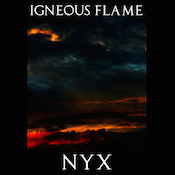
Igneous Flame, Nyx

igneous_nyxTaking advantage of the freedom from time constraints offered by downloadable music, Igneous Flame (aka Pete Kelly) provides two solid hours of brain-gelling ambient on Nyx. Right from the start this is big, densely layered work, a confluence of cloudy structures fringed in places with strong hints of darkness. Nyx exists, more or less, right at the edge of evening, a place where the light is certainly not its lightest but true darkness has yet to arrive. We’re headed that way, but never quite cross over in one direction or the other. This leaves us in a richly described world-in-between with two hours to carefully look around with our mind’s eye–and there is plenty to take in. The gentle dynamics of the compositions make good use of slow rises and equally slow falls, with the rises often swelling to a dramatic intensity. Here’s where you pause to take in the richness of it, the way it fills your head, the number of sounds coming together before they drift back apart. I particularly like this feel in “Zephyr,” and how Kelly infuses his thinner moments with a hiss of ethereal wind. Igneous Flame albums have always leaned toward warm tones, even when there’s a bit of nascent unease to the music, and that’s very much the case here. Choral pads moan across the sounds in “Night on Earth” like the chant of some forgotten religion. Electronic winds sigh and minor chords in low registers render a sinister edge. And yet, still, the softness of it all gives it a calming edge, or at least a touch of distance from concern. “Mysterium” opens with a mix of low drones and quiet clattering, then resolves into a mix of long, hushed pads. This is another near-dark excursion, with a title-appropriate hint of the sacred lurking at the edges. Just short of the four-minute mark, the textures ramp up briefly, just edgier enough than the rest of the sounds to really catch your ear. (Trust me: by this point in Nyx, you’ll be operating on a semi-subconscious level at best; your brain will be fully immersed.) “Gold Lion” feels like the brighter side of “Mysterium.” The choral voices again come in, but they ride on pads that bend upward. The piece is layered on top of higher-end sounds and chords that give it a shimmer and an aura of optimism. Kelly notes that in mixing down the album, he cut out a lot of the high frequencies, aiming to give Nyx a “softer” sound. Even prior to knowing this, I felt like there was a somewhat diffused edge to the sound, the borders encircled in a hint of fog. There are certainly no rough edges to be heard. Everything flows, and it flows with grace and ease.

I have existed within the wide boundaries for Nyx for hours. I have worked with it playing on loop in my headphones, and no matter where I came back to it, the sound immediately took me back in. I have slept as it looped, its gentle tones quite…hypnagogic. I have given it deep listens, and I have let it fill a space at low volume. It is yet another masterful work from Igneous Flame. It also marks something of a waypoint in the Igneous story; Kelly’s most recent work is taking him in a new “more (for want of a better word) ‘musical’ and structured” direction. He’s always been an artist interested in refinement and redefinition of his identity, so I’m looking forward to that. In the meantime, if Nyx marks the end of a chapter in this musician’s story, it is a very perfect ending.

Available from Lumina Sounds.