Deep Chill Network: Antarctica 3

dcn_antarc3With a long history and discography backing them up, it must be said that Deep Chill Network know their drone. Minimalist in structure but designed and layered for solid impact, DCN’s music demands and rewards a close listen. Such is the case on Antarctica 3. From tactile explorations of the world above the ice to snow-blind wanderings through absolute cold and walls of blowing snow, each expedition here exhibits its distinct character. “1937” opens the release with a classic ambient feel. It may be the most welcoming track, with a certain sunlight-on-snow glimmer. Lest you get too comfy, however, “1908” immediately assails you with raking, icy winds and edge-of-feedback tones that hit like sun glare. Things get heavy on “1897” and the 21-minute “1947,” points where DCN hit their most isolationist. “1897” throws up big ice-cliffs of densely packed sound, while “1947” takes its time describing a vast and inhospitable landscape. Despite the weight of these pieces, the persistent near-white-noise underlays that run through Antarctica 3 do their job to lull your brain into a slight and pleasant stupor. It’s that intriguing dichotomy, and its resultant chemical reaction, that is most rewarding here. You can be slightly discomforted by the tone of some of these pieces, but you will always be pulled fully into them. On the other hand, there are waypoints of solidity worked into the journey. “1917” comes in built on purposely clumsy piano notes that wriggle into backward echoes, and “1969” reaches out with its ringing chimes, their resonance fading back to mix with the background drones.

This is, no pun intended, a truly deep listen. Deep Chill Network modulate their layers, varying the density from the gentle hush of a snowdrift to the pure crush of an avalanche–and both sides of the equation work well. Come see Antarctica 3. It’s a dangerous journey, but worth it.

Available from Dark Duck.

Djam Karet: Regenerator 3017

djam_regenBless your funky prog soul, Djam Karet. With Regenerator 3017 you have given me my day-starting/fast-driving/chilling-out-with go-to album. Fronted by the guitar power trio of Gayle Ellett, Mike Henderson, and Mike Murray, who take turns firing off mad licks, Djam Karet hand out power-blues-marinated chops interlaced with moments of pure jazz. After the opening track, “Prince of the Inland Empire,” which I think is the weak link on the release (and which may also suffer from a touch of muddy sound) DK get down to serious business on “Living in Future Past.” It’s a killer jazz fusion romp with the players each stepping forward to strut their musical stuff. There’s no need to clap after each solo, but you just might. From there it’s full funky-ass speed ahead. I eat up the face-ripping blues-rock solos in “Lost Dreams” and “Desert Varnish,” where the fuzz is laid on liberally, and I’m reaching for the volume knob during the take-center-stage power-ballad pyrotechnics that roar up in “On the Edge of the Moon.” I do have to note, though, that the flute-sound (mellotron?) breaks that split some of the tracks don’t always work for me. They’re fine, but it sometimes feels like an art-rock indulgence. However, they pass and then we’re back into the shredding. Speaking of which, as much as I’ve had to say about the lead guitars, let it also be noted that Regenerator 3017 has ample stores of thick, meaty bass runs, courtesy of Henry J. Osbourne–certainly enough to keep this low-end-lover more than happy. Osbourne’s clearly got more than his share of funk in his soul, and it’s on display everywhere–particularly strolling around on “Wind Pillow.” Rhythm section accomplice Chuck Oken Jr gets kudos for anchoring this jam with steady beats and rich fills, bringing the thunder when needed.

Every time I listen to Djam Karet, I’m amazed that they stayed off my radar for so long. But man, is it a good time catching up with them. Thirty years on–and that would be the “30” part of the title–these guys are still stirring up some mighty chemistry and laying down fantastic grooves. Get this, turn it up, and bliss out. These guitars will do your soul some good.

Available from the Djam Karet web site.

Jalisco: Deserts

jal_desYou certainly wouldn’t know it from listening, but every sound on Deserts, the debut release from Jalisco, is made from processed AM radio transmissions. Musician Dave Bush manipulates his source material into wispy, long-hanging drones in a pair of matched-length (20:03) minimalist pieces. The work is appropriately sparse, almost to the point of seeming a little static at times. Bush overcomes this by occasionally folding in voices or gently ramping up touches of industrial-tinged rhythmic elements. Changes come like checkpoints as we’re guided across this to-the-horizon vista, and the slow-moving repetition that underscores both pieces does have a hypnotic quality to it. “Desert Two” has a slightly more dynamic quality to it at the outset, but before its halfway mark thins down to a steady low pulse that will absolutely nudge your brain toward flatlining. A repeating phrase on chime-like tones rises up to assist. Deserts doesn’t do much for me as an open-air listen. I’ve tried, but Bush has his stuff dialed so far down it doesn’t rise above background noise. This is much more of a headphone experience. It’s only there that you’ll get the full effect of Bush’s textural work. And, honestly, it took me a couple of listens to come around to the sort of patience I think you need to appreciate these two pieces. They certainly take their time, but in the long run they manage to be engaging. Strap up, settle in, and take the 40 minutes (and 6 seconds) needed to tour these Deserts. The view is pretty nice.

Available from the Jalisco web site.

Ludvig Olsen: Trip to the Sewers

olsen_sewerLudvig Olsen brutalizes sound samples in his new experimental outing, Trip to the Sewers. If you’re not into bent and mutilated noise, you can stop reading now. This release smacks of an art-school project, the kind of thing where if you don’t “get” it, that’s your shortcoming. I would say that this is far more accessible than his last release, Breathing Seagull, into which I had absolutely no point of entry. Here, at least, he’s infusing some structure in the clatter. “Deterioration” goes so far as to have the suggestion of a beat. The manipulated voices upon which he heavily relies are put to good use. They yawn like strings, growl like beasts, and wrap themselves into semi-identifiable shapes while still being aggressively alien. There are passages packing dark, industrial tones, like “Night Soil.” Here, feedback is partly tamed and laced through what’s either a field recording or modulated static. “Industrial Wastewater” starts off as an imposing wall of noise that feels like it’s got at least one foot in the isolationist ambient camp. Olsen manages to surprise me when he dials the sound back and unfolds the piece into something quieter but no less intense. What I like here (and yes, I said “like”) is that I find myself waiting for him to drop a fresh bolt of noise on me. Instead, the background rises into a beat and the piece takes on a third identity. This track managed to bring me onto Olsen’s side. (I will be the first to admit that after enduring Seagull, about the last thing I wanted to do was listen to more Ludvig Olsen.) Still, this is not an easy thing to get through–but if looked at in comparison to what came before, Trip to the Sewers is a sizable step in the artist’s evolution. It comes off as more thought out, less aggressively avant-garde, yet is still able to keep less adventurous listeners at arm’s length.

I had expected, quite honestly, to really dislike Trip to the Sewers. And I don’t. I’m not going to hurry back to it for more listens, but it allowed me to look at Ludvig Olsen’s work in a new and better light.

Available at Bandcamp.

Zero Ohms: Process of Being

zero_processI have listened to and enjoyed a lot of Zero Ohms’ work over the years, from solo albums to collaborations, so it is absolutely without hestiation that I tell you this is the best thing he’s ever done. This is an album I never want to end, an ambient flow based around flute and electronic wind instrument underscored with warm drones. I just want to put this on and ignore time, get completely lost in the rich sounds and let it draw me into a state of pure meditation. Along with his soul-warming slow flows, Ohms folds in subtle touches, like the hushed night sounds peering out from below the washes on the first two tracks. It’s a thoughtfully used element that helps to deepen the dimensions of the work. There is also a great balance at play between the electronics and the breath-based instrumentation. When Ohms takes up his flute to play it unprocessed, we get the intimate whisper of his exhalation in our ears as the notes course over us, a reminder of the human, the organic, amid the enveloping electronic mist. And that playing is so very gorgeous. Patient and graceful, soulful and touching. It truly shines on “Glimpsing the Eternal,” spinning out beautiful, lyrical lines and then settling back to let the underlying ambient drift wrap itself around the listener. This is not the place where I want to draw comparisons, but this track does take me back to an album I loved in the 80s, Larkin’s O’Cean. It has that same deep honesty, that pure sense of soul. While your initial encounter with Process of Being should involve headphones to take in the fantastic detail work and to really experience its overall intimacy, this is also a work that should be allowed to fill your living space at low volume, to salve your mind while sleeping, to play on as endless a loop as you care to allow. This is a genuinely stunning album, and when I say I don’t want it to end, it’s not reviewer hyperbole. I mean, I have let this thing run for days and listened to nothing else. Happily. This is a masterful piece of work that excels in its perfectly understated beauty, and it is a must-own release for every ambient music fan. Easily one of the best ambient releases of 2014. Congratulations to Zero Ohms. Process of Being is nothing short of wonderful.

Available from Spotted Peccary.


Erik Wøllo: Timelines

wollo_timeI quite enjoy Erik Wøllo’s signature sound, even though in past reviews I have mentioned that I feel it can make new releases come off as too familiar. That being said, I’m happy to toss that consideration out the window as I sit back and launch into yet another round of listening to Timelines. And, oh, my friends, there have been a lot of repeat listens. I am going all-in for more of the wailing guitar singing out across broad, descriptive sonic vistas. I am very much on board for the windswept washes of sound and romantic piano fills. I am once again diving headlong into the simple bliss of digging an Erik Wøllo album, over and over. On this release, Wøllo started with melodies picked out on acoustic guitar, then built up from there. As always, the layers are perfectly piled together, complex forms crafted out of loops and infused with melodies. For me, what works best on Timelines are small touches of texture Wøllo brings in to differentiate this release from others. For example, the way jazzy brushstroke drums add a cool flair to “Pathfinder,” paired with analog-glitch rhythms and gossamer pads. It’s a smooth blend of beat and drift. On “Color of Mind,” beautiful acoustic fretboard work lays down a core that’s as steady as a sequencer–if Windham Hill made a sequencer. And you know, I just can’t help myself–every time that signature guitar sound rises up out of nowhere, headed for the far horizon on a solid wave of sustain, I get chills. It always works. There are stretches in “Along the Journey” where that sound meets up with Oldfield-style trills and the effect is nothing short of soul-stirring. It ranks right up there with my favorite Wøllo tracks.

So, yes: Timelines is familiar territory for Wøllo fans, but as always it’s a very pleasant place to visit. Emotional and filled with sonic imagery, it absolutely demands repeat listens. Superb work from a true master of the craft.

Available from Projekt.

Thy Veils: Lumine

thyv_luminePart of the pleasure of listening to Lumine for review has been trying to figure out which angle to approach it from. Over the course of an hour it exhibits folk-dance influences, Renaissance music flair, ambient tendencies, a touch of symphonic attitude, and a soupçon of gloomy post-rock structure. All of which is to say that this Romanian ensemble is a lot of fun to listen to. Lumine follows an interesting path, going from livelier pieces down to a very quiet, soft feel. It opens with the acoustic guitar-led “Within the Ludic Ocean,” which gives us a light, airy mix of post-rock and folk. “The Calling” is where I hear the Renaissance expression, tapping drums, gorgeous woodwinds, and chanting vocals. On we go, through a changing musical landscape where each switch in style comes as a new exploration rather than an abrupt change of course. There is the soft and calming guitar on “Auditore,” a track that lets pauses and resonant sounds take their time. More cloud-like sounds are layered in to craft a dreamy space that slows time and draws in your full attention.”Many Waters” is a drum-driven jam session with clap-along potency in its hook. Quiet at the outset, with a bit of a Mark Isham echo, it builds patiently into a complex structure. It flows into the long track “Nest Choir,” with the most modern feel of the album, eventually hitting a nice run of glitch-like beats over floaty flute lines and hushed vocals. It’s got a cool minimalist feel in spots, but it takes the listener to a pleasantly deep place.

Lumine and Thy Veils have come as very pleasant surprises to me. The group have been releasing music since the late 90s and have clearly refined their chemistry over time. Crisp, beautifully played, and absolutely engaging, Lumine is an album I’ve happily spent a lot of time with. You must give this a listen.

Available from Thy Veils’ web site.

Alio Die & Sylvi Alli: Amidst the Circling Spires

alio_amidstHello, incredibly pleasant brain massage. With Alio Die (Stefano Musso) laying down drones coaxed out of transformed acoustic sources and vocalist Syvli Alli chanting and keening her way through a slow and graceful ritual, Amidst the Circling Spires reveals itself, particularly over the course of the multiple listens that will understandably become mandatory, to be a masterpiece of electro-acoustic ambient. I may sometime overuse the word “deep” in describing ambient music, but this release is exactly that. Musso’s soundworlds are huge, aurally explorable things that overflow with detail. Tiny crackles, light clatters, and liquid whisperings fill the space between bigger sounds to keep the environment in constant evolving motion. The organic solidity of string instruments, particularly the zither, along with chimes and light hits of percussion, beautifully offset the misty washes of the electronics. And then there is Ms. Alli’s voice, arcing, dipping and soaring in wordless prayer that bends the feel of the release toward sacred music. It is a soul-piercing sound, capturing and conveying a complete sense of meaning that transcends language. It is as moving as it is mystical. She is at her finest–and yes, deepest–on the long, gorgeous track “La Grotta della Naiadi.” On “Crepuscular Birds” she takes on a mournful tone that is still unspeakably beautiful, packing the feel of a heartfelt story being offered to you–and you will be compelled to listen. Musso’s sounds here come across with the gentle rise and fall of a harmonium, backed with wind chimes and the zither sounding more like a dulcimer, the notes bouncing brightly in contrast.

To me, this is a perfect album. It is absolutely moving and makes a true and immediate connection to the listener on a very deep, spiritual level. The detail work, as I said, is masterful. There is not a wasted moment here, nor is anything shoehorned in–and there is a lot of sound going on here and every tiny bit of it is integral to the whole. Even in its darker moments it is soothing and utterly immersive. Willing or not, you will find yourself entering a meditative state as it moves along. It’s best to leave this on loop because it’s a bit of a disappointment when its final note fades. You may not want it to end. I know I didn’t.

Available from Projekt.

Scyye: Timegazing

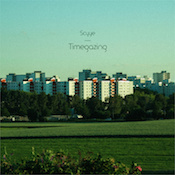
scyye_timegReach for the volume knob. On his debut, Timegazing, Scyye is dishing out tasty, feel-good glitch that wastes no time in getting you moving. What works best on this release is the mix of styles. They don’t stray too far from your standard glitch base, but Scyye definitely stretches. On the one hand, you’ll get the chipset-and-distortion groove of “Overrun.” On another, the slow and thoughtful mix of washes and bass-synth rhythms in “Please Remember.” A cool shuffling beat anchors this piece and ups its lounge cred. “Aqersus” is an instantly catchy riff on sequencer, its nice old-school feel brought up to date with glitch percussion. Add a couple of nice drops and away we go. On “Green Garden Gate,” Scyye offers us his more ambient side, setting warm pads free to drift where they will. Light atmospherics in the background are an excellent touch. It’s a great way to break up the album’s flow, and also leaves me wanting to hear more of what he can do in this vein.

Timegazing has gotten more than its share of repeat plays over here. The mix of styles, the infectious energy, and the playfulness throughout have made it a pleasure to come back to again and again. An excellent first outing. I am ready for more Scyye.

Available from Sparkwood Records.

Steve Roach & Kelly David: The Long Night

roach_longHere is a night you may not want to end. Despite its ominous title and shadowy cover art, Steve Roach and Kelly David’s collaborative work, The Long Night, is not a particularly dark release. I was expecting something along the lines of Darkest Before Dawn or A Piece of Infinity, but although The Long Night has its share of dark passages, it’s more a vision of the beauty and mystery of the deepest parts of night. There is the cold shimmer of moonlight cutting through clouds, the lightly haunted sense of not being entirely alone among the shadows, the calm quiet of being the only one awake and out in the space before midnight and dawn. Its darkness is the alluring sable of the sky, mysterious but not intimidating. Musically, it’s classic beatless Roach, blending endless bass drones and slowly wavering pads in thick layers. There’s a distinctly soothing quality to much of the work here, particularly in “Calm World” and the title track. The latter, particularly, will slide you into a dream state with warm, hushed tones and gorgeous harmonies. The duo also work in touches of percussion, just enough to texture the surface without having it take over. It arrives first in the distant clatter that dwells in the background on “Season of Nights,” then hits a stride on “The Deep Hours.” On that track, I hear (because I love it) the distinct sound of drums plucked from the tasty loops that Roach crafted for the Fever Dream releases. Dialed down to pulse quietly under the wash and flow of the track, they nicely insinuate themselves into your consciousness, melding with the crackle and curl on analog synth. This track in particular is signature Roach. “Calm World” also gets a bit of tribal percussion before it slips beneath the pads. I wish I could tell for certain where Kelly David’s contributions come in, but given how much I enjoy this release, suffice to say that his role in the overall chemistry is integral. Listening to this album got me to head over to David’s site to listen to his earlier work. I would suggest you do the same. My only bump with this release is that I found the breathy, hissing sounds early on in “Season of Nights” a little distracting and out of place. The sound is too sharp and feels almost dropped into the flow. But it passes soon enough to be forgotten amidst the calmness that follows. This has not kept me from looping The Long Night over and over. It’s a beautiful, meditative release. Put it on your outdoor speakers some evening and let it play in its natural habitat.

Available from Projekt and at Steve Roach’s web site.