Tetuzi Akiyama and Jeff Gburek: Respect

akiya_respectGuitar improvisations backed with light electronic touches, played with absolute attention to the potency of space and silence. For 20 minutes, Tetuzi Akiyama and Jeff Gburek converse, their back-and-forth on acoustic, prepared, and slide guitar exploring tone, texture, and the pure expression of the moment. Being improvised, there is always that air of controlled randomness, of hovering at the edge of uncertainty, and the four pieces here do occasionally drift into slight cacophony. What saves those moments, for me, is the duo’s ability to not only keep within their framework, but to readily pull back out of it into a more traditionally focused form. The balance of harmony and dissonance tends to lean in favor of the latter, but not egregiously so. It’s an equation that demonstrates how we only really know the simplicity of the one against the challenge of the other, with the added lesson of how we perceive space in music, how it can heighten our attention to the moment. So, yes, Respect will play better when it falls upon ears that embrace the role of dissonance and non-standard structure, ears that are willing to try to accept the truth and rawness of expression found here. While Akiyama and Gburek flirted with losing me in spots, mostly on the second part, there was something here that made me stay, and I’m glad I did.

Available from Spectropol.

Hessien: Calcifer

hessien_calcTwenty minutes of electro-acoustic music in the vein of Brian McBride and Loscil, Hessien’s Calcifer uses its brief time to make a solid impression. Tim Martin and Charles Sage send the listener immediately into a space where misty washes and long drones spin behind slow guitar lines with “Wrong Turn At Albuquerque,” then thicken the wall of sound with “When the Planets Align.” When the mass of drone in the latter track lets up to allow the guitar to speak in a growling voice raspy with distortion, the release is a tactile thing. “From Beyond the Fourth Wall” cools things down a bit, taking a repetitious, post-rock stance that curls its way into a hypnotic pattern, aided by a white-noise backdrop. The release closes out with the ambient feel of “There Are No Coincidences.” This is a gentle, windswept piece where the guitar textures whisper very quietly beneath the wash like distant thoughts. Best thing I can tell you about this is that at just 20 minutes, Calcifer did exactly what it should: it made me want to hear more from Hessien. You may, too. So take the time, drop into these nicely layered textures and drones, and see what you think.

Available from Sound In Silence.

Undermathic: Indistinct Face

underm_indistMaciej Paszkiewicz returns as Undermathic and brings big, edge-of-symphonic electronica with him on Indistinct Face. The work here is dense and lands with considerable force. Paszkiewicz’s beats punch out their cadence; his sound layers are designed to bury the listener; and the scale ranges from passing moments of relative simplicity to panoramic vistas that all but burst into view. This is not your standard electronica release. It clearly aspires to be more while still utilizing familiar elements. “Colorize,” for example, has a distinct drum ‘n bass lineage, with booming percussion crushing out the foundation, but its swelling strings stand in counterpoint to take the overall piece into a fresh space with a cinematic feel. Speaking of which, “When?” has the kind of oversized dramatic chops that would make it perfect as a soundtrack piece for some dark, moody movie. Between orchestral string pads and drop-the-hammer punctuation from piano, this is another piece with sizable mental visuals. Mid-track there’s a shift of style which Paszkiewicz navigates smoothly, taking the track into a more modern-electronic space. It’s not as if he’s left the glitch side behind, however. There’s some nice work hiding in “Three Different Worlds,” the hurrying, skittering sounds coming in to spatter the background with texture. On Indistinct Face, however, that side of his style mostly resides in the back seat as a more contemporary instrumental approach takes hold. If you’re not big on drama and a bit of bombast, this may not your best introduction to Undermathic’s work. I’ve enjoyed its depth and potent emotion. It rewards deep listening with detail, but also often begs for extra volume to drive its impact home. Great work from Undermathic.

Available from Tympanik Audio.

Andrew Young: Inkplaces

young_inkplacesStrictly fare for the experimental music crowd, Andrew Young’s Inkplaces is “…representing granular synthesis, but on a larger scale.” Tearing field recordings into component moments, improvising with a patch created in MAX/MSP software and lacing the proceedings with pink noise, Young focuses on the “microscopic textures within a sound.” This makes for 25 minutes of challenging listening that has its “wtf” moments–like the booming ship horn that explodes in the middle of “Artifacts 2” or the slight electro-freakout in “Traces/Tapestry/Pinkfour.” While it’s not easy to take hold of, there’s a lot of interest to be had in digging down into Young’s sonic minutiae. Things crackle and hiss and crunch as Young repurposes them, crossing into fresh textures and expressions.

Inkplaces is a brief 25 minutes in length. For some, this will be quite enough. I can’t say I’ve enjoyed my excursions into it as much as others may, but I can say it has made me pay attention to it. In the places where Young’s sound-washes filter down into a drone-like space, I have found myself getting wrapped in it. The detail work is excellent  even if the approach can be a little off-putting. Those whose tastes run deep into the land of the abstract will want to give it a spin.

Available from Spectropol Records.

Miaou: Bring the Lights

miaou_bringBring the Lights is just under 30 minutes of feel-good electro-acoustic music with a dose of post-rock gently stirred into it. Though light, it gains a lot of depth through its excellent production work. If your tastes run to shiny, infectiously toe-tapping music, this the place for you. Glockenspiels ring out bright notes, guitars pluck and strum away delightfully, and suddenly you want to be out in a field on a sunny day, spinning around for no reason. This is especially true on the closing track, “Water & Us,” which ramps up to an almost carnival-like feel, big and happy and carefree. The trio (Tatsuki Hamasaki and Mayumi and Hiromi Hasegawa) can get pensive as well, hitting that with the slow and lovely shoegaze sigh of “Paper On You.” Bring the Lights is a delicious appetizer of an offering, short and sweet and perhaps leaving you wanting more. I like it in a mix where its sudden brightness shines a little better than it does on its own. Still, it’s been fun letting it roll through a few times in a row. Definitely worth checking out, especially if your spirits need a little uplifting.

Available from Sounds in Silence.

Phelios: Gates of Atlantis

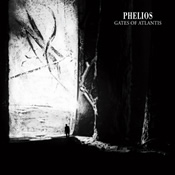
phelios_gatesBold, cinematic  dark ambient is in store for you on Gates of Atlantis, the new release from Phelios. Although it’s something of a by-the-book dark outing, being grim, weighty, and a little on the bombastic side in spots, Phelios (aka Martin Stürtzer) refines it with his storyteller’s eye to fill it with a narrative sensibility. His vistas are large-scale and compelling, even if we’ve seen their like before. Take a track like “Hibernation” or “The Shadow Out of Time,” where ominous martial drums pound out a dramatic cadence and dark-wind drones brush coldly past as our mind moves in a smooth tracking shot through Stürtzer’s aural imagery. (Pär Boström’s cover art beautifully captures the tone, along with the album’s sense of scale.) Or find your way into sparse spaces described in long, miasma-draped drones that barely move. (“New Stellar Age.”) You know these zones if you’re a dark ambient listener; they are familiar ground. Thus, it takes a strong guiding hand to not simply settle into cookie-cutter genre memes. Stürtzer does that with authority and, in doing so, gives us a story worth listening to. Hail, Atlantis!

Available from Malignant Records.

Mikronesia: Torn Ivory

mikro_tornI’m not sure I can describe Torn Ivory any better than musician Michael McDermott does in his press release: “a saturated forest of delicate acoustic piano framed by a flickering stream of static textures.” With that firmly in mind, you can concentrate on dipping into the intricacies of McDermott’s machinations and manipulations as he pulls, snips, splices and mutates his original low-fi piano recordings. This culminates in a kind of dream-haze state of listening where the sharp, solid notes of the piano pick out their halting melodies as the air around fills with fresh sounds, echoes, and fading resonance. Against it all, the non-intrusive crackle of the static peppers the flow with its hint of imperfection. McDermott keeps the proceedings soft and almost meditative; the mix of elements gel even in their disparity. If anything, the constant deepening and refinement of the sound pulls the listener further into each statement, and the space between pieces becomes a waking moment before the next begins. I have always appreciated McDermott’s detail work, and it’s in full force here. Torn Ivory works nicely as an ambient listen, but close attention points out the elegant construction and the no-wasted-sounds philosophy at play, further clarified by the mastering job done by renowned ambient musician Taylor Deupree of 12K. Dive ears-first into “Black and White Boo” to hear this at its most complex and engaging. McDermott respects negative space and the note untouched, and knows that the listener can and will fill each pause with their own meaning. This is where Torn Ivory derives a good deal of its emotional power.

With its minimalist framework, charming piano base and deeply hypnotic treatments, Torn Ivory has kept me intrigued through many repeat plays. It gives the listener space in which to think, but at the same time is continually presenting focal challenges–do you pay attention to the thoughts and feelings the music is pulling up, or will you peer more closely into McDermott’s artistry? The best answer is to just listen again and see what happens. A superb release from Mikronesia.

Available from earSnake.

Zinovia: The Gift of Affliction

zinov_giftA background of creating music for plays and films informs the feel of The Gift of Affliction, the compelling debut release from Athens, Greece-based Zinovia Arvanitidi. Loaded with crossover potential, The Gift of Affliction pulls together hints of jazz and textbook contemporary instrumental structures and anchors them with a solid glitch core to create a deeply enjoyable listening experience. Each piece here packs its own narrative/cinematic feel, bringing a story to tell or a vista to share. The central focus is Zinovia’s superb piano work; she plays with pure technique and a healthy dose of passion. The piano shines against ambient-wash backdrops and the click-and-hiss rhythms that drive each piece forward, and she shades the songs with plenty of other tones, but instrumental and thematic. Tasty melodica gives an Eastern flair to “Entangled” while a 1-2/1-2-3 bass line lays down the unwavering cadence. A great jazz feel courses through it, with Zinovia giving herself long enough–seven minutes–to stretch and play. “The Blue Shade of Dawn Covered Your Skin” glides in slowly and seductively with breathy pads, a rich low end, and more melodica. (It’s here a fair amount, and I quite like the feel it gives.) What works here is the way Zinovia gives each element a fairly simple phrase to speak, patiently layers and joins them, then drapes a gossamer symphonic-string feel over the top. “Chimera” is lounge-smooth, with strong glitch-work, gently placed wordless vocals, star-twinkle sequencing and a shift toward a rising tone in its second half that creates a genuine “ooh” moment. “Attached, Our Eyes Wide Open” closes the disc quite simply, spotlighting the piano in a perfect contemporary instrumental space, lightly accented with string sounds. I absolutely adore the very last moment here for its bare honesty, its “and we’re done” declaration.

The Gift of Affliction offers a lot and delivers on it. The electronic side of it is handled nicely; the sounds take their place as backup elements to the piano and they fill out the sound without getting in the way. The piano, as noted, is crisp and affecting. I’d love to hear a solo piano album from Zinovia. The shifting tones provide welcome diversity, yet Zinovia manages to keep things tied together thematically as the release proceeds. There’s a through-line of thought that’s well managed. This is a great end-of-day disc, one that’s laid-back but still manages to draw a lot of attention to itself. And headphone listening reaps some tasty rewards, too.

Available from Tympanik Audio.

Naming Ghosts

naming_ghostsNaming Ghosts work hard to defy categorization on their self-titled debut release, offering up a shifting blend that encompasses chillout grooves, hushed ambient, and an arc of subtle darkness. Musician/producer B.J. Schweinlin teams with pianist and vocalist Eva Zimm on these 10 tracks, pairing acoustic instruments with electronic treatment and turning out work with solid impact and plenty of depth. There’s strength in diversity here, for the most part, and none of the changes in tone seem, forced. The duo can handle a piece like “The Light and Shadow Show,” where a slow moving, darkly twinkling opening rises up to spin into a sort of Oldfield-style flair on string sounds and acoustic guitar. The symphonic side here conjures thoughts of Ommadawn, had Oldfield chosen to temper it with extra electronics. They can also nail the techno/lounge smoothness at play on “Deep Green,” coolly laying doing a punchy, steady riff on organ chords and thickening up the feel with more rhythmic elements as the piece progresses. It’s infectious. And there’s the hushed side, evident most clearly on a piece like “Early Transitions,” hanging long chords out to travel and fade over round chime tones. There’s a nice half-dreaming sense here, and the balance between the soft lines of the pads and the more solid texture of the chimes is perfect. As much as this album works for me, Naming Ghosts do lose me briefly during “False Sunrise.” The clatter of bells, while appropriately dramatic for the piece itself, just feel bombastic and distracting compared to the rest of the album’s subtler flow. Nothing else pulls me out of the moment here, and considering that Schweinlin and Zimm keep me fully involved during all their musical costume changes, even having one moment where my focus is crunched makes a difference. This release has been a pleasure to keep on repeat during my review listens. A strong debut that leaves me looking forward to more.

Available from the Naming Ghosts web site.


Bvdub: Born In Tokyo

bvdub_tokyoWhen I consider the deep effect Bvdub’s Born in Tokyo has had on me through several repeat listens, and that this is Brock Van Wey’s 20th release under this name, my first thought is, How did I miss the first 19? On this outing, Bvdub entices the listener with a blend of styles that encompass EDM, New Age and dream pop. Typically, within the melodic electronica genre, songs tend to run at pop length–three, five, six minutes, tops. Bvdub takes the feel and the framework and stretches it out to the 11-14 minute range, and in doing so gives his pieces more room for expression and more potential for impact. It allows him to work movements into the pieces, full-on changes of tone that dovetail neatly and keep his grooves going strong. It’s an influence that comes from Van Wey’s background as a DJ–the man knows how to craft a smooth blend. These shifts are, for me, one of the strongest points in an already very effective album. “Reach for Me (Awake For the First Time)” begins its run with deeply emotive piano playing under airy electronics and a will o’ wisp vocal. If you pulled everything out but the piano, you would have a very lovely New Age piece. The core of it, the strong phrasing and passionate emotion, would (and does) stand on its own. Van Wey’s atmospheric additions act as amplifiers, buffing up that content without sullying the clean, simple foundation.  The song glides through a short ambient passage and emerges coated in a cool sequencer line. Shuffling glitch beats, a heavy low end, and dreamy, washed-out vocals complete the transition. Your first time around you may find yourself checking to see what this new track is. But it isn’t. And that’s the cool part. Check another great crossover on “We Love Together (It’s Our World).” Symphonic washes float like warm breath on cold air for the first 90 seconds or so–then you get a quick drop and Van Wey brings in sweet lounge chords and a house-style beat. On this track he’s assisted on the vocal side by Jenny Mayhem to take into a club-perfect space. It’s slick and sexy as hell, an aphrodisiacal slow groove that hits its emotional peak as the voices plead, “Why won’t you stay the night?” “Don’t Cry Mamii (To The Sky)” backs its way in with reverse-echoed notes and gentle guitar. Van Wey builds in layers by deepening his vocal loops, rich with more echo, developing a delicious interweaving of individual lines that strengthens with each pass. When, this, the closing track, sighs to an end, I would bet good money you’ll immediately start it up again.

I would not be surprised to learn that Born in Tokyo was crafted out of the highest quality silk. It’s unbelievably smooth and fully wraps the listener in its glistening textures. The perfect balance of hush and groove is immediately infectious. Van Wey’s pure confidence shows in every track. He knows how good his transitions are and he knows you’re going to love them. This is a release full of “oh,yeah” moments. A genuinely fantastic release from Bvdub that you must hear.

Available from n5md.