
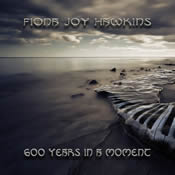
 In presenting an “exploration into time and history” to her listeners, Fiona Joy Hawkins employs a broad, global array of instruments and an all-star roster of contemporary instrumental talent. Will Ackerman (who also produced the disc), Philip Aaberg, Eugue Friesen, Todd Boston, Tony Levin, Charlie Bisharat and others accompany Hawkins, who steers the voyage from behind a handcrafted Australian piano. Celtic influences weave through most of the work, but all the world flavors come through clearly, courtesy of flutes, whistles, strings, didgeridoo, a shaman’s dream’s worth of percussion, woodwinds, and guitars from just about every point on the planet. These 12 tracks are washed through with equal parts melancholy and romance; they are vivid, heartfelt songs full of imagery and emotion. Hawkins’ piano playing is elegant as always; the sound of the Stuart & Sons piano she plays is rich and full, gently taking command of the ensemble but making sure each contributor shines through in the parts. When it plays alone, as on “Earthbound,” or more lightly accompanied, as on “Forgiveness” where Paul Jarman softly lays in lines from a Chinese bawu, the instrument’s simple beauty and soul-touching resonance is highlighted. But it’s the ensemble pieces that set your spirit flying here. I particularly like the tracks that heavily feature the strings, so I’m in heaven when Hawkins is surrounded by violinist Rebecca Daniels, Dave Ellis’s double bass, and deep cello from longtime Paul Winter Consort member Eugene Friesen on “Antarctica” and again on “Ancient Albatross.” I like the way “Running On Joy” appropriately alters the mood, swinging into an uptempo space. Michael Jackson barks out didge notes while Levin and Ackerman take double duty on bass guitar. Heather Rankin’s vocals here are smooth as silk and sweet as sugar. (Dear Athletic Footwear Companies: Here is the music for your next commercial.)
600 Years in a Moment is a breathtaking New Age-style album that will surely end up topping every Best Of list in that genre this year. With Ackerman handling the production, the sound is flawless. This is a vibrant, breathing album that’s the perfect accompaniment for every sunset or quiet evening. It flows seamlessly, shuffles itself nicely, and finds a new way to move you with each song. A genuinely brilliant work.
Available from Fiona Joy Hawkins’ web site.

 Hypnagogue Music Reviews