The Pure Heart Ensemble: Bliss of Being

pureheart_blissIf you have small children, particularly ones who are troublesome at bedtime, I recommend grabbing a copy of The Pure Heart Ensemble’s Bliss of Being. Beyond that, you’ll like this if your tastes run to quietly soporific music falling somewhere between lullaby and chamber music. Individually, the 12 pieces presented here are lovely enough; the quintet of pianist Richard Shulman, cellist Adriana Contino, flutist Kate Steinbeck, crystal bowl artist Bob Hinkle, and vocalist Dielle Ciesco come together beautifully, and the simple, un-augmented sounds of their instruments ring with feeling and honesty. It’s across the expanse of the hour, however, that the music begins to feel repetitious. As lovely as the pairing of Shulman’s piano and Cieso’s wordless coo’ing may be, and despite how beautifully it feels at first like a mother singing softly to her child, it soon becomes a matter of “Didn’t I just hear this?” as the pattern repeats. The other instruments certainly add depth–Contino’s cello is especially affecting in the long track “Heading Home” and Steinbeck’s flute is the whispering, soaring mate to Shulman’s earthy, grounded piano throughout the disc–but it’s not enough to outweigh the sameness after a while. As much as Bliss of Being is a true ensemble work, Shulman’s piano is certainly its focal point and anchor. His playing is rich and elegant, whether he’s patiently spacing notes within a melody or, as in parts of “New Openings,” he’s running through glissandi that sparkle like sunlight on water. The solo song, “Resting in God,” is an absolute showcase piece that makes me want to hear more just of Shulman’s piano. This quick tune flows nicely into “Loving All,” where he again takes the forefront before the rest of the group ease into place.

Bliss of Being faces something of a weighted scale with me as a listener. The music here is much lighter, much more bookstore-ish, than I typically prefer, and there’s never a marked shift in tone or tempo. That certainly factors in to my problem with its sameness. And yet, given plenty of space apart from one another, these songs are outstanding from a quality point of view. The players are impeccable; they play with emotion and meaning, and you can feel their connection to what they’re doing. But coming at it as a straight-on, one-hour listen, I find myself wanting to move along. That being said, New Age music lovers will likely find a lot to enjoy here. Plus, as I suggest, it’s absolutely fine shuffled into your daily rotation. Give it a try,

Available from Rich Heart Music.

Meg Bowles: The Shimmering Land

bowles_shimElegant, calming spacemusic awaits in your journey to Meg Bowles’ The Shimmering Land. This is Bowles’ sixth release, and her second in two years following a long hiatus, and it reinforces that she is an important voice in the genre. Across six tracks, Bowles barely raises her musical voice above a whisper, opting instead to make its impression via depth and dimension. With a practiced hand, she places airy layers one atop the next, mixing the pure simplicity of ambient structures with nicely understated melodic elements. “Nightwalk Across the Isle of Dreams” showcases that blend, the melody drifting in via woodwind and plucked-string sounds. When she opts to add rhythm to her flows, it’s with subtle pulses from the sequencer; they arrive not to intrude but to lightly amplify the sensation. You hear it in “Beneath the Radiant Stars,” a present but distant ripple in her spacey, panoramic drifts. On the lush and serene “Venus Rising,” the sequencer heads into a higher register, casting star-shine glimmer across long string pads. This has a classic spacemusic feel to it, a bit of nostalgia pinging at your long-time-listener pleasure centers.

The Shimmering Land quietly invites itself into your listening space. It makes no demands as it patiently fills your head and works its soothing, aural-imagery magic. The feel is always warm and utterly calm as Bowles spreads out her vistas before you and floats you through them. This is a wonderful disc to have playing at the end of the day and into the evening, helping you wind down and re-center. An absolute must-hear from this (quietly) powerful voice. Let it loop.

Available from Kumatone.

Christopher Alvarado: Ancient Doors

alvar_ancientChristopher Alvarado taps into the mysteries and rituals of primitive cultures on his new release, Ancient Doors. While not a “tribal” release per se, these twelve tracks definitely delve into a primal space, pushing forward on varied percussion and atmospheres thick with incense smoke, but also weave in some new-world grooves for an original glide. The balance is the strength here, and Alvarado is clearly at ease working both sides of the equation, alone or together. “Dakini (Sky Goer)” is a great example of this mix, rising out of misty drifts before it starts pumping along, catching hold with its chugging rhythm. There’s something pleasantly raw about the sounds forming that rhythm, and they way they counter the fluidity of the pads. “Jewel of the Jackal” is another, a Mediterranean fantasy where sharp raps of the tabla and flavorful strings like sitars melt into a hypnotic sway. Alvarado builds up to a frenzy, then just fades it away like a breath. Probably my favorite track here. On the more tribal/primal side, “The Lock of Past” is a great atmospheric track. Drums distantly hammer out a dance as Alvarado ramps up the drama. Static-washed hisses and chant samples blend into the sound. On the more ethereal and sometimes dark side of the equation is  “Dunes,” pairing long ambient pads with a keening vocal sample and more of the Middle Eastern flavor that runs through the disc. Later, that voice gets a different treatment in this tune’s “Drifting Wave Mix.” There, it’s  clipped and chopped and used as a rhythmic element for a glitchy feel. It plays nicely against a meaty bass line and cool strings for a silky overall flow. Meanwhile, back on the quiet side, “Andromeda at Dusk” is a slow-moving ambient piece with a calm-breath movement. It’s a perfect closer that mixes its hush with just the right amount of shadow.

There’s a lot of visual imagery at play on Ancient Doors, and several of the tracks have a soundtrack-ready sensibility to them. (Understandable, what with this release coming from Aural Films, whose motto is “Soundtracks for films that do not exist.”) Alvarado’s sounds run very deep, creating fully described spaces that evoke a lot of emotion. As I said before, it’s the mix of modern feels with old-world sounds that works best for me here. It makes the music easy to get caught up in and a pleasure to come back to. Check it out for sure.

Available from Aural Films.


Audio Cologne Project: 2911

audio_2911 See those guys jumping on the cover of Audio Cologne Project’s 2911 ? They’re jumping because they just got a jolt of this prog-drenched, Krautrock-influenced musical adrenalin. ACP, if I may call them that, are a power trio consisting of keyboardist Dave Pearson, aka Computerchemist, guitarist Uwe Cremer, aka Level Pi, and drummer Zsolt Galántai, who played with Pearson on last year’s Signatures release. This is a flat-out fun, turn-it-up offering that kickstarts with the wild ride of “Chemist’s Bike” and doesn’t much let up on the gas until the last note. While all three players are rock-solid, it’s Cremer who acts as your sonic tour guide for most of the release. It’s obvious to me that before playing, he soaks his guitar overnight in serious blues, then proceeds to wring every sweet drop out of it while he plays. And by blues I mean thundering 70s-style blues-rock blues, equal parts fire and gritty emotion. He absolutely crushes it on “Chemist’s Bike,” and later lightly smokes his riffs in Middle Eastern flavors on the 20-minute epic, “Spieluhr.” Throw in some guitar effects, and things get nicely trippy. In the latter half of “Spieluhr,” he again lets fly with more aggressive lines, hitting the wah-wah good and hard to slide the notes right into you. Of course, all this praise for Cremer is not meant to short the other players, because this is a big batch of effective chemistry. Galántai anchors the trio with his massive fills, driving the frenzy from the rhythmic side. Pearson, as ever, contributes masterful sequencer lines to support Cremer’s flights and lend a crisp and not-too-nostalgic Berlin School feel to the proceedings. In addition, he handles bass guitar duties, most notably the fast-running riff that kicks off and then underscores “Grobmotorik.” (And also, a nice break in “Chemist…”) On “Mind the Gap,” he serves up a sweet, jazzy electric piano solo, its creamy smoothness standing in contrast to the raw guitar licks coming from the other side. This another great long track, which the trio modulate through several tempo and tone changes. Along with its rock bombast and jazz, it also has some fairly Floyd-like moments, quiet passages where Cremer shows his soulful side. Listen carefully for Pearson’s sequencer bubbling under the surface of his keyboard solo as the piece draws to a close. Great attention to detail.

While Cremer and Galántai have worked effectively with Pearson before on their own, the decision to bring everyone into the fold was a very, very good one. The three mesh perfectly, and this release is just full of pure musical joy. I have been a Computerchemist fan for quite a while, and for me, Audio Cologne Project is Computerchemist on steroids. Everything I’ve enjoyed about Pearson’s work just gets amped up here. I have taken the 2911 ride many times since I received it, and I expect it to stay in heavy rotation at Hypnagogue HQ. Like I said, it’s just damned fun. Grab this, and enjoy yourself.

Available from the Computerchemist Bandcamp site.

Steve Brand: The Great Hoop

brand_hoopMy biggest problem with writing a review of Steve Brand’s The Great Hoop is that, having done so, now I have to stop listening to it and move on to other discs. Easier said than done, because this is a disc I have deeply enjoyed. On this release Brand pulls inspiration from Native American culture and the landscape of the American Plains (in particular, the Cahokia Mounds in Illinois), but does not set out to make a Native American music disc per se. It’s more the artist’s interpretation of how his own interest in and connection to the subject manifests in music. So, yes, there are flutes, shakers and rattling bones that call up the impression and which also lend an air of ritual in places as the five pieces here move along, but their role is to act as a perfectly placed accent to Brand’s big, deep ambient soundscapes. The flute, particularly, works as a tether for your floating spirit. Brand’s playing is elegant and spirited, and I like the way he varies between full-voiced playing and occasional wispy, breathy whistlings. The latter brings a bit of a ghostly touch, especially in a darker piece like “Hoop of the Earth.” It’s wisely played against low-end pads, the thrum of a frame drum, and the crisp sound of the rattles. The drama gets ramped up on this track as Brand alternately thickens and thins his sounds in superb measure. It’s an interesting blend of potency and peacefulness. This is something I really enjoy about Brand’s work; he knows how to create impact either with a minimal amount of sound or a heavy dose of it, so his more hushed passages still leave an impression. Definitely the case here. Fans of Steve Roach are sure to hear echoes of his influence throughout The Great Hoop, and perhaps nowhere more so than in the fantastic “Medicine Bag Ghosts,” with collaborator Frore. This is the centerpiece for me. It’s seriously powerful medicine that’s ready to take you very, very deep. Layers of flute swirl and spiral, echoing off into the distance; throaty drones beckon from somewhere below; a whisper of wind eases through the sound. Halfway into it we enter into Roach’s established territory, marked by slow tribal beats and a humid sonic atmosphere. This is pure ritual in action, evoking a primal, gut-level response. This track alone is worth the price of admission. When I first listened to The Great Hoop, I felt like the last track, “Suspension Vision,” had something of a mis-step. Brand whistles on this track, a sort of wayward, almost haphazard whistling. It struck me as odd at first, but after some repeat listens I came to see it as a very personal, connecting touch. It echoes the songs of the flute we’ve been hearing across the disc, but this is the song without the external instrument. This is the breath that makes it happen. This is a reminder that, in the end, all of our music begins with us and in us.

The Great Hoop is a brilliant release. It may very well be Brand’s best. It digs into the listener and doesn’t let go. Its organic parts are wonderful, down to the simplest shaker. It manages to embrace tribal and Native American musical themes, but they’re always tied directly to the ambient spaces Brand is known for–vast, moving, and impressive. Steve Brand is a genuine force in the ambient sphere, and this disc helps to solidify that position.

Available from Relaxed Machinery.

George Wallace: Soul Ascending from the Primal to the Celestial

wallace_soulSoul Ascending from the Primal to the Celestial presents a variety of vistas with a nearly equal number of styles. Veteran composer George Wallace offers up spacey ambient, semi-dark tribal, and touches of world music in these 12 tracks. It’s a mind’s-eye sort of affair, as Wallace shows a solid feel for setting a scene and telling a story within the few minutes he allows each song. His ambient work is suitably quiet and leans toward the spacemusic side of things, that sense of vastness that comes from big, well-layered pads. “Celestia Aeterna”is one such piece, building up from the soft call of chimes (of which, it must be said, there are many on this album). It gracefully floats outward, a very classic-sounding bit of work, light and promising, anchored with a nice bass drone. Its followup, “Mystery Unfolding,” drifts along as well, but is infused with a dramatic chord structure that raises the narrative ante. (And it has chimes.) As noted, however, it’s not all ambient here. “In-Betweenland” recalls Windham Hill combos with it rolling fretless bass. Hand percussion sets the groove, and a lightly applied jazzy feel weaves its way over washes and pads. “Speaking in Tongues” rams forward on tribal percussion and widens out into a world-music groove. “Ecstatica” (which falls under the “Speaking in Tongues” storyline of the disc–see Wallace’s web site for info) opens as a dark, drifty piece, then drops in bouncy didge and a shuffling beat that takes it to a cool new place. There’s almost too much added for my preference–for example, a high, Eastern- style flute comes in here and there, but it feels it walked into the wrong room yet decided to stick around. This happens here and there on Soul Ascending; spots where it seems that Wallace is trying to do too much, throwing too many frames of reference at us. It only stands out for me because other songs where Wallace embraces less density work very well. “Tibetan Moon Behind Clouds,” for example, is a lush drift that makes the most of its simplicity and still packs a distinct emotional core. Or “The Primordial Chord,” where pads mix with acoustic strings (and chimes, of course) in a very affecting, hypnotic blend.

Soul Ascending is a pleasure to listen to. It’s diverse without straining; each piece is strong on its own and moves the whole forward. While, as noted, I prefer the simpler side of Wallace’s work, pretty much everything here hits. Be sure to check this one out.

Available from Airborn Music.

PAS Musique: Abandoned Bird Egg

pas_egg“Repetition, beats, and field recordings” form the basic sound-set on PAS Musique’s new release, Abandoned Bird Egg. With an eye toward creating a “meditative” experience, Robert Pepper and his crew take those elements and assail your listening space with thick swaths of gurgling electronics pinned under industrial weight, accented with IDM-style voice samples. I throw quotes around “meditative” because while the dense sonic atmosphere and buzzing, drone-like undercurrent can forcibly lull you into a kind of numb stupor, it comes fully edged and barbed and is in ceaseless, abrasive motion. A lot of the sound on Abandoned Bird Egg is super-dense, mercilessly piled upon you into whirlwind cacophonies anchored, now and then, with thudding and, if I may, catchy beats. In other places, as on “The Light Side,” the drones take hold, possessing their own considerable weight. Here they take a white-noise hiss and an incessantly repetitious sequencer riff, distort the sound like it’s over-amplified, ramp it up and down in intensity, and pull back the edges to let additional sounds leak out to keep you aware. And just so you can’t really get a handle on what’s happening, there’s always the clumsy funk bassline that welcomes you into “Dark Canopy.” But don’t get comfy–this soon rises up with spurts of feedback and more aurally aggressive clusters of sound. As challenging and rough as it is, I actually find Abandoned Bird Egg to hold some of the most approachable work I’ve heard from PAS. It’s not an easy listen by any measure, but there are enough familiar elements to let you take hold of something in the storm. You have to like your noise, but here’s the thing–this is purposeful noise, a chaos that actually achieves what the artist sets out to do. It may be the weirdest meditative experience you’ll ever have, but if you can find your way in, I assure you this stuff will carve out its own space in your ahead. But still, approach with caution. It’s not for everyone.

Available from Alrealon.

Bruno Fleutelot, [ozo viv]

fleut_vivHad I thought to check before listening, I may not have reviewed this re-release of a 2005 work from Bruno Fleutelot. My policy is to disregard work over a year old. But since I only learned of said status after diving into [ozo viv], and having heard what it offers, I felt it was worth giving up a few words. Thematically based on lunar landscapes, according to the artist’s label, [ozo viv] offers up guitar-based minimalism heavy on drones, processing and atmosphere. Touches of vocal samples work their way in as well. The overall feel is slow-paced music that’s taking time to think. Fleutelot understands the importance of pauses, not just the ones filled with resonance and fade, but simple breaths of silence within a flow. His guitar playing tends to focus on patient, simple playing, letting the sounds of the strings melt into his electronic backdrops. “Palus Nebularum” is a great example, as he strums his way through a chord one simple and deliberate string at a time while the background whispers with understated electronics and spectral voices whimpering in the distance. “Oceanus Procellarum” pairs the slow guitar with echoing string rasps. Fleutelot hangs a lot of pauses here, gaps in the sound that hold you in a bit of suspense. The feel is dark and heavily weighted.  “Mare Australe” takes a similar approach with piano. Fleutelot plays slowly while a drumbeat shuffles in, the combo working through its slow-motion song over a quiet, swirling curtain of electronic sound. Aside from these sort of near-deconstructionist pieces, he also meanders into experimental territory. “Sinus  Roris” is one of the dark bits,  driving forward on a metallic, scraping sound that stalks across low-end drones. It’s uncomfortable in it edginess but also a little hypnotic. I particularly like the bonus track, “Marc (Pt 1, 2 & 3).” Fleutelot modulates the flow here, going from deep, hypnotic drones to clear guitar tones that waver and fade like heat shimmer.

Fleutelot maximizes the effect of his minimalism, heightening our awareness of waiting for the music to do its next thing. The music here pairs simplicity with uncertainty, the obvious with the odd, and the blend works. [ozo viv] is mesmerizing and a pleasure to give a deep listen. I do hope this reissue heralds newer music from Bruno Fleutelot.

Available from Eglantine Records.

Wacky Southern Current: Argonautica

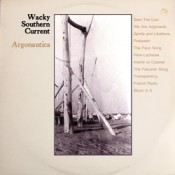
wacky_argoYou would think that after ten years in the review business, I’d have stopped flinching at artist names. But, come on…”Wacky Southern Current”? Luckily for us all, Italian musician Marco Cervellin redeems his odd moniker choice with a batch of guitar-fronted pieces that range from folksy finger-pickers to feedback-laced post-rock wailers. Cervellin harshens up the sound a bit in spots with distortion and light electronic treatment, but never to the detriment of the song itself. Argonautica is a decent release, but with several listens I couldn’t shake the feeling that I wanted more out of it. The songs are pleasant and varied, and Cervellin’s guitar playing is excellent. He can absolutely tear it up, as he does on the rocking “We Are Argonauts,” which cuts loose with snarling, prog-like riffs and runs. And he can run the edge of experimental, which is where we find “Padawan,” where dissonant chords, seemingly wayward drumming, and electronic grind fight for attention behind a simple five-note arpeggio. But these are the exception rather than the rule. Little else jumped out to impress me. The release comes across as an easy-listening album with the occasional touch of something more ambitious–and it makes me want more of the ambitious stuff. Definitely worth having a listen, and I will be interested to hear what’s next from Wacky Southern Current.

Available from the No-Source netlabel.

Menion

menion_selfMenion is the pseudonym of guitarist Stefano Ferrari. In this 10-song release that clocks in at just over half an hour, Ferrari cranks out a mixed batch of pieces that run from jittery experiments to dubstep-influenced rides and even a bit of jazz. This is all meant to capture the feel of the musical scene of Berlin, where he has spent the last few years, and in doing so winds up packing a sense of hurrying from place to place, musically, and visiting each just briefly. This gives it a slightly schizophrenic quality, with its approachable moments in distinct contrast to its more left-of-center ravings. Thing is, the approachable pieces are very much so. “Night in Berlin,” with its dubsteppy warble and plodding pace, makes for a great start to the release. Ferrari spatters the piece with microsounds and underscores it with a stalking bass line. When his guitar really kicks in, wailing its way through what would make for a very funky spy-movie theme, I get chills. There’s a similar, and similarly effective, break in “Stai Attento ai Segnali.” It busts open after several minutes of minimal, chopped sounds laying out a multi-layered beat, accompanied by pizzicato guitar. This track highlights Ferrari’s attention to small detail, which runs throughout the release. “Sopra un Aeroplanino di Carta” shows another side. Its chill-out groove is balanced with gritty noise, and in its quiet moments it’s simple, pensive, and engaging. When it breaks into a sort of smooth jazz thing just before the four-minute mark, the shift is both surprising and pleasing. The song wears several different faces in its five and a half minutes, all of them done well. There are also several very short pieces, the longest just over a minute, the feel a bit wayward, like half-thoughts thrown into the mix for transition. They’re fine, but for me they don’t add to the experience.

It took me a little time to warm up to Ferrari’s style. Whereas at the start I thought it was going to be too “out there” for me, I found myself getting quite into both his superb guitar playing and the richness of the sound. There’s a lot going on, and he manages it all skillfully. I find that sometimes glitchy elements can be overdone or overemphasized; here, they’re downplayed to the point of a well-used accent. When Ferrari chops and re-arranges sound or throws in drop-outs, as in “In Fondo a Un Lago,” it can be a challenge upon first listen. Then understanding comes. It’s not just that the sounds are chopped up, it’s that they’re being bounced back and forth between speakers (or ears) to play up their rhythmic aspect and to give dimension. So I have to say that Menion managed to win me over. See if he does the same for you. I’m looking forward to more.

Available at the Menion web site.