
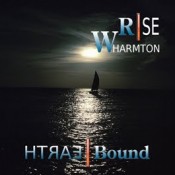
 Andrew Mark Lawlor, recording as Wharmton Rise, continues to best himself with each new release. On his newest offering, Earthbound, Lawlor further perfects his style, a sort of cinematic spacerock that gives a distinct wink & nod to the progressive rock artists who have clearly influenced him. Although the disc starts out somewhat too stiff and formal with “Orbital Excursion,” Lawlor immediately kicks things up on the title track. It’s looser, hipper and fuller, bolstered on soaring, wordless vocal samples. (These are used so well throughout the disc, especially on the slow burn of “Long Lost,” that I had to write to ask Lawlor if they were live or sampled.) A synth flute adds an upbeat melody along the way. This is more along the lines of what Earthbound gives you for the rest of the disc. One of the things I quite enjoy about Wharmton Rise is how Lawlor creates convincing, flat-out-rocking guitar lines with his synths. He says it lets him unleash his “David Gilmour side,” and I defy anyone hearing his work for the first time to tell me they didn’t think it was actually him flailing away at his axe. It adds a gritty rawness to the sound, slashes of glorious prog-rock savagery. Have a listen to “Straight and Narrow” to get a taste of Lawlor’s blues-rock side, or the soulful 70’s arena wail in the early stages of “Cloudburst.” My favorite track here is “Downtown Desolation,” which busts the door open proudly wearing a Tangerine Dream t-shirt, sequencers set to stun. It’s an intense track that shifts gears a couple of times without losing sight of its narrative. My best suggestion for listening to Earthbound? Take it in the car with you, crank up the volume and go–just go wherever Wharmton Rise’s excellent CD takes you. It’s a helluva trip.
Available from LAD Records.

 Autumn Fields is the least successful of the three for me. It opens strong, with cracks of rolling thunder and melodic piano from guest artist Connum on the track “Gewitterregen,” but then starts to corrode under a batch of noise and overwhelming field recordings that too often feel directionless. The problem for me comes down to a lack of subtlety in these elements and how they’re used. It felt like a barrier keeping me from connecting to the work, so I just kept skipping tracks. I stuck around for most of “Minus 10,” where Geiger lets his IDM sensibilities outweigh his penchant for noisy glitch. But overall this is largely a miss.
 Lest it seem as though I just don’t enjoy glitch and/or noise (and many of my past reviews would belie the idea anyway), I found Access to Arasaka’s void(); much more accessible, if occasionally a little too chaotic. Quick-stitched sound samples whisk by in rhythmic flurries, beats snapping together in fractions of a second. On this one, though, it’s the opener, “*strtok(),” that almost loses me by feeling close to wayward if not downright random–but the experience is saved as soon as the followup, “kill_recorder=$c1,” kicks in to show Access to Arasaka’s sense of high-speed beatcrafting. void(); is about a 60-40 good/meh mix for me. The pieces that feel more thoughtfully put together, tracks with a strong identity like “inc(tumbler),” “Switch(Pcap_Datalink)” and “Syslog_Ident,” hold my attention more than some of the other cuts here which simply seem to lose their way in the electro-muddle of glitch. (“Array[08191]” comes to mind.) Overall, though, I find more to like the more I listen to void();. Access to Arakasa’s style is growing on me.
 And then there is Undermathic’s 10:10 pm, which charges out of the gates in a blended burst of post-rock melody, IDM beats and a decidedly narrative voice. Maciej Paszkiewicz instantly finds his sure footing in this middle ground and shows that he knows how to use his position to advantage. 10:10 pm is a solidly crafted piece of work, packed with a multitude of elements that do nothing but add to the ride, never impeding the flow or taking the listener out of the moment. I like the gear-switching intensity of “Searcher,” shifting perfectly between pounding drum-driven rhythms and a glistening, floating break; the calm story that unfolds in the closer, “Sea”; and “I Remember,” the highlight track for me, which manages to exhibit a robotic angularity and a romantic smoothness at the same time. 10:10 pm is a smooth ride on easy beats and a well-planned depth of sound. It’s a straight-through listen that will give your speakers a workout because you’ll want to turn this one up. Make space on your iPod. 10:10 pm is bound to be a keeper.
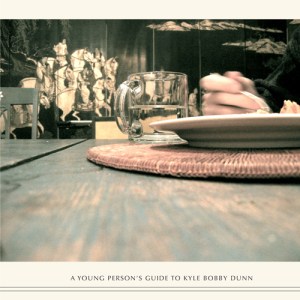 There is a slight Catch-22 hiding in the act of writing a review for Kyle Bobby Dunn’s 2-disc work A Young Person’s Guide to… Problem being, trying to write a lot about the music seems to run counter to the conceptual idea behind a work that appears to comprise very little while at the same time doing quite a lot–but quietly. Picking up from Dunn’s formerly download-only work Fervency and then embossing it with newer work, A Young Person’s Guide to… is a set of slow-moving pieces that never raise their voices much above a whisper, but those voices blend to form a deep, delicate chorus track after track. Dunn had several musicians play traditional instruments, then took the sounds and stretched and slowed them into new, hushed forms. The resultant pieces are absolutely graceful and soothing, yet possessed of a discernible edge that pricks at your attention and appreciation. Calling the work “minimalist” would in a way detract from what Dunn has accomplished, because while in structure it all seems fairly simple and straightforward, the composer has infused it with movement–albeit subtle–and feeling. Certainly, played at low volume it’s textbook ambient, unobtrusive and patiently waiting for you to notice it. I slept with it playing on loop one night, got up and went about my business and only noticed, literally an hour later, that it was still going. To some, that could be perceived as a flaw or an inherent dullness. But it’s all by design, and listening to it closely (as you should) belies the idea of an ignorable simplicity. If the earmark of a good ambient disc is its ability to affect you even when you’re not immediately aware that it’s there, then A Young Person’s Guide to… is a good ambient disc. Dunn also makes an interesting choice of adding a couple of piano tracks amidst his misty flows. Surprisingly, given the tone of the rest of the disc, they’re not at all forced or interruptive–just a welcome checkpoint along a very enjoyable listening path.
 Although the majority of my exposure to and appreciation of Tim Story’s music has come over the last five years, largely through his collaborations with Dwight Ashley, Deiter Moebius and Hans-Joachim Roedelius, his name has been in my head since I first heard his track on the 1990 Windham Hill compilation, Soul of the Machine. I probably couldn’t name you three other artists from that disc, but Tim Story’s sound always stuck with me. While in recent years his work as a chamber-ambient artist has been delineated largely by his subtle manipulations of sound in otherwise straightforward instrumentals, the fact is that what’s residing under it is exactly that–the straightforward and quite lovely instrumental work that hearkens back to his earliest recordings.
 Ion is the lighter of the two. Here, Kelly sets aside the processed guitars that have formed the bulk of his past few albums and instead calls all of his floating forms from keyboards. The feel here is classic ambient: cloud-motion drifts in airy, angelic-choir pads and soft bass exhalations that lazily nudge each other along for two hours. In that regard there’s nothing groundbreaking happening here; it’s just that it’s all done extremely well. Ion is one of those listens that creates moments where you suddenly realize that your breathing has sympathetically slowed to match the music and that you’ve allowed yourself to wander off somewhere, mentally. Sometimes you’re brought around by a Kelly shimmer or a shift in tone (as at the beginning of “Earth Metal”) that tugs at your attention, but soon enough you’ve returned to that quiet section of headspace Ion has been gently hollowing out for you. Obviously, this disc truly comes into its own when it’s looped quietly, as the artist intends. Kelly’s meditative, time-stretched imaginings will simply curl around the space and make themselves at home.
 sounds and sonic images herein are meant to call to mind “the current corrosive energies unleashed into the world,” and they do. Metallic sounds grate and rasp against one another. Static spatters the soundscape. A sense of unrest pollutes the space–by design. Kelly effectively varies the work from overloaded sonic detritus to sparse nuclear-winter stretches of near-nothingness. There is loneliness and there is noise. I’ve been listening to Igneous Flame for several years now, and this is absolutely the densest and darkest he’s ever gone. It’s to his credit that there’s no sense of pretension here or the feel of an artist overstepping his bounds. Kelly is clearly comfortable making listeners uncomfortable. Given its length, Orcus isn’t something I’m likely to put on often for a full listen–I have a hard enough time getting through dark ambient CDs of normal length. But it will certainly stay in iPod rotation for those times when I need a little blackness and despair.
 Hypnagogue Music Reviews