
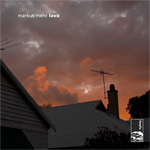
 No sound is safe from Markus Mehr on his new release, Lava. Each one is subjected to an array of sonic surgeries that slice, pull, invert, roughen and deconstruct them even as Mehr reconfigures them into abstract structures. The yawning waveforms that open the first track, “Agenda,” stand as about the least molested sounds here–and about four minutes into what seems like it’s going to be a fairly standard ambient/drone work, Mehr starts manipulating the sounds and things proceed to get more interesting by degrees.
I find that I’m more involved with the music on Lava when Mehr keeps his machinations subtle. I’ll take the calm grace of “Hubble,” for example, my favorite track on the disc, over an aggressive now-hear-this experiment like “Up Sturz.” There’s still a lot to listen to in “Hubble.” Mehr puts a slightly coarsened edge on wavering synth tones to keep the thing from just being simple. There is still some effort involved in listening, a minor barrier for you to get around, but it’s not alienating. It’s a well-meant challenge. He plays with this idea again on “Everyware,” where a straightforward electric piano melody has to vie for attention against the wayward splashes of sound Mehr flings at it. Simplicity at odds with complexity–this equals interest. At least, as long as the complexity’s not too daunting. For me, what it comes down to is that the smoother rides offer a deeper level of listening because I’m not fighting against what I’m hearing. Or, more to the point, what’s being forcibly jammed into my ears. It’s only a minority of tracks here that pull me out of the listening experience. For the rest, Mehr has my full attention, which he duly rewards with an interesting set of compositions. The sounds here are viscous and rich, layered and neatly woven. I’ve gone back for many repeat listens to make sure I haven’t missed anything, and I look forward to more from Mehr.
Available at Hidden Shoal Records.

 There is a scene in the movie Amadeus where the King complains that he did not like one of Mozart’s pieces because it had “too many notes.” Mozart wisely advises the King that if his majesty would simply point out which notes he objects to, Mozart will have them removed.
 Hypnagogue Music Reviews