Subsonic Winter: Introducing

subsonic_introIt has taken me several listens to get into Subsonic Winter’s first full-length release, Introducing, and while it’s grown on me a bit, it still remains a hit and miss affair for me. It’s not that there’s anything particularly wrong with it, it’s just that nothing seems overwhelmingly right. Perhaps it’s that the disc starts so strong, then waters down a bit somewhere around the middle and loses me at the end. Looking over Harden’s press materials, it appears that the first few tracks are newer works, and these are the better pieces. Two of the other tracks are remixes that, put up against newer material, suffer by comparison. For the most part, Introducing is a comfortably familiar disc–musician Alex Harden cites Jarre, Oldfield, and Enigma as inspirations, and the imprint is certainly there. Harden shoots out of the gates with “The Inner Circle,” immediately bouncing into a vibrant Berlin School groove with a hint of laid-back lounge by way of  good Netherlandic electronica. Harden rides his energy up and down nicely, keeping the flow very catchy. The melodic line, like a lot of the work here, smacks of the 80s–in a good way. (There are places on Introducing where the electronic percussion instead conjures up memories of clunky electro-pop, with everything very rigid, laced with predictably programmed fills. The remix of “The Obsecration of the Inestimable Glass Clouds” is the most egregious example.) “Providence and Virtue” cooks along on a nice percussion line, loaded with the sound of congas and tabla. A smoothly sliding synth gives it voice. “New Haven” is pure, delicious synth-pop, its thumpy bass line and, I have to say, slightly cheesy electronic drums (which I don’t mind here) hitting the nostalgia button before giving way to an absolutely ripping guitar line. It may be synth, it may be guitar. Once it blows the door open, I really don’t care what it is. It just rocks. Harden hits his stride slightly before that with “The Sirens of Io.” This is where he offers up his Engima side, but also comes away reminding me of T-Dream offshoot Picture Palace Music. Soaring vocals work across a big, dramatic backdrop that gallops past, laced with a touch of vocoder. It’s got a lush, cinematic feel and takes the listener right along for the ride.

So there is some very good stuff on Introducing. The rest simply misses for me, but–again–perhaps only by comparison. The tracks where Harden nails it, however, definitely make me interested in hearing more from him. But only if we’re going forward.

Available from the Subsonic Winter web site.


Dark Sunny Land: Emanations for a Returning

dsl_emanationSteve Painter calls his work as Dark Sunny Land “cranky ambient.” Employing effect-laden guitar along with keyboards, rainsticks, household objects and more, he grinds out a set of moody and mildly unsettling constructs on Emanations for a Returning. The disc opens with the four-part title work, 44 minutes of gritty, humming drones layering aggressively to cast a mesmerizing spell while other elements knock and clatter around them. It opens with the jarring clang of a gong, and then Painter begins to wrench sounds from his gear. Part I works through a slow build, elements folding in and thickening the sound as it goes. A bass note marks a slogging sense of rhythm as Painter works toward an industrial tone harshed by long yawns of feedback. Part II takes on a slightly more menacing air, opening with a well-stretched, eerie drone. Here he keeps minimal elements in play, maximizing the tension through modulation. Part III gives off a sense of having something resembling a more traditional structure. There’s less straight-line drone and more of a feeling of interplay between phrases–while maintaining a vaporous and metallic tone. Part IV is ghostly at first, the sound thin and distant. A noise like a host of electronic cicadas chitters in a rise and fall cadence. The deep resonance of temple bowls ring out against rasping chords. From there Painter takes us to the “Toxic Playground,” a sparse and creepy place, a space haunted by dying memories and ringing with a metallic clatter like empty swings banging on rusting metal. Painter’s guitar shimmers and weeps. “Blues for RJ” is an interesting mix of finger-picked acoustic guitar and a waveform drone, with Painter’s random sound collection clattering, thunking, and reverberating in the background. A separate set of bass notes underscores the guitar. What really works here is how the soulful feel of the guitar vies against the cold, mechanical repetition of the drone. There’s a definite loneliness to it, heightened by the play of the familiar versus the off-putting. And, in a very nice touch, Painter ends with a strike on the gong. Your dark meditation has come to an end.

It takes some patience to dig into Painter’s work. His drones tend toward the appropriately static side of things, shifting quite minimally, gaining strength through slow-motion repetition. But there’s a rich depth of sound at play and a very strong emotional thread coursing through it. Mind you, that emotion can border on unpleasant at times, or at least uncomfortable, but it’s worth working through. Emanations for a Returning grew on me over repeat listens, and I look forward to hearing more from Dark Sunny Land.

Available from the Dark Sunny Land web site.

Colin Edwin & Jon Durant: Burnt Belief

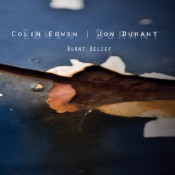
edwin_burntBurnt Belief is an energetic and varied prog-based excursion from Porcupine Tree bassist Colin Edwin and guitarist Jon Durant. The eight pieces here mix the complex with the cool, churning them into a thought-provoking, must-listen mass. The hook comes straight away, as  “Altitude” describes the sighing, ambient sound of Durant’s signature “cloud guitar,” the thick, round tones of Edwin’s bass, and the way in which they’re going to get along just fine. Durant begins, assisted by small tangles of electronic burble that will manifest itself into a light sequencer beat. Edwin’s bass steps in one patient note at a time before getting comfy and deciding it’s okay to ramp things up. Durant’s guitar takes the cue later in the track with the first of many blistering solos. Here is also where you’ll catch wind of the Middle Eastern tinge that glides through much of the music. It’s a musical masala made up of Durant’s elegantly carved guitar lines, touches of snappy tabla, dumbek and more on some tracks from Jerry Leake, and the serpentine potency of Edwin’s bass. I’m a huge bass fan, so this disc offers me a lot of love. “Impossible Senses,” for example, where Edwin’s rich lines slick their way over sharp raps on the tabla from Leake, laying down a bed for Durant to shred across. Just to note: While Durant’s delay-based cloud guitar style is his signature, let’s just lay it out here that the boy can absolutely rip it up in a blaze of  pure rock  attitude, and does so often, much to the listener’s delight. In fact, you get the best of both of Durant’s worlds in the dark, slow-at-first track “The Weight of Gravity.” In the early parts of the piece, the cloud guitar trades phrases with the bass. Midway, Durant flicks the switch and unleashes a snarling, rapid-fire array. I like the mix here, keeping the sharper edged guitar tucked just under the gurgling bass. It’s a great, well-thought-out balance. But getting back to that Middle Eastern taste: the flavor is also strong in “Uncoiled,”  with a cool pace and stretched notes that remind me of Shadowfax’s “New Electric India,” and the sultry “Semazen.” Geoff Leigh, formerly of avant-rock legends Henry Cow and Edwin’s bandmate in the Ex-Wise Heads, sits in on “Balthasar’s Key.” It opens on growling, king-sized chords roughened up with distortion, and then in comes Leigh to counterpoint it with the high, fluttering flute. Leake again lays down the cadence. Durant not only flails away on the axe here, but also anchors the rhythm section with smooth electric piano tones. This is just a big, meaty jam that requires you to turn it up. Edwin and Durant bring the ride to a close with the quiet song, “Arcing Towards Morning.” Durant takes up his acoustic guitar here, along with piano, and the duo lay out a sort of late-Windham Hill feel. It’s small and intimate by comparison to the rest of the disc, a perfect choice on which to end.

I have quite gladly spent a lot of time listening to Burnt Belief. It’s packed with musical adrenaline and wears it rock ‘n’ roll heritage proudly, yet it certainly doesn’t shy from its own intelligence. Crank it up and let it roar, or settle in to listen closely to the collective years of art-rock understanding at work. Either way, it’s a pure pleasure.

Available at Alchemy Records.

Frore: Undercurrent

Frore_UnderFrore (aka Paul Casper) heads into dreamily miasmal electro-shamanic spaces on his newest outing, Undercurrent. Employing  rattles, stones, digeridoo, shakuhachi, fujara, Tibetan bowls, field recordings and more to layer over long-form drones, Casper creates an hour-long journey reminiscent of Steve Roach’s more shadowy excursions. This is a darkly meditative disc, a spot-on bit of tribal ambient that oozes with primal memory and takes the listener well down into themselves courtesy of  big, horizon-spanning pads and soul-awakening percussion. It’s easy to get lost in, and to do so quickly. Undercurrent begins  with “Journey Internal,” rising out of a quiet, cave-like atmosphere.  The percussion kicks in to drive up the energy and fill the space. The sound thickens and deepens; the flute calls out like a bird from this tangled jungle of sound. It’s an energetic way of setting the stage, and gives us a peek at the elements ahead–the drums, the rich field recordings, the deep greys that form the tone overall, the shambling pace. Casper carries us deeper in “The Dreaming Ground,” guided by the resonating thump of a frame drum. (I won’t keep dropping Roach references, but this puts me very much in mind of InnerZone, a personal favorite.) The middle of this track is about where I surrender to Casper’s constructs and just cut loose into the flow. The small sounds at the periphery, the gurgle of the didgeridoo and the dry clatter of shakers, add a lot of subtle dimension. “Trial By Fire” is pushed along on some of the strongest percussion here, pounding a beat over soft, eddying flows. This one has a nice sense of ritual to it. For pure immersion, drop into the 18-minute centerpiece, “Emerge from Shadow.” A churning rhythm charts the course over softly wailing pads. The steadiness of the beat is hypnotic, and the flow is warm, wrapping around you like smoke. Casper manages a nice shift mid-track, easing out the rhythm and giving the space over to these silken sounds. It truly lets you focus on them, and just dwell in the wide space Casper has carved out. The beats are slowly and briefly folded back in, but you’re left to drift for the last couple of minutes. This fades to the closer, “Place of Shelter,” which is pure ambient. Casper lays out his wide-sky pads, anchored with a rich and earthy low end and lets the work coast to a soft and soul-cleansing finish. There’s a definite sense of the journey gliding to completion.

Undercurrent falls squarely in my personal wheelhouse. This is exactly the stuff I love–strong tribal overtones that shake loose our primal memories, textbook drone and ambient pad work backed with superb percussion, and a true sense of journey. That’s one of the strongest aspects of Undercurrent; you move along with it, pass through its shifting spaces, rise and fall with it, and emerge feeling the effects. It transports and  transforms the listener, and absolutely demands repeat play. One of the best tribal-ambient works I’ve heard in a while.

Available from Dark Duck.

Michele Cross and Joe Frawley: Dolls Come to Life

cross_dollsLet’s start here: breathtaking. No hyperbole. This collaboration between singer/songwriter Michelle Cross and sound artist Joe Frawley is the most interesting and emotionally powerful half-hour of music I’ve heard in quite awhile. Dolls Come to Life comes at you wielding two very effective weapons. The first is Cross’ voice, a gripping hybrid of a Kate Bush range, complete with quirky arcs and angles, and the turn-in-a-heartbeat duality of Tori Amos, that ability to flick the switch from wide-eyed, verge-of-tears vulnerability to a sharply worded, visceral threat. The story she tells through her lyrics is a raw wound we’re invited to look into and poke at. “No more dollies for you at Christmas,” she says at the start of “No More Dollies,” and it’s genuinely sad. Later in the track she drops firmly into Amos’ territory in both sound and lyric: “And how I hate the pretty girls/they all think they’re so popular/And how they shame an ugly girl/and so, I sacrifice myself.” At a break in the title track she asks, “How many times should I believe you?” and we have to ask ourselves what lies she’s been told. For pure heart-rending truth and sadness, there is her re-work of “My Favorite Things.” It’s sparse at first, with Cross’ words spilling out with the weary ennui of a disenchanted chanteuse. The revisited lines–“Valentine and roses and whispered confessions/Unwritten poems and soft-hearted villains”–make for a nice disjoint between what we know and where we’re going. There’s a beautiful drop and then the piece takes off. When Cross reaches, “And then I don’t feel so sad,” the piece takes a turn and blossoms into something striving toward hope. Layered vocals and big, rich piano reach upward, peaking with “Finally seeing a bad day come to an end.” Suddenly, we find ourselves back in simple sadness, and it arrives like a punch.  Toward the end, when she all but whispers “When the phone rings/and it’s not him,” it feels like she’s naked and face-down on the floor, one hand stretched toward a door that isn’t going to open, and that should be about it for your heart.

On the other side is Frawley, taking snippets from Cross and rendering them down with surgical precision into atmospheric elements. Frawley’s specialty is capturing in sound the rapid, jump-cut way our minds work. Moments flash past, things come up half-formed and changing, pain flashes past in an instant, still leaving a mark. Frawley sets that up, creating someone else’s memories and moments, then grabs us by the hand and runs us through it. Callback is a large part of the potency. We re-hear things we recognize, stuffed into different moments, and we’re freshly reminded of how they made us feel. He repeats a line from “Dolls Come To Life”–don’t lose the way–over and over. It keeps the theme of the thing together and makes us revisit the emotional core of the story. As always, too, he takes tiny moments of our natural sounds, like breaths between words, uhhs and wavering notes from songs, and uses them to heighten the overall intimacy. There’s a lot of atmospheric work here. Listen to the young girl’s voice counting off waltz steps in the title track, or the kids singing “Ashes, ashes” in the background. Static crackles, snips of conversation ghost past, a radio spits out Morse code. “Wish Thing” is a scattershot burst of elements reworked into fresh patterns. Low piano notes mimic restructured utterances from Cross, like a song that can’t quite find itself.

I can’t stop listening to this work. Between the pure impact of Cross’ voice and Frawley’s vivid sound-pictures, between the straightforward beauty of the songs and the constantly shifting thoughtscapes, Dolls Come to Life just hits over and over. It’s hard to believe, sometimes, that it’s only half an hour. A little weird, a lot of wonderful. Please discover this disc for yourself.

Available at Bandcamp.

Timothy Wenzel: A Coalescence of Dreams

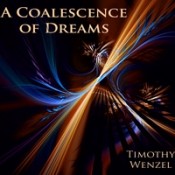
wenzel_dreamsCarrying the momentum of his well-received debut album, Mountains Take Wing, Timothy Wenzel returns with a fresh set of  New Age pieces on A Coalescence of Dreams. While Wenzel’s songs course across fairly broad New Age territory, he plays with the lilt of Celtic music throughout the disc, notably in the pleasant flute melodies in “Follow the River” and “Miles from Nowhere.” The title track is an engaging blend of choral pads and Wenzel’s lyrical piano. This one takes on extra dimension when dulcimer-like tones enter as accompaniment. The long voice of rich string sounds finish the blend.  Folksy acoustic guitar opens “The Road to Hana,” quickly joined by strings and piano. The cantering pace is catchy. It’s a traveling tune that sets the foot tapping but also takes a nice emotive turn–there’s something very personal at work here. For me, however, the go-track on this disc is the brilliant “Mountain Rain.” Opening with acoustic guitar, piano, and string pads, it moves gracefully along, fluid and calm. Then a shift–everything drops out except for hushed choral pads, underscored with a low string sound. It creates a stunning, spiritual moment that gains its strength from its simplicity. That passes, and the guitar and piano resume, joined by flute. This is a wonderful piece that really showcases Wenzel’s multi-instrumental talents. He’s not alone here, however; Michael Rud offers up some soaring edge-of-rock guitar licks in the late half of “Ice Wind,” and Lenny Lavash contributes drums to that track, along with snappy hand percussion on the closer, “We Walk Together.” This track was created in the throes of emotion stemming from Wenzel’s learning of his brother’s incurable cancer. On his site, Wenzel writes, “At around 2 AM I could not stand any more so I went to my keyboard and poured out my soul, every last drop of it. The keyboard was literally wet with tears by the time I finished. Exhausted, I could do no more. I could not even listen to the song again without crying.” It’s a fantastic piece, built on piano and sliding in and out of complexity in its arrangement. It has distinct phases, and is a truly affecting piece of music.

A Coalescence of Dreams is a straightforward New Age disc, beautifully played and designed for downtime listening. It may be too light a take for some, but on the whole it’s easy to enjoy and lovely at low volumes–but do yourself the favor of giving Wenzel’s work a close listen, too. This is a talented composer with a lot to say. New Age fans will want to keep an ear on Timothy Wenzel.

Available at Timothy Wenzel’s web site.

Pedrick Bitts Walker: Three

pedrick_threeWhile I am not a jazz reviewer, nor do I intend to become one, I am a long-time jazz fan and one-time jazz radio show host, so I can be kind of a sucker for jazz-based discs that arrive in the Hypnagogue mailbox. Luckily for guitarist David Pedrick, of Pedrick Bitts Walker, my personal favorite jazz arrangement is the trio–frontman, bass, and drums. Normally I like my trios headed by piano; I could listen to Bud Powell or Ahmad Jamal all day. So here comes Pedrick Bitts Walker’s Three, with guitar, bass, and drums, all improvising, live and unrehearsed and bound only by a “unifying concept…of designated meters, tempos and sonorities based upon the number three,” and soon enough I’m kicking back and digging into a nice set of exchanges and interchanges between three solid musicians. Pedrick, bassist Mike Bitts, and drummer Aaron Walker all share the front. Bitts’ work takes on a very lyrical feel in “Two” (the tracks are just their order number), playfully running alongside Pedrick’s picking and taking the lead late in the track. Throughout the disc he’s right there supporting Pedrick’s moves, laying out super-fluid lines and keeping the rhythm section locked down. Walker slides up front on “Four,” pounding away as Pedrick and Bitts keep pace with the click and check of muted strings, and is the skin-slamming superstar of  “Eight,” conjuring six minutes of serious thunder to an unchanging rasp from the strings. (It’s quite a way to end the disc!) Pedrick, however, is the “singer” of the trio, and his rich hollow-body noodlings are top shelf jazz. I like the Latin flair he brings to the title track, peppered with speedy runs up and down the neck. His phrasing is tight, and he knows when to dial it back and support. He plays with pleasing restraint; there’s no fear of wild avant-garde grandstanding here, just the pure shine of the notes. Although it must be said that he cuts loose a little on “Six”–but he could just be following Bitts’ cue as the bass has apparently gotten a dose of sugar, too, especially late in the track.

One thing that shines brightly on Three is the sense of sitting in some intimate club where you’re just feet from the stage, watching as these guys play and challenge one another and pull fresh directions out of the moment. The sound is clean and vibrant and the work doesn’t get bogged in the cacophony that can plague improv. Sit back and enjoy three musicians at play on Three.

Available from David Pedrick’s web site.

Caul: The Long Dust

caul_longdustBroad and dusky ambient vistas meet shuffling, shoe-gazey post-rock beats on Caul’s new release, The Long Dust. Caul (aka Brett Smith) brings a cinematic sense to his tracks, everything moving with a thoughtful slowness, the long, considered pace of deeply mulling something over. It’s like watching a series of long tracking shots, the camera panning and pulling back to reveal a lone figure. It’s moody and a little brooding, a mindset that’s strongly presented from start to finish, but which never bogs by getting maudlin. That’s due in large part to the beats and the guitar, the way they ground the ambient side. The slump-shouldered drum beats and the lazy twang of the strings serve to amplify the emotional effect of the edge-of-giving-up synth pads. The post-rock framework makes it accessible, and infuses it with a recognizable energy. The ambient side is a thing all its own. Tending toward the low end of the scale, earthy notes grumble and sigh as they spread out to form a somewhat bleak landscape. In the moments where it exists on its own, the ambient aspect is deep and potent, with its own definite beauty. The mix, therefore, ramps it up. “Relic” nails it early on with garage-band drums and a spaghetti-Western guitar. The synth pads moan in the background as Smith casually turns up the catchiness. The last 30 seconds are given over, to great effect, to the synths. This moves us into my favorite track, “Anointing.” The drums clatter, a bit on the ungainly side, over crying pads and chords. It’s a bit stark, bordering on minimal for two minutes, and then–oh, my, how it explodes in a sudden burst of power-chord joy. “Veil of Sand” also works upward from a sparse start, the loneliness of the guitar and drum combo offset by an almost hopeful-sounding blend of high pads and chorals. Even so, it retains a solitary feel. “The Road” has a roll-the-credits solemnity to it. Watch the main character walk off, only partially defeated, into a heat-shimmer sunset, accompanied by a resonating acoustic guitar. Smith builds in more elements to heighten the feel. Once again the backbeat makes it catchy even as it keeps its head-down, alone-again tone. A keening voice sings the last few notes alone.

I’ve seen this disc described as dark ambient. It’s not. It’s heavy, certainly, but it’s a stones-in-your-pockets emotional heaviness. It’s painted not in cloying blacks but in chromatic greys. It dares to show a little hope here and there. What it is, is human. This is a very human disc. It is vulnerable and sad and alone, but it’s finding its inner strength and going on ahead anyway. It has a story to share, and it’s told very well. The Long Dust will ping your emotional core and find something in there to make you a little sad, a little pensive. That’s how and why it works so very well. Another superb offering from Caul.

Available from Malignant Records.

Markus Mehr: Off

mehr_offYears ago, I had a college professor who described the effect of words in poetry as taking one palmful of rose petals, which have their own scent, and one palmful of some other flower petals, rubbing them together and then opening your hands again to discover the new scent that been made. I thought of this while listening to Off, the third piece of a triptych from experimental composer Markus Mehr, because the equation is somewhat the same. In one hand, Mehr holds simple and lovely piano melodies and string phrases; in the other, loudly hissing walls of sharply stippled white noise and random spatters of electronic chatter. These two elements are ground together, rubbed vigorously, and set free to fly in a new, engaging, and quite stunning new form that at once challenges the listener while celebrating a clearly well-considered balance. Off is a single 42-minute piece of constantly shifting character. The sounds clash and clatter, the air clears for a moment to allow the piano to speak, the wall of sound re-erupts and thickens, a sacred chorus chants its way through some storm-wracked hymnal, tense harshness vies with moments of clearing-skies beauty to return your breath back to you, and the whole time you are fully and hopelessly engaged. The contrast that’s hitting you squarely in the face, this overt pairing of clarity and corruption, of coarseness and calm, is hypnotic. Beyond the piano I wouldn’t even venture to guess what or how much of what Mehr has brought in to form his sounds. There is the electronic, there is the acoustic, there is the howling. And it all co-exists in this maelstrom of intent. Clearly, many of the sources at work are repurposed from Off‘s predecessors, In and On (read those reviews here), each of which were their own experiments. Off, then, represents in part the alchemy of all the disparate elements in one place. Where In was quiet and built to noise, and On started out roughly and pared back to calm, Off insistently puts them together from the start, then modulates the relationship along a constantly sliding scale.

Listening to Off is a challenge, but it’s an incredibly rewarding one. The balance is tricky, because the opposite ends of this equation are the far ends, but Mehr makes its work perfectly. You are pummeled with the unyielding intrusion of blatantly non-musical noise, and you are salved with the reassuring solidity of the piano, and somehow it makes sense. Yes, it requires an open approach to music. If you like it pat and simple, this won’t work for you. And maybe it’s not supposed to. The triptych as a whole has been slim on easy access points, but that’s also a hallmark of Mehr’s work–he’s not easy to listen to. He is, however, well worth the effort, and Off is perhaps Mehr at his most stunning.

Available from Hidden Shoal.

Chronotope Project: Solar Winds

chrono_solarJeffrey Ericson Allen, recording as Chronotope Project, takes listeners on a classic spacemusic voyage on Solar Winds. From the very beginning, this disc resonates with familiarity as it charts its own course to the stars. In five tracks, Allen creates a comfortable trip built on space-between-stars drifts, occasionally using uptempo sequencers to bring us up to cruising speed. The opening title track welcomes you with big, rich pads crossing slowly past one another to establish the spacey theme. A fantastic transition late in the track ushers in a shift that hits in the form of a percussive sequencer groove–it’s brief, but effective. From there the tone shifts back to the quiet side with “Raga of the Earth.” Here, a woodwind tone wafts introspectively over a bass-loaded drone and the unobtrusive exhalations of sighing-wind pads. A pleasantly meditative piece with a slight Eastern touch. This one works its way into you, body and soul–you may not be aware how much you’re relaxing to it until it ends.  “Sirens” livens things up, packed with star-twinkle glockenspiel chimes over rolling waves and vocal pads. A touch of harp finds its way into the mix. Allen captures a sort of feminine grace with this track, along with a very solid 80’s spacemusic vibe. It feels like a track you’ve heard before–and don’t at all mind hearing again. “Redshift” opens with more spacey pads before a beat works itself in by way of an insistent tone, something between the ring of a dulcimer and the sharp snap of a tabla. Allen uses it to ramp up the pace to the disc’s most energetic, building a rush of vibraphone-like notes with a Phillip Glass pacing. Even at that it’s still a pretty laid-back, toe-tapping kind of thing, a starfaring joyride that deposits us into the very hushed environs of “Clear Bells Ringing in Empty Sky.” The title tells you what you need to know. Gentle wind chimes sing their complex song over choral pads as Solar Winds winds to a calm close.

Solar Winds doesn’t go out of its way to do anything novel with the spacemusic framework, but the easy familiarity and the superb execution of the style make it very listenable. There is a wonderful softness to it, offset in places with the rigid maths of the sequencer. The balance is excellent. It’s quite loop-worthy, either as a pleasant backdrop or, as I’ve been doing, as a close-up headphone listen. Solar Winds is a very enjoyable journey.

Available from the Chronotope Project web site.