Asteroid Anxiety, Sedna II

aa_sedna“Recorded using a Sidrassi Qin,” reads the note on Asteroid Anxiety’s Bandcamp page. If I take that as written, that Sedna II was made using only this small handcrafted synth from Meng Qi Music, then I’m doubly impressed with both the instrument and this album. Sedna II moves from deep darkness to enveloping drifts over the course of an hour. It has its challenging stretches where thick skeins of noise aggress against the listener’s ear, but that makes for a smooth balance in contrast to stretches where the sound simply runs deep and quiet. That balance is something of a saving grace for me with this album. While I get the whole noise concept, I tend to have only a moderate tolerance for it. But here, Asteroid Anxiety makes it work; the noise is functional and not overpowering. It never feels like “let’s twist this knob and see what comes out.” Rather, it’s a judicious application of texture designed to augment this sonic story. Given my own personal tastes, I’m more involved in Sedna II during the long quiet stretches, such as in “Sedna XXXVI,” and the way they at first quiet my mind and then build out of their docility into something richer and more active. “Sedna XXXIV” reaches points of near-stasis, long exhalations infused with pure patience. From there, Asteroid Anxiety slowly folds in edge-of-feedback sounds and a darkening atmosphere that never quite completely closes around us.

For a largely experimental work, I find that I enjoyed Sedna II more than I thought I would. There is an underlying deliberateness to it, the feel of a slowly executed scheme being laid out before us. Yet it also holds an air of being of the moment, the semi-certainty of sound that comes with hands-on synths like the Qin. Sound development can happen on the fly and it lends that elegant sense of imperfection adjusted into perfection. The work here is sparse and a little dark and won’t appeal to everyone, but the ride is very deep and nicely constructed, with solid dynamics that catch hold and keep your attention. Take a chance on this one.

Available from Bandcamp.

Blake Gibson & Robert Davies, Quiraing

blake_qirAlthough I must admit that I am not familiar with Robert Davies’ work, despite his being a recognized and prolific name in ambient, I have been a fan of Blake Gibson’s music as Broken Harbour over the last few years. That appreciation continues upon listening to Quiraing, the first collaboration between these two artists. This is a very deep, very immersive drone-based release, shadowy and lush. The basic chemistry at play is to match whispering, sometimes gritty low end sounds—I assume from Gibson, for whom it’s something of a signature—with softer ambient washes and the occasional field recording. This is another of those albums that never raises its voice, relying instead on its skillful layering and the interplay between sounds to carry the changes in intensity. This is most definitely a headphone listen. The detail work runs very deep, whether it’s the well-tempered use of nature sounds, from the chirps of small birds to the full-on cry of gulls in “Lochs Obscured,” or just the inclusion of small, vital sounds that add dimension to an evolving set of layers. Gibson and Davies also keep a careful eye on the dynamics. They guide it skillfully up and down the scale, moving, for example, from the big, dramatic tones of the title track to the spacey, floating feel of “Seaside Surreal.” “Moorlands” pours on the density again, building itself into a broad, hissing wall of sound, to be followed by the lighter “Stone Circle” with its appropriate air of mystique. Best of all, both sides of all the equations in play—the light and heavy, the dark and less dark, the rough and the smooth—are played equally well, and nothing in the several changes of tone disrupts the voyage. It flows sensibly and organically, and once it’s got its hold on you, you’re in for the whole ride. Gibson and Davies close out Quiraing by taking a bit of a risk—one that I feel pays off. Coming out of the brightness of “Sunshowers,” the last track, “Only Rain,” is five and a half minutes of exactly that. Rain. Like a classic environmental background tape, Quiraing winds to its close giving you an opportunity to just be soothed by nature. Strangely enough, it’s not hokey. It’s not out of place. It’s just…relaxing.

I have given many hours over to Quiraing, gladly, and I keep finding more to hear. It’s a beautiful piece of work that captures its theme perfectly and draws us fully into the vision. This is one to let loop, and it’s as good at low volume as it is up close. One of my favorite releases this year. Get this.

Available from Databloem.

Intersonic Subformation, Post Apocalyptic Flower Shop

interson_apocFirst off, great title. That alone made me want to hear this release, and then the music absolutely paid it off. So what is the music, you ask? Ah, well, that’s a trickier thing. As Intersonic Subformation, Richard Lisaj does an excellent job of dodging conventional tags. The four pieces on Post Apocalyptic Flower Shop have their own unique identity but each show elements of dub, electro-acoustic, and traditional EM. The ride is over in less than half an hour, but what an interesting ride it is—even if, after listening multiple times over, I can’t quite find the words to explain it. “Roses (White: Voices Inside Darkness)” could be seen as the ambient track. Or more-or-less ambient. Waveform pads rise, expand, and fade over chimes and a quiet bed of clattering percussive noises. Something in the tone puts me in mind of the theme song from Twin Peaks. “Orchids (Pink: Beauty—It’s Neither Lost Nor Found)” brings guitar into the mix, the warm acoustics lending a folk-like feel over chugging electronics and more pads. This, obviously, has the strongest electro-acoustic side and also pings certain unidentifiable retro centers in my brain. Wait, I know…it’s dredging up memories of Oldfield’s Amarok in places. (Big synth chords late in the track sound so very familiar…) “Lilies (Yellow: Timebent)” gets a bit Berlin-ish with spacey twirls off the synth and sliding guitar notes. The keys take over, mid-track, and Lisaj does his best to numb out brains with repeating notes that warp and wobble as they pass. “Tulips (Purple: Welcoming the Unknown)” comes out with a super-strong retro feel courtesy of a tick-tock sequencer rhythm and noisy electric crackles. You will be excused for thinking you’ve slipped into an old Tangerine Dream track. This is the longest track on the album at 13:30, and Lisaj plays with form as he goes. While the track stays true to its beginnings, it changes shape slightly, re-expressing itself a couple of different ways, all of them equally fun.

Overall, Post Apocalyptic Flower Shop is a lot of fun to dig into. It feels like Lisaj builds each piece a bit more on the last one—an idea that’s borne out a bit by noting that each track is longer than the one before it. Clearly, I like this as much for its retro vibe as for its modern, innovative side. I like when familiar sounds are bent into fresh shapes, that workable blend of “this is where we were, this is where we are.” At less than half an hour in length, this one skates right past, but will garner its share of repeat listens.

Available from Petroglyph.

Phobos, Sector Four

phobos_s4Over the course of a dark, droning hour, Phobos’ Sector Four lays out textured, impressionistic ambient to capture the vastness of some as-yet-unexplored corner of space. If you are patient and enjoy a certain sparseness of sound, this album will suit you well. Artist David Thompson gives himself the full stretch of time to slowly build his imagery and while there is a constant dynamic at play, it’s certainly not in a hurry to get anywhere. Although it is a single long track, Sector Four feels like it passes through three stages. At first, Thompson keeps things on the very quiet side, using the long drones to cut your mind free and set it adrift. Which, of course, means you need to listen to it a few times to make sure you’ve heard all of it. You’re going to lose some listening time to spacing out. After about half an hour, Thompson subtly ups the intensity; the textures are more tactile, an edge of urgency works into the sound, and everything becomes a bit more full. The landscape remains vast and desolate, but now features more detail, more mystery. The changeover works especially well after you’ve been lulled into willing submission. In the last shift, the whole thing rises up in tone, density and intensity, brightening up like we’ve discovered something. The end of our journey is upon us. It’s not an all-at-once change, however. Thompson takes us around the far side of whatever place we’ve reached, passing through its shadow once more before being able to breathe easy and admire the view.

Admittedly, I wasn’t crazy about Sector Four when I first listened. The beginning is extremely sparse and it stays that way for a good long while. It was only later, having looped through it a couple of times, that Thompson’s patient plan became more evident and I was able to appreciate the subtlety of how the album shifts. There is a well-defined through-line in play, an arc that satisfactorily resolves itself if you give it time. In the meantime, the work here is solid ambient/dark spacemusic that stands up to a close listen but also shines at low volume. It’s got darkness without the weight and fear, and hits a good spacemusic feel without resorting to tropes. A voyage very much work taking more than once.

Available from Bandcamp.

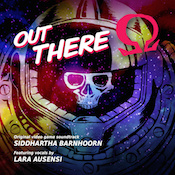
Siddhartha Barnhoorn, Out There Omega Edition

barnh_outAlthough I’m not in the habit of reviewing game soundtracks (nor do I intend to be), Siddhartha Barnhoorn’s accompanying score for Out There: Omega Edition could easily find a slot in the collection of your average spacemusic fan. These are small slices of music, with 23 tracks crammed into less than an hour’s time, each a well-made expression of some aspect of the game’s celestial landscape. Expect plenty of standard science fiction tropes in the music, from twinkly starlight things to the deep, bass-loaded chords of a black hole. Expect also for there not to be a real discernible through-line. While the soundtrack flows nicely enough and the music is pleasantly spacey, we’re not able to forget that Barnhoorn is actively writing to fit particular moments within an existing framework. One effect of being handed all those bite-size snippets is that I find myself wanting to hear more of the ideas expressed more fully. As with his debut album Pillars of Light, which I reviewed in 2011, I feel that the constrictive framework here really hampers the listening experience. Within the confines of the game, I am sure it works well. Tracks like “Out There I” and “Supernova” show a lot of interesting potential as they break the background-music mold and reach for a fuller form of expression. Barnhoorn’s “longer” tracks, “The Story Unfolds” and “The Final Chapter” allow him more running room, and they are, perhaps unsurprisingly, some of the best pieces on the album.

By his trade, Barnhoorn is a soundtrack composer with more than 70 films to his credit, and he certainly has found a niche for himself in game soundtracks. (The last piece of his that I reviewed was for a game called Antichamber.) And while Antichamber and this release have been fairly interesting and I appreciate the opportunity to listen to them, since Pillars of Light I’ve been waiting for a bigger, more expressive standalone ambient/electronic album from him. I always enjoy listening to his work; personally, I just want more out of it.

Available from  Siddhartha Barnhoorn’s Bandcamp page.

Marsen Jules, The Empire of Silence

jules_eosYou could hit the internet and look up whether or not the Inuit actually have a bunch of names for different types of snow, or you could take Marsen Jules’ word for it and dive into his interpretation of nine of those words on The Empire of Silence. I don’t know that there is much more to do here than sit back and let these ambient sounds drift quietly around you. Marsen’s very patient constructs melt easily one into the next. An hour passes without much to mark the time. (An hour and a half if you get the 38-minute bonus track.) You just get a little lost in the steadiness of the drifts and the overall calm. Here and there sounds may glimmer a bit and a chord might rise up for a moment of notice, but otherwise it simply breathes around you and carves out a nice, quiet spot. While The Empire of Silence is a quite beautiful album, it’s also one that seems content to rely on its simplicity. Definitely one to use for your next meditation session, or just to let loop at low volume as you go about your business. It is soothing and pleasant, but doesn’t necessarily hold up to close scrutiny.

Available from Oktaf.

Ken Elkinson, Music for Commuting Vols. 7-12

elkin_mfcAs far as I can figure, Ken Elkinson is one of those composers who has a whole bunch of stuff dancing in his head and he just needs to let it out sometimes—in huge chunks. In 2011 he gave us the first six volumes of Music for Commuting, followed that up in 2013 with two volumes of Music for Telecommuting, and now drops another six volumes of the first on us. (To say nothing of the 14 albums in between…) Music for Commuting Vols. 7-12 is 60 tracks of Elkinson’s soft, light music, the kind of stuff you’ll use to underscore your day. With this collection, I find myself drawn more to Elkinson’s ambient-style forays than to his poppier, rhythmic ones. Problem being, the underlying style doesn’t seem to change up that much. The overall arrangement is soft-edged keyboards and breathy pads paired up with chime-like tones that bounce about charmingly. In places it lands with a bit too much of a leftover Ray Lynch vibe (lookin’ at you, “Data Packet”)—which, in doses, is not a bad thing. I have always liked Ray Lynch’s work…in doses. So while the retro ping can be fun, here (and, again, we’re talking about 60 tracks) it happens too often for my tastes. When Elkinson plays in quieter fields, it works very well. “Icicle Rain” is a perfect combination of sighing chords, that hushed organ sound, and a gently percolating accent to round out the imagery. “Desert Valley, Wind” has caught my ear consistently over my several review listens. It’s got a slight air of melancholy crafted in long-held chords and a melody that sings almost to itself beneath, on what sounds like a melodica. And while “Loosely Held Firecracker” sounds like it should be more uptempo, it’s a rich ambient-style drift specked with twinkling electronics. “Penumbra” makes the most of big chords and a rich string sound as it spirals upward.

For me, Music for Commuting has worked best as part of a bigger shuffle. I like Elkinson’s music. It can be playful, it can be emotional. It’s familiar, usually in a good way, and it’s easy on the ears. Big batches of music like this need to be broken up, anyhow, to avoid revealing its underlying sameness. Blended in, these light, bright pieces pop up as aural palate cleansers and mood adjusters. Give it a listen, and see if it has a place dovetailed into your own queue.

Available from Ken Elkinson’s web site.

Chris Russell & eyes cast down, Memory Palace

russ_memoryMe, upon receiving Memory Palace: “Excellent! A collaboration between two artists who do lovely, quiet stuff.” Me, after listening: “Wow! That was not what I expected!” Perhaps my expectation was skewed; both artists, Chris Russell and eyes cast down (aka Greg Moorcroft)  do tend to work shades of darkness, hints of dissonance and touches of tribal into their individual work. But here, they ramp all that up into a pulse-driven, drum-loaded outing that still speaks most often in a restrained voice. Having called out another artist for adhering a bit closely to the Steve Roach model, I would note that bits of it show up here as well. The opener, “Primitive and Prime,” is familiar territory, pushed along on space-opening drum work from Moorcroft and wide, misty atmospheres from Russell. The influence is clear but the piece stands alone based on its deep groove and the deliciously hypnotic quality of the electronics. You get it again at the end of the disc with “Somewhere the Circle Stops,” which sounds much like a lost track from Roach’s Trance Spirits. Moorcroft takes the front here, weaving several drum lines into a complex and potent structure. Russell’s soundworlds here move as slow as incense smoke, soft washes that sometimes take on a growling, almost didgeridoo-like edge. Outside of that, while the influence still colors the proceedings, Russell and Moorcroft head off into their own zones. “Spatial Mnemonics” has an industrial clatter to it, all serving more of the kind of interlaced rhythms that are the centerpiece of the album. It’s a little dark, and it works. “Touchstone Array” is a fast-paced piece with an up-front analog feel. Glitchy snips of sound tap out a rapid-fire rhythm over slow pads for a nice contrast. However, my only complaint on the whole album comes from this track. The lads play with some high-pitched sounds, one of which sounds—to me—like a kid’s party favor bring blown in one ear over and over. Just like that, I’m pulled out of the track. (It’s playing as I type this out and, honestly, I just want to punch it.) Luckily, that passes and I let myself focus on the cool electronic rhythm work. “Afterimages” quiets things down with an ambient flow lightly touched with (I believe) rain sounds, shakers, and the lightest touch of percussion on the whole album. There’s a very cool effect late in the track where it rises up just a little—a nice touch. On these five tracks, the artists allow themselves a wide time frame in which to craft each piece; the two shortest run about 11 minutes each. Within that frame, they explore and codify their chemistry and justify their initial decision to challenge themselves to do a beat-based album. Memory Palace is an excellent deep listen; Russell and Moorcroft both love their details, and they are plentiful here, so dig into them. An excellent collaboration between two good artists. Well worth listening to.

Available from the eyes cast down website..

Jonathan Badger, Verse

badger_verseListening to Jonathan Badger isn’t entirely easy. You have to get used to quick stops and starts, sounds that come running in to interrupt other sounds, complex signatures, and a near-complete lack of discernible through-line. And it can be fascinating. Verse gives us 10 tracks from a composer who’s clearly not afraid to mix things up, whether by individual tracks or within them. Straightforward post-rock moments arise, as on “St Lucy’s Day” or the initially calm and quiet “Limbec,” but Badger is just lining them up to get mauled into new shapes. “Limbec” makes a very smooth shift from a folk-influenced indie feel to something that suddenly has thick calls of brass and sparkly arpeggios that run in and out. Distorted guitar comes in bursts, crashing sounds drop in the background, and yet it retains an odd coherence. Nothing takes you out of the listening experience, odd as the sounds might be, but just adds another layer of interest. “Nimbus” opens with a dream-pop feel, with vocals from the Sisters Wick over acoustic guitar, breaks out into something more at home on quite trippy prog with fast guitar runs and distortion, and settles back into an actual song with an orchestral overtone. Then it’s gone, snapped off at a perfect point. Badger’s inventive guitar work is on display throughout the album, and is showcased on “Dotter.” This high-energy track boasts meaty bass and fiery runs packed into loops that take on weight as they go forward. “Ebarmen” plays with post-rock, taking something fairly straightforward, rhythmic and melodic, and then throwing in some off notes to tug at your ear and mess with your musical ideals. Throughout, though, it never quite loses its hook and you stay with it as much for its subtle groove as to see where it goes next. Verse is intriguing work for a generation deprived of their attention spans and fed on sound bites. It packs big amounts of intellectual and emotional data into moments that flash past on the retina of your mind’s eye and leave their branded impression. You remember the sudden, interruptive segments as much for how they didn’t seem to fit but did as for how they felt like they fit but didn’t. It may take a couple of listens to get used to Badger’s style and ideas, but the reward is worth the challenge. There’s some very cool stuff going on in here if you’re uo to it.

Available from Cuneiform.

K, Lumi

k_lumiA benefit of our digital music-making world is that in the right hands, it can take very little to do a lot. Lumi, the new release from K (aka Ivan Kamaldinov), was made using “a laptop, two midi controllers, and [an] iPod Touch 4 microphone for taking field recordings.” From that stepping-off point, Kamaldinov proceeds to give us work that is quiet yet dense with texture, calming overall but with the right amount of edge to keep us alert and paying attention. The texture most often comes in the form of small, static-like crackles that tickle the ear. On “Two,” combined with infrequent snaps, the impression is of the sound of a small fire. Long, brooding pads fill the atmosphere darkly. On “Six” the textures take on something of the feel of creaking wood; a washed-through sound in the background whispers like water, the overall effect that of being adrift. Sharp tones and moments of dissonance lend a mildly unnerving edge. In other spots, the textures fade and the slow drifts set about the business of lulling you into a quieted state. “Four” and “Five” blend to carve out more than 20 minutes of ambient bliss. “Five” catches your ear with reverse-echo-style tones over trembling pads. There is quite a bit of music here—the eight tracks cover 81 minutes, but the time passes in a haze. The texture work is kind of the star of the show here; it adds interest, tension, and imagery, all without ever being interruptive. It provides the listener with a viable reason to take a deep dive into the sound, but the album as a whole makes for a perfect ambient looping piece. Very much worth grabbing.

Available from Timbrae.