
 Collective Acoustics return to gleefully smash together heaping helpings of jazz, electronica and experimental music. Art in the Age of Progress finds the core trio of George and Geoff Hazelrigg (keys and bass, respectively) and Eric Hastings (drums) pulling in extra sounds, including pedal steel guitar, trombone and sax, courtesy of talented friends. On this outing, the electronics are kept mostly at the periphery, a light-handed flavoring of extra interest laid over the group’s strong jazz-trio base. The classic three-piece set-up makes the perfect stepping-off point for CA’s explorations, and the pieces where it’s the strongest are some of my favorite tracks on the disc. The opener, “Follow That Kite,” kicks off with rapid-fire arpeggios up and down the keys while the rhythm section holds things steady. This is where your first taste of those small electronics touches comes in–a low buzz here, a twiddle there, just enough to catch your ear. It must be noted, though, that the electronic aspect is sometimes given a little more breathing room. “Resolution” (which features an original instrument called the buzzaphone, played by Matt Glassmeyer) has an almost sequencer-like feel at the outset, then breaks into a great electric piano riff. Speaking of which, I drop right into tracks like “Conflict” and “Carnegie Lake” with their funkified, 70’s electric jazz feel. On the sweet groove of “Carnegie,” George’s keys recall a plugged-in Corea or Miles’ electric-epoch Hancock. Listening (yet again) to “Conflict” also makes me need to note that Hastings’ drumming is a real standout on this disc. Ranging from strident to flair-filled, it anchors everything in the tradition of solid jazz. (Pick a good name from Blakey to Gadd; he’s in step.) It’s kept sharp and strong in the mix, from crisp snare snap to resonant whacks on the toms. It’s a pleasure to listen to his technique. Catch him flailing away in “Marianas Trench,” his hot-foot pace laying perfect counter to the Hazelrigg’s slow-descent blend of lazy bass and down-the-scale piano. If your tastes run on the jazz side of the street and you’ve got a bit of an adventurous soul, you need to catch a listen to Art in the Age of Progress. Expect to become a Collective Acoustics fan immediately thereafter.
Available from the Collective Acoustics web site.


 Steven K. Smith’s guitar is a drill. An industrial-grade, flaming drill that grinds its way into you with unforgiving force the moment Smith lets it fly. And on his new release as A Signal in the Static, Transmissions from Yesterday, that moment comes about 90 seconds into the first track, “Message from Arecibo,” and rarely relents over the next 38 minutes. Smith’s signature is a raw, aggressive cliff-face of sound that smacks of alt rock that’s decided to go on a joyful killing spree. The dense thrash of chords, the mad yowl of feedback, the unabashed fuck you simplicity of three-chord punk turned into its own somewhat more sophisticated descendant, serrated around the edges like it’s being played too loudly on an amp that can barely handle the load—it’s goddamned magnificent. Transmissions puts its post-rock credentials clearly on display. (In fact, much of the stuff here drags up aural memories of listening to Wire.) Crunched together though the sound is, each track packs its own distinct melody, and many of them ring with rock-echo familiarity. You hear it in the deliberate up-the-neck progression and growing intensity of “Sirus B” and the rain-of-fire flail of “Lost Transmission,” driven by pound-for-all-you’re-worth drums. But I should point out that it’s not all snarl and yell. Smith dials it down a bit later in the disc. The rhythm on “They Can Hear Us From the Stars” is metered out on clacking sticks while a snaky bass line curls under a burble of noise. It’s about as calm as Transmissions… gets. Smith clearly loves playing with depth of sound, just piling it on to see what emerges through the haze, and there’s a joy in listening to someone just hammer away at the strings like they’ve just discovered what makes rock rock. This is a turn-it-up disc, a half hour of pure sonic catharsis. Come on. Come to the drill. Open your ears and let it purify your soul.
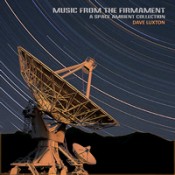 Music from the Firmament is my first exposure to Dave Luxton’s work, but this disc lets me play a bit of catch-up. Pieced together from works previously released between 2008 and 2011, this hour-long journey is crafted in neatly executed spacemusic memes with a flowing, and at times symphonic, New Age timbre. Choral pads sing high, soft notes in a suitably ne0-angelic way, electronic spacewinds swirl and the stars glitter and blur as the listener glides through Luxton’s interstellar constructs. It’s a comfortably familiar journey; Luxton isn’t reinventing the sonic starship here, he’s just painting a good, vivid image of the ride. From the light liftoff of the opener, “Worlds Unknown,” to the thematically dense and appropriately worrisome dronework of “If the Sun Fades Away,” Luxton does a great job of modulating the flow to create moments when your awareness rises back up out of the comfortable lull. The requisite radio voices in “Return to a Distant Star,” filtered through the wash of waking-dream pads, anchor the listener to the real world. There’s a definite hold-your-breath beauty to the easy drift of “Shadow Clouds”; again, it’s not a groundbreaking piece–you’ve heard its like many times before if you’re a spacemusic listener. It just happens to be very well done, Luxton’s minute pauses between pads timed just right to amplify the feel of the next one. Here, those minor shifts carry enough impact to make you come around to take notice. I have gladly taken the round trip on this disc several times over; the uninterrupted, consistently smooth flow loops without you even noticing. I suggest having a seat and taking Music from the Firmament‘s first-class ride.
 I was admittedly smitten upon first hearing Radium 88 when I received their disc, Only Science Can Tell Us the Truth, a few years back. Then they seemed to drop off the radar. I waited for their return. Eagerly. So when I received Escaping Tomorrow, their newest release, I (again, admittedly) gave a little hooray. But I find myself in an odd position. Escaping Tomorrow sounds and feels like a near-seamless continuation of Only Science… to the point where part of me is having a wonderful time re-encountering Radium 88’s absolutely engaging blend of electronica, shoegaze, and ambient, while the other part was sort of hoping they’d show me something new. This, let it be noted, has in no way stopped me from playing and replaying Escaping Tomorrow. This is Radium 88’s signature sound, a template they’re happy to hold onto, and it’s so infectious it’s hard to fault them. I get caught in Tim Thwaites’ burbling, near-electro-pop rhythms and simple four-count arpeggios, and something giddy happens inside me the moment I hear Jema Davies’ ever-so-soft voice, the perfect mix of angel and Anglican choirboy packing an emotional, you-must-pay-attention punch. She sings with a patient cadence, an almost boxy structure that gracefully counters Thwaites’ rolling sounds. The Radium 88 sound is further padded out and deepened by vocals and violin from Clare Hunt (her strings coming through strong and beautiful on “The Angel of Final Warning”), guitar from Matt Clare (his spy-movie-cool playing makes “The Man Who Was Not Himself” shine), coronet from Mike Clifford (again, check him out on “Angel…”) and clarinet from Joe Thwaites. It’s a unique sound that has yet to wear out its welcome and, admittedly yet again, was very much worth the wait. Expect lots of repeat play for Escaping Tomorrow.
 Because Praguedren’s Serfs of the Plant Kingdom is only 28 minutes long, and because it’s quite good, and because it’s very easy to get lost in, there’s absolutely no reason not to just put it on loop and let it trip its ambient-psychedelic way through your head two, three, four times. The duo of Tomas Effliger and Sector 17 pull together seven dream-like drifts gently dusted with slight dub effects. Echoing rim shots snap across cool yawns of sound, drum pulses quietly wobble off into the distance, and the whole time the duo spin out warm, unhurried clouds of ambient. I like the way this disc works its way down into its quieter environs. The title track, which kicks off the disc, is the most beat-driven piece, riding in on a standard backbeat that gets tricky with a little stutter-step here and there. Its followup, “Helical,” spreads out like ripples on a pond, packing smoothly undulating waveforms designed to bring on a little low-level hypnosis. From there, as the drifts get more and more vaporous, as in the nearly ethereal, spectral tones of “Ghost Castles,” the touches of beat become your lifeline back to solidity–but drift, my friends, drift, safely encased in this very plush cocoon of sound. The duo reconnect with the real world on the closing track, nudging the softer tones to the back. It borders on being a little interruptive after “Ghost Castles,” the chords in that fall into the foreground feeling a little harsh and metallic in spots. It’s a wake-up call, but it could be gentler. Don’t let it stop you from going around again. The ride is brief, but the ride is so very deep.
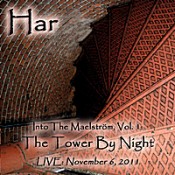 As part of his weekly Nightscaping show on StillStream, Har regularly performs live dark ambient improvisations. Luckily for us, he records them and has started releasing them as part of his Into the Maelstrom series. The Tower By Night is the first release, a live session that aired in November 2011. As Har notes, “It was performed entirely on his 8-string electric guitar, an extended-range instrument with two additional bass-range strings along with the other typical six guitar strings. A variety of playing techniques are used including two-handed tapping as well as treating the guitar as a kind of percussion instrument.” Pushing the sounds through heavy, real-time processing and looping, Har crafts an hour-long, very un-guitarlike flow of improv creations that wind their way in and out of dark-ish spaces. At points, particularly later in the piece, it can be downright calming–but only after you’ve made your way through more challenging passages. (The stretch that begins to roil around the 19-minute mark and grinds grimly forward for four or five minutes is a good example, particularly the way it dissipates into a softer moment.) Har modulates the ride well throughout the hour, his scene changes effected without the slightest bump. New tones slip in almost unnoticed before they move to the forefront and re-direct the flow. Because Har never drives the flow into the sort of cloying sonic abyss that typifies dark ambient, there’s never anything to pull you out of the flow. The shadows most certainly find their way into both the flow and the listener, but it’s so subtle and organic that you don’t push back. It’s a guided tour, not you being tugged into Hell. This is a release that you just give yourself over to. You’re in good hands, and Har delivers you back from your own inner-world excursion in one piece.
 In our ever-so-digital age it’s not uncommon for artists to wade into their back catalog to dust off old tracks, throw them back into the computer to clean them up, then present them anew, This is what the duo Integral (David Rotter and Rafael Milatz) did as a follow-up to their debut, Rise. In fact, they hauled two discs’ worth of old material out of the closet for The Past Is My Shadow. When I reviewed Rise, I called the duo out for not doing much to cast off the standard-issue glitch mold. On The Past…, the offerings are more diverse–which they should be, given the amount of stuff here–while still grounding themselves in the cut-and-stitch model. For example, they slow things down on “CPU Fairy Tale,” laying in a borderline New Age keyboard melody over the glitchy stuff, but poke at it with a resounding steel-press percussion hit. “Pop Realta” churns with a solid Middle-Eastern vibe, the backdrop made from wavering heat-shimmer lines. On “Gitarsis,” a Spanish guitar sings its way through an onslaught of electro-sound, its beautiful steadiness offering a perfect counterpoint to the chaos. My favorite track here is “Synthie Raga,” a smooth cross-breeding of smoky dub, hand percussion, and guitar–and, of course, synth. This one just glides its way past, oozing cool from every moment.
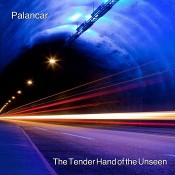 Whenever I listen to Palancar’s music, I am struck by the thought that composer Darrell Burgan must be a very contemplative, complex guy. His music certainly reflects this, always bringing a balanced blend of quiet and unease, soul-calming lightness and spirit-shaking darkness. His latest release, The Tender Hand of the Unseen, gives us more of that mix in a set of tracks that loop perfectly for a very deep listen. Burgan notes that the work is meant to reflect “the redemptive and instructive value of pain, as explained in Kahlil Gibran’s poem ‘The Prophet'” and that, due to losing much of the original data in a disc crash, what’s represented here are a set of intermediate mixes. Having listened to the disc a number of times before learning that second tidbit, I have to say that for intermediate mixes they’re quite complete. There’s certainly no lack of emotional connection when you’re adrift on the warm currents of “Sacred Tears” or when the edged shadows of “Seasons of Your Heart” begin to press in on you in the form of subdued, gnashing drones and the wayward clatter of tinny bells. (More than once I have found myself holding my breath in the middle of this, an autonomous reaction to the atmosphere Burgan has crafted.) Burgan’s sense of balance, following Gibran’s equation, shows itself well in “Bitter Potion.” This track starts as another teeth-clencher, rising up on torturously slow and dark drones punched with a clash of metallic/electronic sound like the fall of a whip. Half way through its 10 minutes it melts into a quieter space that retains sonic burrs at the edges. After enduring the first half, which is a very visceral stretch, the relief of release as Burgan stretches out his sounds is downright tactile. And when Burgan turns his intentions to the more meditative side of things, Tender Hand becomes a salve of calmness and deep ambient builds. The title track is a warm whisper of sound, long pads and high, falling chords blending with easy grace, This is a genuinely stirring, soul-touching piece of music, one of those works that reaches into you and nudges something loose. Warning: introspection may follow. An excellent release from Palancar; he hits his theme perfectly and leaves the listener needing to go through the experience again.
