
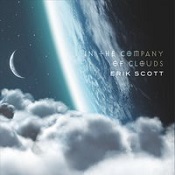
 Readers who follow me on Facebook may know I often take my review listens in the company of wine. Sometimes I also refer to music in terms of wine. For example, I have unrepentantly referred to some lighter New Age as “Chardonnay music.” In listening to Erik Scott’s In the Company of Clouds, I find myself thinking that for me it’s like a Riesling. I enjoy it although it sometimes borders of being a little too sweet, but under the right conditions and in the right mood it’s perfectly refreshing. On this beautifully produced album, everything is built around two dominant sounds: the sensual, round tones of Scott’s bass guitar and the saucy drawl of pedal steel guitar from John Pirruccello. If you’re not a fan of pedal steel, you may want to take this album in smaller sips, because it’s everywhere. It swaps between its familiar heart-tugging country-music feel, as in the opening track, “Nine Lives” and the closer, “The Long View,” and something a bit more bouncy and island-flavored, as on “Waves” where it comes in like an ocean breeze. Scott rolls in a host of side players, including ambient guitar maestro Jeff Pearce, who appears on “Breathing Room,” a piece that shimmers and yawns beautifully against a backing of light hand percussion. The players get their moments behind the bass and steel, and every track has a rich and full ensemble feel thanks to superb mastering and production from Tom Eaton. Chris Cameron brings piano lines that skip from the swelling romance of neo-classical to the riffs and trills of borderline honky-tonk on “Open Door.” Cameron and Scott swap phrases over big clouds of string pads. A lovely piece. Scott’s bass takes on a lyrical voice on “Seven Veils,” and I fall totally into the complex lines of his incredible playing. I can just envision his fingers zipping across the strings as he pulls this speaking/singing quality out of the instrument. I’m a sucker for good bass to begin with, so this lands precisely in my wheelhouse. The speedy joy of “First Cup” loads up on feel-good to get the heart racing. A tapping, dopplered percussion line adds character and keeps the pace up. I do have to say that not all of In the Company of Clouds is entirely to my liking. The “ooo-ooo” vocals on “Women of Avalon” are where this charming Riesling ups the sugar content a bit too much for me, and there’s an odd moment in it where we’re suddenly thrust smack into the middle of an Ennio Morricone western soundtrack. As much as I dig its sound, I could have used a break from the steel here and there. Plus, between the steel and the bass track after track, there are points where the album can suffer from a touch of sameness.
In the Company of Clouds recently nabbed Album of the Year and Best Contemporary Instrumental Album of the year at the Zone Music Reporter Awards, a prestigious competition in the New Age/ambient world. So my opinion, that it’s not superlative throughout, clearly comes with a few pinches of salt at the least. I enjoy it very, very much under the right circumstances–which is to say, mixed into my playlists, where I can enjoy Pirruccello’s fantastic and emotive steel without taking in too much at once and I don’t notice the sameness. I want to say that New Age fans should definitely have this in their collection, but that pigeonholes this refreshingly unique album. Rather: people who enjoy good, well-produced, catchy, engaging contemporary instrumental music should absolutely own this.
Available from CD Baby.
 My initial impression of Arrocata’s Man in the Maze is that it is exceedingly quiet. Not just ambient quiet, but whisper in the middle of a desert night quiet. Robert Straub apparently does not want to rouse you whatsoever as you slip through this 48-minute offering. Long, underplayed drones melt across breathy pads and everything gets coated in a light glaze of hush. Let me correct myself: there are occasional moments where the sound rises up briefly, like the start of “Looking Back,” but it almost instantly and somewhat apologetically quiets back down. For the most part, these pieces feel delicate. They never speak loudly, choosing instead to just course by. This becomes, paradoxically, both a strength and a weakness. Certainly, its lowered voice fortifies its contemplative nature, which is at its best in “The Gift.” Built on string pads and a hiss of rain, it seems fairly simple on the surface, but the mix of sentiment and sound effect create a vivid image and a true emotional core. “Day Break,” which opens the album, establishes the overall tone and also welcomes the listener with a familiar set of synth sounds. Grumbling low end pads and glittering higher notes waft easily past. “The Passage” shifts into a moodier, twilight-shaded space, but again never rears up, never does much more than pull its sonic thread slowly through your ears. “Rising from the Depths” is the most active track, as Straub laces in squibs of curling electronics and some breathy flute sounds. Straub’s music has tended in the past to have that Southwestern sort of flair to it, a light touch of tribal/shamanic influence, but outside of this track, Man in the Maze tends to keep away from that.
 I am hoping it is not too presumptuous of me to suggest that the musical chemistry between Tim Story and Hans-Joachim Roedelius borders on legendary. Each of their collaborations comes to us with a new variation of brilliance, a new way of playing with or discovering sonic expression, a fresh redefinition of the borers of composition. On The Roedelius Cells, we have Story taking piano improvisations by Roedelius and re-imaging and re-configuring them into new shapes and thoughts. Treating pieces of these solos as “found sounds,” Story─who came across them some time after they were originally done─set about making his own music out of what had been Roedelius’ music. So here we get the flowing, almost romantic lyricism of the originals, paired with a funkier, more playful cut-and-paste approach as Story isolates a few seconds’ worth of notes and blends them back together. In some pieces the stitch-work is not all that obvious. You hear it as a slight stutter in “Cell One,” the briefest of pauses between phrasing─just enough to catch your ear. It hides again in “Cell Four.” A slight click seems to mark the juncture, but there is also a perceptible sudden stop, an eye-blink of silence, in this pastoral stroll before the main phrase repeats. It’s also hard to detect in the surprisingly fast and vibrant “Cell Seven.” This jubilant piece feels virtually untouched, but listening closely reveals the interplay between its various loops, and it’s spectacular. At its core, it has the heart of minimalism, but feels so much richer and less rigid. A heftier sense of being in Steve Reich territory comes through when Story brings his strong but short repeating elements more forcefully to the front. “Cell Three,” especially in its waning moments, carries this vibe quite clearly. In among all the piano sounds, Story also drops vocal tidbits and “accidental sounds.” In “Cell Three” we catch moments of studio conversation, from variations of someone saying “I can’t hear…” to Roedelius’ charming “Ooh la la!” The use of vocals is even more effective in “Cell Six,” where Story sprinkles them among piano passages that seem to only barely match, harmonically. It’s a challenging piece, perhaps the most so of all the works here, so adding one more unusual element into something that’s already daring you to keep up is a fantastic touch. (Story notes on his web site that this piece “contains well over 450 … separate audio ‘events’”…) The final track, “Cell Eight,” shows off small, curling burbles of a signature sound that instantly call to mind the duo’s earlier collaborations, such as Lunz and Inlandish. One choice I quite enjoyed is the change of tone on “Cell Five.” Although still rooted in piano sounds, Story draws the instrument’s voice out, stretching and folding it into synth-like shapes. Placed in the middle of the album, it arrives as an unexpected but immersive ambient-style break.
 Chris Russell recorded Spectra after taking a hiatus from creating music. Getting back into the art again, he notes, “I decided to allow myself to merge with this project and just record a collection of vignettes to capture what manifested in the moment.” Russell has always been an artist who looks to explore fresh vistas in his work, and Spectra, by its exploratory nature, covers a fair amount of ground as it shifts through shadow and light. The opener, “Anake,” greets you with a dark wind and a sound like spatters of rain on a koto or zither, punctuated with sudden glissandi. Russell underscores this moody, slow-moving piece with crackles of static for texture. Things brighten considerably on “Vegha,” with pads that rise up shining, yet in spots have an interesting, almost industrial metallic feel. The gentility carries into the smooth and spacey flow of “Domoos.” It whispers its way past on crossing, nicely layered pads, matched for ambient style only by the even softer “Gada.” That track takes you into a dreamy cluster of warm, breathy pads to shut down your ability to have conscious thoughts for 10 minutes. A beautiful, fully immersive piece of classic ambient. Toward the end of the album, Russell heads directly toward the darkness. “Kadium” takes you down a coarsely paved path, edged in thick, immovable shadow. Sparse and grim, it’s an attention-getter, especially coming right after “Gada.” It gives way to “Keon,” which takes an almost minimal approach, building off a repeating bass thrum. There’s more excellent, almost indescribable textural work here, and the whole thing is anchored with a breezing drone beneath it all. The only minor misstep on Spectra for me is the title track, where Russell opts for a lead sound that reminds me too much of an electronic doorbell. It’s not a bad track, but that sound wears a little thin on me.
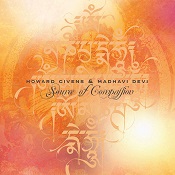 Here is a deep-breathing exercise in sonic form, and a firm reminder of why we enjoy meditative ambient. With calming, mantra-ready flows mixed with dancing bits of sequencer and hand percussion, Howard Givens and Madhavi Devi (Cheryl Gallagher) bring together an album that’s ready to be looped for blissful hours on end. More often than not over many listens, I have put Source of Compassion on quietly to play, then went about my business, letting it work its dream-inducing magic in the background, politely requesting my attention in various spots as it went along. However you choose to listen to it, there’s simply no escaping its embrace. The opener, “Intention,” gets the flow going with long pads and a slowly repeating melodic phrase. It rises into a pulse that softly massages your brain. Close your eyes and pay attention to how many layers are at work here, crossing and weaving. From there the album moves into what has become my favorite stretch, the combination of “Emergence” and “Omkara.” The first is a gliding, hushed ambient offering that unfolds itself over and over as you listen. A perfect 10-minute meditation, a butterfly wing of sound. The second carries that softness, then laces in a percolating sequencer line. Once again, the energy is subtle, more a suggestion of movement than an outright command to do so–but move, you will. The title track again immerses us in warm sound-clouds to accompany our deep breathing–which, by this point in the album, is pretty much unavoidable. “Pathless Passage” provides another nice dose of old-school thought, with a simple sequencer line going unobtrusively through its paces over a spacemusic framework. It picks up some vibrancy midway through the piece from a glistening arpeggio set just a bit to the back of the scene. “Connected Space” closes the album with the gentlest of hands at the controls. It comes on like dusk and fades gracefully into a quiet and reflective evening.
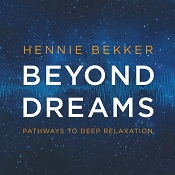 Pillowy clouds of melodic music are ready to comfort you as you take an hour-long immersion in Hennie Bekker’s Beyond Dreams. This blend of New Age piano with lush and spacey synth pads sets right to work in taking any rough edges off your day and letting you know everything can be all right if we just get quiet and breathe. Bekker nails the relaxation equation here by lacing in moments of subtle vibrancy, usually via easy sequencer pulses, allowing him to find─or create─a spot that lets the listener unwind, enjoy, refresh, and come away feeling good. Across all tracks, there is always enough small detail going on that deep listens are quite rewarded; but Beyond Dreams is also a solid candidate for low-volume background looping, or even as you’re headed off to sleep. Most tracks run close to or over 10 minutes, but all of them have that wonderful time-stretching capability, and the hour running time feels blissfully longer. Bekker slips from one track to the next through very organic, seamless transitions. “Self Connect” and “Floating to Forever” open the album with a soft spacemusic feel, the sort of thing that elicits long, contented sighs and gets you ready for the deep ride to come. Bekker’s piano slips in on “Floating…”, giving us a nicely grounded aspect to harmonize with the ambient side and nudge us into New Age territory. From here, the piano becomes more present. “The Calm” adds resonant chimes for a feel that hits a gamelan-like tone in spots, that recognizable hollow ring and touch of dissonance. It’s perfect against the romance of the piano, which in turn is aided by soft string and pan-flute pads. The satiny chords of “Quiesence” are underscored with a hushed sequencer pulse that gives it just a tiny touch of energy, a gentle velocity. On the title track, Bekker goes almost pure spacemusic, bringing back the chime tones to play under long pads and a steady bass drone. The genre-ubiquitous vocal pads, lightly applied, round out this drifting voyage.
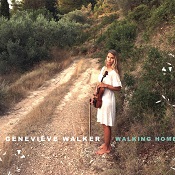 Here is an album I have been loving from the first listen, taken in completely by its rustic charm, calming voice, and heartwarming honesty. Genevieve Walker plays violin, viola, guitar, piano, banjo, and glockenspiel on Walking Home, working threads of folk, bluegrass, and chamber music into these tapestries, their own unique colors adding to the blend. Walker notes that these pieces take their initial cues from simple sounds, from the swish of a broom to, charmingly, the beating of her son’s heart. From what I can hear they’re not used overtly—if they exist as more than inspiration—but however she chooses to translate them into the music, it works. The violin is the star of the show, however, whether it’s singing in lilting trills or sighing across the strings to draw out long, melancholic lines. Her playing is fluid and heartfelt, reaching out to create a real, direct connection to the listener. The album begins with the casual stride of the title track, lead on the road by acoustic guitar and given sure feet by the low weight of Rebecca Foon’s cello. Pizzicato notes give it a little extra joy (which they also bring to “Cicadas And Light”). “Embryonic Voyage,” the song with its basis in her son’s heartbeat, is of course one of the happiest, most vibrant pieces here. It dances along with an almost gypsy-like undertone, the heartbeat taken up by light hand percussion. Banjo adds more of that rustic smile to the sound. In her quieter moments, Walker mines deep for strong emotions. “Sweep” is slow and graceful, approaching minimalism in its bare construction. But every note speaks, ringing with something very true. “Falling” is where we hear the strongest sense of a chamber music influence, a small ensemble of strings playing a delicate interweave of lines and using the thoughtfulness of the pause to great effect.
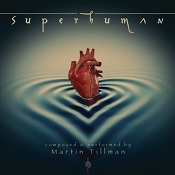 Ready to be stirred? To feel like you’re smack in the middle of a really good movie? Or several of them? With his experience working on a number of film soundtracks with Hans Zimmer, it’s no surprise that cellist and composer Martin Tillman brings plenty of vivid, cinematic narrative energy to his album Superhuman. The mental pictures are full-screen and the emotions are spot-on across all these tracks as Tillman moves from soundtracks in search of a scene to thumping club-influenced dance numbers. I’ve had a lot of fun listening to Superhuman despite the fact that, to be honest, it can be a little sweet for my tastes, a little heavily skewed to a New Age sound. Within that context, however, it absolutely works and will hold a lot of appeal for fans of that sort of style. And, admittedly, I have caught myself many times firmly grooving on something I never thought I would. The title track, for example, opens quietly but then spins itself into a very techno, whumpa-thumping thing. Tap that hi-hat, kick that bass drum, and set me chair-dancing without apology even as the synth hand claps and dance-music chords that should be pissing me off for their cheesiness are making me somehow dig it more. Damn it, Tillman, you made it fun. On another side of the equation I pick up─as Tillman intended─a cool Pink Floyd vibe off the start of “Celluloid Spaces.” Take a listen, and tell me you can’t hear Richard Wright in those keyboard chords “I wanted to do one track which covers thirty years of drugs from LSD to ecstasy,” Tillman says in his liner notes. The piece accordingly evolves through styles while keeping its thoroughly trippy edge. With “Cracked Diamonds” and “Translated to Beauty” we’re brought into Tillman’s sketches for a spy movie soundtrack. “Cracked Diamonds” has symphonic depth, complete with spiraling string stings for emphasis. It’s familiar and still original. “Translated…” gets its scene across with a shuffling beat, a whistling melody, and the lonely twang of a Goldfinger-style guitar riff. The album closes with the beautiful piece “The Invisible Shield of Strings and Bows.” which piles on a ton of emotion in another big, symphonic composition. It surges and rises on a classically romantic melody played out on strings and keys, building in potency until its quiet finish.
 Hypnagogue Music Reviews