
 Apparently, all it takes to make misty, thoughtful post-rock that skews more to the ambient side is one guitar, one bass guitar, and some effects. That’s the gear list at play on Rise from Stratosphere (Ronald Mariën). The seven tracks here feature spiraling loops that build and thicken, almost but not quite hiding their melodies behind walls of sound. What distinctly comes through that wall is feeling, pure and human and touching. The title-perfect “Melancholy” sets the tone, and also delivers the message that you need to throw on those headphones to take this all in. Mariën’s layers run deep, and it’s a pleasure to hear each one being smoothly slotted into place. “Hypnotic” wafts up slowly, grabbing long chords as it comes. Single notes ring out, opening the way for the more distinct melody line to come through. “Enmity” follows with long drones led along by sliding bass notes before breaking into a post-rock line. After the melody’s had its say, Mariën folds it back down into wavering pads and one final bass note. “Duality” seems like the first track to let its post-rock side take the forefront over the pads and mist. Late in the track, a big, potent wall of chords lifts up, its insistent buzz leading a shift in intensity. The last couple of minutes hit hard, and I like it. The album closes with “Explore.” This is eight blissful minutes of a long, layered drone peppered with small, almost chiming pings. (Again, get those headphones on!) It’s one of those tracks that doesn’t appear to have a lot going on, but its ambient voice and mind-massaging texture are super effective, and they bring the album to a meditative close.
There is some degree of sameness to Rise, as everything’s built on drones and loops, but Mariën so effortlessly folds one track into the next, it feels more like a singular journey that shifts its look. Every piece has its own distinct flavor, and as I will say for the third time, getting up close with this in headphone is imperative. Falling between minimalism and post-rock, Rise is well worth a listen.
Available from Bandcamp.
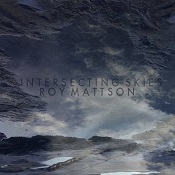 I have to honestly ask myself if I like Intersecting Skies just for its deep flows, or for how much it pings the Steve Roach reference points in my head. From the first few moments of this release I was finding analogues, no pun intended. In his efforts to capture the essence of summer weather in the northeastern US, Roy Mattson relies on a lot of Roach-esque sounds and styles. I felt like I picked up a hint of the grating stone sounds from Early Man on “Transitory Season,” caught some familiar tones in the tribal-style grooves of “Respective Realities,” and the tiny analog scritches and insectile burbles in “Unstable Atmosphere” launched me into memories of Possible Planet. Fact is, a lot of ambient artists draw on similar sound libraries or find ways to create familiar sounds in their own gear, so I’m not suggesting Intersecting Skies is derivative–it’s just not unusual for me to hear reference points in this music because of how much I listen to. It just seems like here, there’s a lot. Considering it regardless of its sonic waypoints, this release finds Mattson in his signature territory, a place where cloud-like pads hang out with field recordings and most everything moves at the pace of a comforting breeze. It’s a bit more active at the outset on “Transitory Season” as Mattson throws a bucket of sound sources out to play amongst each other. A sequencer line chugs along through the middle of it all. After “The Calling” slips down from its burbling start into a more distinct ambient space, we get a hushed flow that runs for several tracks. The title track and “Lichen Lattice” hit some very deep spots. Mattson increases his atmospheric colorings starting with “Humid Heat (Barometric Depression).” Field recordings of birds and wind play against the slow pads and super-light touches of percussion. This one moves lazily, the perfect feel for conveying the thick air of a humid summer. Crickets chirp on “Slate Clouds in Granite Skies” and the pads start to take on an almost watery hue. With “Electro-Static Release” a summer storm arrives, complete with thunderclaps and rain. This is what the album–and the weather–has been building to, and I like that Mattson doesn’t take this as his cue to make it all dramatic and over the top. He lets the field recording convey the storm, and keeps his pads going with cloud-motion grace. The final movement of the album, “Clearing Summer,” is loaded with the hopeful tones of a rain-washed sky, the way it always seems cleaner and brighter once the storm has passed.
 Hypnagogue Music Reviews