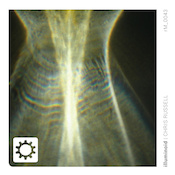
Chris Russell, Illuminoid

russell_illumDespite not being a particularly religious person, I have a long-standing fascination with devotional music. I have a big soft spot for gospel; classical masses stir my soul, with a special place reserved for kyries (none more so than that from Haydn’s “Nelson Mass”); I went through a long stretch of  digging into medieval Christian polyphony. There is something about the spiritual potency that comes with wanting to make a pleasing noise unto the Lord that manages to resonate even within my heathen heart. Which may be part of why I enjoy Chris Russell’s Illuminoid. In his “journey into the realm of the spirit,” Russell mixes ambient textures with varying forms of vocal expressions of devotion and ritual, from Gregorian chant to prayer to throat singing. On my initial listen, I worried that this was going to come off heavy-handed, something of slowed-down revisitation of Chant and everything Enigma’s ever done. But no. Prior to this release, Russell specialized in extremely soft and deep flows, richly layered and calming. That feeling is most decidedly here as well, and he matches that by not overdoing to vocal drops. The Gregorian chant in the midst of “Benediction” slides in and out of the ambient haze like a recurring memory; now vivid, now distant, now gone. The plaintive voice in “Hildegard” rises high above an ambient wash; Russell has found an amazing, heart-piercing song to use here. It simply stops time, and he dials back the sounds around it to let it shine. And if you like the soul-shaking rasp of throat singing (as I do), “Sanctum” is just the thing. Surrounded my slightly eerie drones that bring up memories of Roach’s Spirit Dome, this guttural prayer heads straight into your primal spirit. It’s not just about the voices, however. As noted, Russell’s base structures are tone-perfect ambient drifts, quite capable of lifting your mind up and away. I also like the rich pipe-organ tones of “Cathedral.” Big and sanctified-sounding and hit with a perfect touch of reverb to replicate the spatial aspects of a church.

Illuminoid is a bit of a risk. It would have been entirely too easy to overload the vocal side of the equation here and fall a bit too far into gimmick territory–a gimmick that’s been done enough. Russell manages to find a superb balance, which lets the singing retain its spiritual energy. It’s not shoehorned into beats to be something new. Instead, Russell builds around it and in doing so creates a nicely meditative release with a little extra boost for your spiritual side. Let it loop.

Available from Relaxed Machinery and Void Music.

Phillip Wilkerson, Wondrous Encounters

wilk_wondrousYou have already heard Phillip Wilkerson’s Wondrous Encounters because it graciously pulls from and offers homage to the pure spirit of its spacemusic progenitors. As he puts it, this is “a collection of space music, atmospheres, and soundscapes suitable for stargazing, or cloud watching, or cruising around in a flying saucer.” Once this album launches, you’ll spend the next hour and 45 minutes (thank you, bonus tracks) drifting through Wilkerson’s classically vast cosmic vistas, guided by his always-soft hand on the controls. From the clear, shining tones of “First Glimpse of the Milky Way” to the densely layered stratosphere of “Low Gravity Field,” Wilkerson conjures memories of the genre’s pioneers–Stearns, Serrie, Demby et ux. And it’s wonderful. Put on the headphones, close your eyes, and just go. It’s a seamless ride that will take you out of yourself for a while. I have to call out “Range Safety Clear,” the first bonus track, for the way it revels in delicious retro appeal. When I say that the keyboard sound that fronts it is a little cheesy, I mean that in an absolutely adulatory way. There’s a beautifully tinny sound to it that simply drips with the essence of 70s electronic music. Perfect sequencer lines run beneath, and for 15 minutes I’m back discovering electronic music for the first time. This one is a must-hear for spacemusic fans, and it’s a great addition to Wilkerson’s already impressive catalog of superb ambient.

Available from Bandcamp.

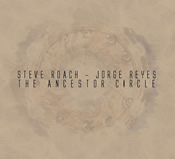
Steve Roach & Jorge Reyes, The Ancestor Circle

roach_ancestorBefore it even begins, The Ancestor Circle has its own air of mystery. The source material comes from “cryptically marked tapes” Roach found in his studio in 2013. Turns out that these were recordings Roach made with Jorge Reyes in 2000, at the time of their collaboration Vine~Bark & Spore, prior to a concert in Tucson. The Ancestor Circle recaptures what may be my personal favorite collaborative chemistry in the Roach catalog, the deeply primitive, ritual-driven desert-ambient meditations. This is the sound-set that forms the basis of some of my go-to albums, including the superb Suspended Memories outings featuring Roach, Reyes, and guitarist Suso Saiz. So listening to this puts me, quite blissfully, in familiar territory. The depth of sound, as always, is stunning. Analog pulses with a cool rubbery consistency lay down the beat framework, incense-smoke pads whisper like wind in the background. Wordless chants pack shamanic potency, a call to open the space. There is a wonderful twilight darkness to it; not cloying and oppressive but the darkness of our own primal spirits, the one still connected to our animal self. Roach has taken the source material, fleshed it out and tied it together into a continuous flow that pulls the listener in and down and keeps them there. This is certainly a space in which to lose yourself–or, you see, to find a version of yourself. In terms of the years-long evolution of Roach’s tribal ambient and desert ambient styles, The Ancestor Circle represents a vital component that had gone missing, but now slots perfectly into the narrative and builds on what already existed. What’s more, it is a fitting tribute to the talent and voice of Jorge Reyes, who left far too early in 2009. A must-have for Steve Roach completists, and a must-hear for anyone into tribal.

Available from Steve Roach’s web site.

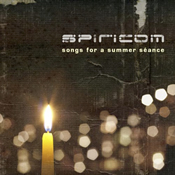
Spiricom, Songs for a Summer Séance

spiricom_songsLess than two minutes into “Voices in the Vortex,” the first cut on Spiricom’s Songs for a Summer Séance, I reached over and nudged up the volume. It was something of an autonomic response; my brain wanted Mark Cody’s fuzzed-right-the-fuck-up guitar to punch me a little harder. That’s your point of entry on this sophomore release: a big, aggressive, fist-in-the-air post-rock piece, complete with driving drums from Steven K Smith, who also handles keyboards and synth guitar. Once your heart rate has been driven up, Cody and Smith dial it back a little for two tracks, focusing on the kind of spooky, mystical air the title suggest. “Identify the Moved Objects” has its own snarl as Cody trades licks with some big, bassy synth chords, but then fades into sighs and a quietly picked melody. “Watching the Spirits Leave” starts darkly, on growling drones and vocal samples. The sounds swirl into a hypnotic haze, with Cody laying bright repeating notes over the top. But you’re not getting away that easily. On the title track, which takes up just about half of the entire release, Cody’s guitar will come back to rip and flail and bring us back around to the kind of nasty power that kicked it all off. It opens in post-rock territory, establishing its verse, if you will. Around the three minute mark, the first wave of unleashed guitar hits–big and beautiful and brightly distorted. Cody and Smith drop things out to a calmer space for a while, constructed in background sounds and long, wavering chords. You know the phrase, right? The calm before the storm? Yeah, that. Listen to this piece build itself back up in intensity. The percussion takes on a touch of tribal, the flavor of ritual, as static-splased radio voices babble at us urgently. Then you’re locked in as it grinds upward into an absolute hurricane of sound, screaming in your ears as the guitar revels in thickly distorted rock joy.

I’d give Songs for a Summer Séance high marks based on the last track alone. The fact that it lands with such impact in just 30 minutes? Bonus points. Everything about it makes me want to listen to it just one more time. According to the Spiricom web site, this EP is a little musical layover while Cody and Smith finish up their next release. To that, I say: HURRY. UP.

Available at the Spiricom web site.

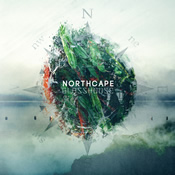
Northcape, Glasshouse

northc_glassdHere’s a nice way to spend half an hour. Smooth, melodic electronica from Northcape. No surprises or reinventing the wheel here, just a fresh round of laid-back environments and catchy melodies. Glossy around the edges, like we’re viewing the world through a soft focus and taking our sweet time about it. Alastair Brown’s go-to sound is soft and round, anchored with a solid low end. The beats here are less hectic than on a lot of its kin, which I like–too often in this genre the staccato assault of the glitchwork is front and center. Here it functions as a quiet rhythm section whose job is to just augment the soft tones. There’s a fair degree of sameness here, perhaps highlighted by the short running time, but when I’m in the middle of this and it’s working its bit of chillout magic, I mind less. This is one of those releases I’ll melt into a wind-down playlist and enjoy it that way. Brown closes out the EP in a more ambient style with “Green Waves,” letting warm pads stretch and just barely touching them with a tick-tock beat played out in quiet chimes. It’s got a pleasant lullaby-like quality to it that ends your time in this Glasshouse quite nicely. A good addition to your melodic electronica stash.

Available from Sun Sea Sky.

John Luttrell, The Dream Exchange

luttrell_dreamSo there I was, eyes closed and smiling, just grooving along to the sweet guitar riffs in the middle of “The Sphere,” the second track on John Luttrell’s The Dream Exchange, and I thought, this is the kind of stuff that got me into New Age in the first place. Mind you, I don’t particularly care for the term “New Age,” but in Luttrell’s smooth, jazz-tinged style I could hear echoes of Kindler & Bell, Peter Maunu, Barry Cleveland–my cassette collection, circa 1987, when the genre’s name wasn’t in heavy debate. The Dream Exchange is a light and pleasant listen centered around Luttrell’s superb playing, but it’s also willing to take a step or two outside its own box. On the guitar-centric side, you can dip into “Interstellar Dust” where layers of overdubbed guitars create a sweet ensemble sound with just a hint of prog-rock structure. Harmonics ring and folksy lines are picked out in solos as this one eases along. The title track also has its share of close-your-eyes-and-enjoy guitar licks. There’s a classic semi-hollow sound at play here, a jazz classic, and it works fantastically against a backdrop of ambient pads and soft chords. “Dreamcast” is a gliding, lounge-infused tune that gets a little extra sexiness from slide guitar and shimmering. Luttrell’s leads here are like a lesson in smooth jazz, and I like the added touch of spiraling sequencer lines in the background. He pulls his piano up to share the front on “Away,” a beautiful ballad with a slightly stripped-down feel. I mean that as a good thing; there’s something about the very clear atmosphere here that accentuates the feeling of the song. The trade-off between piano and guitar is nicely balanced. Then there’s the point where Luttrell stretches for a bit more funk…”Ethereal Raga” is at once spacey and earthy, blending flutes, drums, a bit of chanting, and a few far-reaching chords liberally lifted from your favorite spacemusic tunes. In an album that hangs out more on the side of light jazz, this is a little bit of a risk–but it works. It has its own defining cool, and it breaks things up nicely without being too interruptive.

There are places where this album gets a bit too light for me, a bit too textbook New Age. (Lookin’ at you, choral pads and whooshy wind sounds.) But they’re the exception on this excellent outing, and easy to overlook. A very good end-of-day disc, charming, well-made, and worthy of repeat listens. I will take a dose of John Luttrell’s guitar playing anytime I feel like I need just a little more soul.

Available from CD Baby.

Unearthly Red, Purgatory

unearth_purgDustin Terry and Tim Risher, composing as Unearthly Red, offer up their soundtrack fragments for a nonexistent film on Purgatory. In 18 short tracks covering an hour, the work skews toward the dark and experimental. Atmospherically speaking, it’s spot on, rusted through with industrial clamor and the glitchy grind of faulty hardware. It gurgles at you in throaty, indecipherable tongues that leave you uneasy at having heard them. The pieces are short, so they hit, leave an impression, and run. The tone of the album overall is guided by its proto-cinematic viewpoint, ensuring that even though its components come in bursts, we don’t end up with a scattered musical mindset. As is often the case with Risher’s collaborations, Paragaté, for example, what you get here is two composers offering up their own pieces along with a few that where they’ve come together. The differences stand out, and help to make the album work. Risher’s tracks tend to be the floatier of the two, as with “Before the Storm,” which pairs long drones with jarring metallic clatter. Comparatively quiet compared to other tracks here, they’re still dark and shot through with a sense of being ill at ease, designed to leave you with a sense of dread. Well, in most spots. Late in the album, when the story is headed toward resolution, we get the almost oddly upbeat “Under the Skin.” I like this track, but it sounds like Risher held onto some of the techno-based rhythms from the last Paragaté release, Pattern of Light, and repurposed them here. Terry, who records as Void of Axis, is the more directly visceral of the duo, serving up deeply dark offerings like “Quiet Springs” and “In Sickness,” two pieces that use a somber minimalism to firmly ping your discomfort buttons. He also gives us the roll-the-credits piece, “Remorse.” Belying its title, it pulls in bright chords and a cool beat, providing the listener (and, ostensibly, the viewer of the non-existent horror film) a respite from the heavy darkness of the last hour. When the two come together, things can get grittier and more experimental. “Dissonance” should test your tolerance levels a bit, with its repetitious snarl of electronic noise. On early listens, I was ready to hit the Skip button on this. But give it a few minutes, because when the sound drops out, a thick wash of pure atmosphere will roll in, and it works.

Purgatory was not an easy album for me to get into. The heavy industrial wallop of the early tracks threatened to put me off, as they sometimes seemed a little gratuitous. (They’re not.) It was the rich environment, dark and unpleasant as it is, that kept bringing me back in to have another viewing of this imaginary film. You’ve got to like things a little on the creepy side, but it wouldn’t hurt you to spend some time in Purgatory.

Available from Bandcamp.