Anima: Light of Aluna

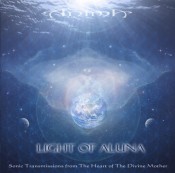
anima_lightI clearly remember my first impression of Anima’s Light of Aluna. I was in my car–I often load my CD changer and then forget who I put in there–and I heard throat singing. The sound got hold of me, as it tends to do, and my first response was, simply, “Cool…” As the sounds proceeded to broaden and open, they brought me into spaces reminiscent of my early excursions into the more electronic side of New Age, and then Light of Aluna had me pretty well hooked. Musician Ali Calderwood and vocalist Daniela Broder fill an hour with changing, always gentle soundscapes with a healing-music sensibility. Lightly energetic in spots, the album overall is quite laid back and spiritual. Tone and tempo shift just slightly as the music moves along, never enough to break the easy flow. Calderwood’s piano and guitar work mesh neatly with his electronics, from soft pads and swells to sparkling, classic-synth runs and arpeggios. When Broder’s voice glides in like clear river water, it adds a sacred-music feel and a true performer-to-listener intimacy. She is at her best on the absolutely gorgeous “Peace,” her chants and verses coursing intensely over deep drones and rising, glittering synth sounds. Her voice takes on a storyteller quality, and you’ll find yourself swept up in the narrative. Calderwood keeps his input on the low end, letting Broder spend the entire 10 minutes in the spotlight.

The more I listen to Light of Aluna–and believe me, I have listened to it quite a bit–the better it gets. There’s always some new element of beauty that reveals itself in the next listen. Calderwood’s compositions are nicely layered, smoothly flowing and absolutely soothing. It’s healing music without some of the overdone memes that can plague the style. This music makes its way into your spirit, soothing and salving, but never gets entangled in its genre’s trappings. It just does what Anima set out to do. A great repeat listen that should definitely be enjoyed in headphones. Expect this one to rank high on New Age and healing music “Best Of” lists at the end of the year.

Available from the Anima web site.

East Forest: Prana

east_pranaPrana is a deep, cleansing breath of music, a calm and uplifting meditation–which is fitting since, as Trevor Oswalt, the man behind East Forest notes, “Prana was recorded and improvised live in an underground former silo in the deep southern Utah desert over the winter solstice of 2012. The temperature outside was at about 10 degrees below zero; inside, I was playing right next to a giant wood stove, and around me were twenty or so sonic journeyers forming a circle on a slate floor.” Now you get to take part in the moment, and while it may not be as cool as meditating in a silo, the music retains its wonderful, salving potency. Piano takes the forefront here, accented with soft synth washes and chants sung in a language that exists strictly in the heart. I love this aspect of Prana; Oswalt uses “channeled sounds intended keep our language centers quiet and our hearts open,” but theser ur-words carry their own weight and intonation, and we the listeners, in turn, translate them according to our own emotional needs and understandings. The piano is gentle yet insistent and strong, with a very New Age quality to it. It takes on a Steven Halpern feel when Oswalt switches to electric piano on “Samana,” and your core vibrates in harmony with its deeply resonant tone. Oswalt’s playing across the disc is honest and full of meaning. And he packs a lot in without overloading. Natural field recordings wash in at the edges. Wind, water and crickets. Wind chimes sing. Time just sort of fades as a consideration while you’re listening. Prana is just five tracks and 46 minutes long, but it’s so cleansing and relaxing, it feels pleasantly longer. Just leave this one on loop and fill your space with it. It’ll do your soul a whole lot of  good.

Radio Free Clear Light: Joyful Noise Vol. 2 – Nomina Nuda Tenemus

rfcl_nudaIt’s become my habit, when reviewing a new release from Radio Free Clear Light, to let JC Mendazabal, the mad sonic genius behind this ever-shifting collaborative, explain what it’s about. So: “This project was inspired both by RFCL’s prodding into the history of those heterodoxical sects termed Gnostic as well as a creative analysis of Umberto Eco’s linguistic parable The Name Of The Rose.” Out of that comes another round of funky experimentation that glides between uneasy, skewed dreamscapes and subtly beat-based chill. The more drifiting pieces, like “Seven Trumpets” or “Adso Tastes Ox Heart,” are heavily layered and in constant motion, putting the listener into a very dynamic space that’s easy to visualize. (Don’t worry about the minor hallucinations if they come; it’s par for the course with RFCL.) Instruments are distorted and reborn, voices wail and cry , long, thin drones make their way along the foundation. A sense of sacred music creeps in with the chant-like quality of the voices, and viola from Colin Hamilton and Elanna Sack offer a sort of neo-classical, chamber music angle. Their sounds are beautiful and a trifle mournful. Mendazabal and Co. do a great job of balancing the softened-brain mesmerism brought on by the drone with a rich and real aural environment that you want to pay attention to. The detailing, as always, is superb. The centerpiece here is the 10-minute, smooth and slightly eerie “Penitenziagite.” moves along on a steady and hypnotic three-note bass line. Drums shuffle in the background and Lydia Harari ululates a wordless incantation in a sometimes uncomfortably screechy voice. (Mind you, it works for the piece.) An arpeggio dots the flow and amps up the rhythmic side. It’s a weird and wonderful piece that encapsulates what RFCL is about–layering the familiar with the mildly frightening and the comfortable with the alien. And once again, it works. Put on your experiment-friendly ears and dive in.

Available from Black Note Music.

Phragments: New Kings and New Queens

phrag_kingsRolling by like a dark cloud that engulfs you for 30 minutes, New Kings and New Queens takes a minimalist approach to standard dark ambient tropes. All in all, it’s fairly innocuous as dark ambient goes. It’s moody, with its drawn-out drones, hammering piano chords, and specks of industrial clamor, but it’s also comparatively easy to get through. Composer Matej focuses on feeling, which is good, but expresses it in fairly straight lines, and very long ones at that, dependent on small shifts in the flow for any sort of dynamic. Four cuts in, with “New Queens,” he starts to show a more bombastic leaning, the piece coming in on big fanfare chords. It’s a good wake-up call at the start but then just hangs there without much texture. At no point did New Kings and New Queens make me need to pay attention, or elicit much response from me. Dark ambient fans may find this to their liking, or, like me,  may find it a little too much on the light side of dark.

Available from Malignant Records.   

Djam Karet: The Trip

djam_tripBack when the classic rock radio format was new, my local station announced, with great fanfare, that they would be playing the long version of “In A Gadda Da Vida” by Iron Butterfly. Not a long radio edit, but the whole 17-minute album track. Literally promo’d it for a week like it was the Second Coming. I asked my girlfriend at the time if she’d ever heard the long version. (She was six or seven years younger than I.) She hadn’t, so when the evening came for it to be played, we went out to my car, put the seats back, turned the radio up, and stayed there, just listening, until the last note faded. I was reminded of this when dropping yet another hit of The Trip, the first all-studio album in eight years from venerable prog-ambient jam band Djam Karet, because I’d do the same thing if I was introducing someone to it–set aside 47 minutes, get comfy, and do nothing but be in the music. The Trip blends long stretches of fairly quiet, introspective, wash-filled sound-spaces with a pair of very, very solid rock jams. After opening with a little melody that comes back around at the end, the band spends about 20 minutes fiddling with small sounds, vocal drop-ins, airy drones, electronic twiddle, and guitar, all folded into a meditative and deeply detailed space. The mood turns just before the 15-minute mark, going from lulling to edged with shadow and rough edges, but never to a point of distraction and it passes to make way for the next stage. Around the 20-minute mark is the first place where The Trip steps over to the rock and roll stage to give us a little Pink Floyd homage. While Gayle Ellett lays down a bed of keyboards that would do Rick Wright proud, guitarists Mike Henderson and Mike Murray take turns scorching the landscape with riffs and runs and big, bold powerchords. Ellett takes his own solo as well, dripping melty psychedelic lines all over your brain. The whole section oozes with a great combination of head music and pure, fiery 70s guitar rock. Plus, it has a great open-jam, “You take this” feel to it as the players trade off the spotlight to keep the whole thing cruising. This portion empties out into another darkly lighted realm full of ominously pealing bells and bassist Aaron Kenyon leading us through it with slow, sinister lines. A stretch of dark ambient follows, a slow-moving, pulsing thing that gets invaded by lively electronic swirls. A vortex of sound rises and then, out of nowhere, drummer Chuck Oken, Jr. crunches in with a hey-now full-on arena-rock drum fill, Henderson and Murray dive in with powerchords, and Djam Karet bring this baby home in gorgeous prog fashion. Ellett leads the rhythm section with Hammond-sounding keys (giving you your dose of Jon Lord nostalgia) and later absolutely dominates with a soaring, spacey solo that hits just about every rock keyboard meme ever laid down. I wish I could tell you who’s who on the guitar solos, but suffice to say that both axes tear the place right the fuck up. Period. The back and forth between them and the support each offers the other is the stuff you only get from decades of chemistry. The disc ends where it began, with that happy little phrase and a quiet whoosh of wind and, if you’re at all like me, a strong urge to do that again.

Djam Karet have been at this for 29 years, and The Trip makes me very sad that I haven’t been around for the first 28. This is an exciting, deep, relaxing, funky album that is a pleasure to listen to. Keep a hand on the volume knob because although you can ease through the misty and shadowy ambient parts, you will max out your speakers on the prog. These master musicians, craft honed to an absolute razor sharpness, will see to that. This is a stunningly good disc.

Available from the Djam Karet web site.

Toaster: Theophany

toaster_theoToaster (aka Todd Elliott) tells a story in both song title and sound on his new release, Theophany. In my previous outings with Elliott’s music I often found myself looking for a point of entry, something to hang on to when things went a little far afield for my tastes. I had no such issues with Theophany. Maybe this represents a slightly more restrained artist in that regard, or one who can set himself a fresh thematic course when needed, but it certainly doesn’t mean he’s lost any edge. Theophany moves in a distinct narrative direction, coursing from straightforward, beat-based electronic music into hypnotic ambient spaces and ending in darker, abstract zones, and all of it’s handled well. The disc opens with birdsong and the lazy beat of “From the Coast We Traveled East.” Sequencers gurgle over long chords and pads. It’s a nice, laid-back and accessible piece–and then things begin to change. “Eventually, We Reached the Desert” and “We Set Up Camp, and Got Drunk” are more angular and leaning toward disjuncture. “Eventually…” is pushed along with a thudding beat and a melody played out two plunking notes at a time. “We Set Up Camp…” elbows its way in with a recorded conversation thrown over hissing drones and a shuffling beat that turns into an almost-urgent and strident rhythm. After this is where the shift toward ambient and deeper spaces begins. “When We Woke Up We Realized We Were Lost” tosses out the beats and turns the landscape into a mist-shrouded, half-lighted place. “Night Fell. We Saw A Light and Walked Toward It” starts out hushed, but evolves into big-waveform ambient, swells of sound layered with more vocal samples. It leads to the center of the release, the 29-minute title track. This alone is worth the price of admission. It’s a vast, droning track, recorded live, heavy on the low end and accentuated throughout with (more) muffled vocal bits and other wayward sounds. Thematically, if this is the point where we experience theophany–the physical manifestation of God–then this is the slightly disjointed, mind-altering space we’re taken into, experiencing something with which we’re not familiar, and looking back through the manifestation to get our bearings. Elliott takes us through it with these gentle sounds and breath-slowing simplicity, but heightens our awareness with the additional elements. Late in the track he folds in harsher sounds, forcibly pushing us out of reverie. A great track. It also serves to take us into the disc’s biggest gamble, “We Made It Back to the Coast.” Minimal drones rise to a buzzing level, then give way to a long stretch of little more than wind, rumbles of thunder, birdsong and field recordings. (And a couple of jarring slams.) This is where Elliott runs the genuine risk of losing the listener. We’re talking about almost 10 minutes of a 14-minute piece given over to what might literally be a sound recorder sitting on a window sill. Listen at the very end–someone comes over and picks it up. I find this part fascinating for its simplicity, the layering of sound–I can’t tell if the wind or a bass drone is grumbling at the low edge of hearing–and also for its sheer ballsiness. I do think, however, that a fair share of listeners may be put off by it. The disc closes with the  deep drones of “We Mourned the Dead, and Drew Comfort from God,” another live recording, to end the story.

I like the way that Theophany starts with very open doors, very accessible and, for lack of a better word, easy, and then gets more challenging as its story progresses. Elliott’s not afraid to leave people behind in pursuit of what he’s got to say. The depth of sound here is excellent, and it’s a very affecting release. I’m coming to appreciate Toaster more with each new exposure.

Available at Bandcamp.