
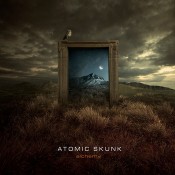
 Rich Brodsky is cool. If you doubt me, just take a listen to his third Atomic Skunk release, Alchemy, and there won’t be any further questions. Alchemy blends world-music grooves, spacey ambient textures and atmospheric electronic touches to keep itself fresh and engaging over its seven tracks. The variety shows itself from the start. “Rhino” begins with nature sounds, then quietly twists itself up into an easy-moving groove riding on chimes that sound like a cross between a vibraphone and a kalimba. Beneath it all boils a heady mix of glitchy percussive elements. A great kick-off track. “Equinox” resonates with a strong and steamy Latin/gypsy vibe courtesy of Brodsky’s guitar, backed with percolating electronics. String sounds, like a half-muted electric violin, bring the melodic voice to this piece. “Serpent and Rose” is my favorite track on Alchemy, with calm sequencer lines arcing around a beautiful, wordless vocal sample that absolutely soars. Brodsky loads this one with plenty of drama and a narrative feel that demands repeat listens. “Sunwheel” opens with a mechanical grind that transforms itself into a funky rhythm. Drones and twinkling chimes fill the space. Brodsky slowly builds his way to a vaguely Middle Eastern feel, bringing in big, wavering chords to sing his song while the beat simply plies forth. “Lotusmud” starts off a bit on the dark side, then blossoms halfway through the track to become an uplifting piece coursing along on an airy flute melody. The beats go away on “Temple of Stars,” as Brodsky showcases his ambient side in a 23-minute deep-space drift out to the darker spots between galaxies. At times vaguely unsettling, at times spindrift-calm, it’s a fully immersive trip.
I’ve been avoiding writing track-by-track reviews, but the diversity at play on Alchemy demands breaking it down to its components. While all separate entities in theme and feel, they’re all absolutely integral pieces of the superb whole. There’s not a moment here that’s not engaging, intriguing and expertly crafted. It’s a disc that requires your attention because there’s so very much going on, moment to moment. This disc is getting a lot of attention in the ambient/electronic community, and with good reason. Listen, and remove all doubt. Alchemy is a Hypnagogue Highly Recommended CD.
Available at the Atomic Skunk web site.

 Guitar sounds and textures get put through a rigorous ambient workout in the new release, Scáth M’anam from I’ve Lost (aka Bobby Jones). The two-track disc opens with hour-plus, eight-part “I Wish I Could Fly.” Here Jones works his way through strata of emotion, going always deeper, the guitar sounds shifting appearance to match. It’s rarely a straightforward guitar sound, of course. For the most part it’s transformed into windy pads that skim off to the distance, rushes of sonic wind moving across the scene. It can also come through with a hint of menace, blood-thick low-end chords rumbling and grinding toward the listener. In one beautifully unexpected stretch it rings like a somber steel drum, the change in timbre a unique surprise in the flow. Something in the way Jones plays this section brings a sense of sacred music to mind. It’s some sort of reverence. Listen and see if you catch it. Field recordings under the sound and between the segments add another dimension of texture and interest. One more thing to keep you paying attention.
 The hour or so it takes to find your way through the fog-shrouded washes and drones of Forrest Fang’s Unbound is time extremely well spent. The San Serif project is Fang’s exercise in minimalism. Here, he notes on his site, it’s minimalism crossed with a “maximalist twist.” The source sounds are stripped down to certain tones and elements that are reworked into large, long, tonally dense structures. The listener is treated to five extended works, each with its own identity, each in varying shades of light and dark, uplifting and ominous–and, of course, often several of these in one sitting. There’s a great range of emotion at play, mood changes that come on like unnoticed shifts in wind direction. Unbound is a dynamically meditative work, which is to say that while Fang’s cloudy drones are absolutely relaxing, there is constantly so much going on, in a very good way, that it deserves as much attention as you can manage to give it. (It’s the great ambient Catch-22: there’s a lot you need to hear, but your mind has floated off somewhere…)
 This collaborative CD from Chris Russell and Disturbed Earth (aka Dean Richards) is sculpted with amazing patience in big, bold, pad-based forms, enormous chunks of sound that inch inexorably forward. While the duo deftly balance shades of light and dark as the music proceeds, there is always a rich density of sound in constant motion. Elements urge each other along without hurry, describing spacey vistas and immeasurable distances as they spiral slowly past. It’s the interplay between Russell’s soft-synth-based drifts and Richards’ analog tape looping mastery, bringing the disc into a space with distinct ambient overtones, but harshed up to just the right degree with Richards’ sound-manipulating edge. For the most part, the listening is easy, your mind drawn into the sound and held there as it forms around you. “Leaves on Trees” absolutely mesmerizes, the sound pool probably at its deepest. Shimmering pads rise and fall in intensity, the only constant being the impressive, effortless thickness of sound. Its follow-up, “Cold Night,” is a slow-moving, perfect ambient piece, wavering waveforms gliding over each other. There are challenging moments here as well. “Neon Light” finds its way into some high, harsh tones as its story intensifies. The beginning of “Clutching at Straws” comes at you armed with a full load of dissonance and slightly jumpy textures. In neither case does the noise level detract or feel gratuitous; it’s obviously integral to these pieces, and comes off well. But they’re not the easiest listens here.
 Disparition (aka Jon Bernstein) returns for the first time since his intriguing sound-collage, 1989, with the kinetic vibe of Neukrk. Giving a nod to the history of electronic music that has inspired him, Bernstein takes a far-ranging approach, from dark atmospheres matched with club-hewn beats to noise experiments perched on the outside border of music. While Neukrk is in no way a derivative rehash, chances are you’ll still find yourself playing the reference game in your head while you listen. I dig into the energetic charge of “Ratchathewi” with its heavy bass licks, snare raps and industrial grinds and I pick up sonic shadows from Tangerine Dream, New Order and Heaven 17. The big, powerful keys in “Nieuwe Utretcht” feel like OMD filtered through several layers of gauze to roughen it up slightly without taking off any of the bounce or melody. And when “Anomie” kicks in with the same James Brown sample that made the 80s hit “It Takes Two (To Make A Thing Go Right)” painfully unforgettable, I couldn’t help but chuckle. (Don’t worry–Bernstein takes it in his own direction. No pumping of the jam will ensue.) Your associative mileage may vary, but you’ll hear familiar touches all over this disc. They range because Bernstein isn’t about to settle into one particular zone. Neukrk is a slideshow in sound, each track a new vista and a new approach, each with its own way to grab you. “Succession” packs a solid cinematic punch, particularly when the beat sets in just short of the two-minute mark, and a hint of Middle Eastern influence. String sounds upgrade the drama. Speaking of drama, “Ditmas” draws a vivid picture of a sense of emotional hollowness in the wake of loss, a soul-ache set to music. A piano, played sadly within some cold, cavernous, echoing space intermingles with the sound of a passing train. Sadness and beauty, perfectly melded. The track “Jandoubi” drills straight through me–an amazing piece of work. It has a big, symphonic-rock feel, spacious and bold. And when Bernstein drops in a Middle Eastern-feel vocal sample set off by single, slammed-down piano chords, I was stopped in my tracks. The closer, “A Door,” drones past, with quietly clattering percussion dancing around it, the effect belying the thickety tangle of sounds before it. There are no bumps or jolts as this disc crosses borders. Bernstein smoothly stitches the tracks together with effective, low-key transitions to turn Neukrk into an ongoing flow. Over the course of 18 tracks, Bernstein keeps things interesting and every piece comes off perfectly executed. Neukrk is an exhilarating, thoughtful and thought-provoking work–which is why it’s a Hypnagogue Highly Recommended CD.
 With glittering, sun-on-ice notes, Jeffrey Koepper begins his seventh analogue-only voyage, Arctisonia. Koepper patiently sets up his mathematical sequencer rhythms, balancing them atop one another, then lets the interplay of pulse and flow take over. There’s a hypnotic quality to the way the main algorithms seem to simply repeat. (Trust me, there’s actually nothing simple to them.) The dynamics at work shift glacially, change happening over the course of mental eons. By the time you perceive the change, it feels like it’s been there all along. As always, Koepper pays attention to both sides of the scale, the Berlin-school energy of sequencers and the windblown washes of pure synth pads. In “Ilulissat,” he hits a perfect Berlin stride, his geometric baseline laid rock-solid while his high, calm melodies move cloud-like over the top. Spirals of electronic twiddle punctuate the flow. This track makes a superb transition into “Ice Flow” which has to be heard to be appreciated. As “Ilulissat” wends down to a waveform drone, Koepper hits a switch that for all the world sounds like he simply tapped the “Marimba” automatic rhythm on a cheap keyboard. While it tick-tocks away, he begins to lay in walls of oscillating sound that take over as “Ice Flow” gets underway. A twangy beat rises to modernize that marimba, and Koepper’s off. The centerpiece is the 21-minute “Avalanche,” which has a great narrative flow. It begins with sequencer arpeggios appropriately racing at breathtaking speed before Koepper flattens them out to long, layered drones. Another round of sequencers rise to work through the drones. Koepper gives himself plenty of space to make this track work very effectively. There’s a great sense of development in all the pieces here, and Koepper brings them all to a solid sense of closure.
 First, I have to apologize to Uwe Gronau. I have had his two-disc collection, Midsummer, in my review queue and on my iPod for many months now, and it seems that in that time every time I was caught by some catchy blend of New Age and prog-rock/jazz fusion, I’d look over at the iPod and it would be a track from Midsummer. Having enjoyed it for a while, it’s high time I reviewed it. This is a big offering, 35 tracks spread across the two discs, which are split into a “melodic disc” and a more “atmospheric disc.” To me, disc 1 is something of a guilty pleasure. It’s thick with that un-apologetically upbeat, 80s-infused mix of electro-music and prog. When guest Martin Brom’s guitar starts cutting the air in “Magic Forest,” you’ll get the idea. This is one of those line-straddling discs, and Gronau covers both sides of the border well. His keyboard leads are rich, engaging, and a pleasure to dive into, but they’re just part of the very cool whole. “Royal Road” kicks off with a twangy electro-bass lead that feels like the Dr. Who theme gone all funky; then Gronau drops swirling, Hammond B3-style chords into the mix for a high-octane cocktail. “Secret Meeting (2)” is a favorite on this disc, with its easy Caribbean beat that flares up in a post-rock frenzy. Brom returns to flail away at his axe on “Left Hand,” which starts off well in experimental land but resolves itself into a screaming, soaring jazz fusion piece. Again Gronau’s too-cool organ fills enrich the overall sound in classic style. (Wolfgang Demming also contributes guitar on some the tracks here.)
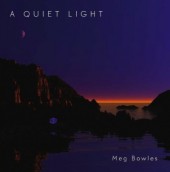 Seductively graceful and contemplatively hushed, Meg Bowles’ return to music, A Quiet Light, is a classic spacemusic disc that’s extremely easy to get completely lost in. In her liner notes, Bowles talks about the concept of liminal space, “a territory between the worlds which can feel intensely private yet vast.” A Quiet Light becomes the key to that territory, like gates easing open in front of you as you listen. It’s a deep relaxation disc, but it has passages that percolate with subtle energy–like the delightful, unexpected moment when the opener, “Nocturnal Flight,” suddenly shifts from gossamer drifts to rise just slightly under a cool, upbeat melody. In every track, Bowles’ long, soft pads absolutely teem with emotional phrasing, and her atmospheric touches, like the stream running under “Forest Glade,” are laid in with a perfected mastery to elevate the overall effect. Bowles is at her best here with “Chant for A Liquid World.” This is, quite simply, a stunning track that heads directly to your soul. With sacred-music overtones provided by sampled voices and a breath-slowing pace, this prayer in sonic form is, for me, the centerpiece of the disc. It eases into the horizon’s-edge feel of “Beyond the Far Shore.” Sighing chords and a gently played melody dance quietly together and the overall feel is like watching the onset of twilight.
 First you look at the title: Dying Sun/Scarlet Moon. Then you start the first track: an ominous thud, bassy electronic twiddle, grim tones. And you begin to think, “Here we go again” and you brace yourself for a dark ambient deluge. But maybe you’re forgetting that this is Danish beatmeister Nattefrost (aka Bjørn Jeppesen)–or, at least, you forget until that opening track, “In Natura,” kicks up with a pseudo-Calypso kind of sound and you’re diving into some pretty thick grooves. Dying Sun/Scarlet Moon is a cool, catchy set of tracks that mix old-school analog grooves with layers of laid-back Scandinavian chill and the occasional dose of musical humor. (If you don’t smile at the playful spunk of “My Wake Up,” please consult your physician…you may already be dead.) Jeppesen starts strong, following “In Natura” with “Draconian,” the strongest track here. It opens with lounge-worthy chords that remind me of a great Beanfield track, then retains its sense of casual cool even as Jeppesen pilots its into the dark distances between stars and back. A gorgeous ride that pairs a spacey feel with a rock-steady club pulse. “Music for the Man” is a throbbing, shadowy homage to German disco, in which I pick up memories of Kraftwerk’s “We Are the Robots.” He enlists fellow artist Matzumi for the straightforward, 70s-style spacewalk of “Der Kinder der Erde.” Here, long, arcing pads twist their way through sharp sequencer lines for a deep, dramatic ride. The flow is interrupted then by Jeppesen’s update of Saint-Saens’ “The Swan.” It’s a clever idea, but it’s out of place and quickly devolves into an almost parodic, saccharine waltz. He recovers pretty well on the next couple tracks. “Seduced by Grief” is snaky, a little sinister, and coolly pared back. This and the follow up, “Ghosts from the North” feel in parts like they’d make great theme songs for some sort of sci-fi detective show. “Ghosts” in particular benefits from a very funky/retro keyboard lead. “The Dark Spell” builds up from a slow, dark starting point and quietly kicks into gear with a melody on high, glittering keys. Superb sequence work here, laying down an unwavering foundation. Jeppesen pulls in Synth.nl for “Close Encounter,” a sequencer-driven space-rocker that just drips with 70s electro-love. Analog fans will definitely want to take a listen.
 Hypnagogue Music Reviews