
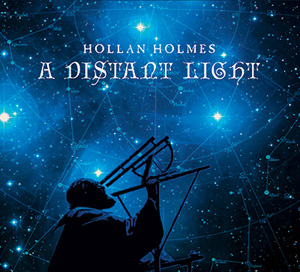
 A testament to the combination of soft synths and ambient spirit, Hollan Holmes’ debut, A Distant Light, is a well-crafted spacemusic disc that unfurls the solar sails with its first note and sets a course for the furthest star. With only the Reason and Cubase software programs as his instruments, Holmes pulls off eight tracks infused with uplifting energy woven through with a sense of peace and the definite feel of a far voyage. Despite its computer-generated genesis, A Distant Light displays a rich, organic sound that’s broad and warm. (Credit here can be shared with Steve Roach, who mastered the disc for Holmes.) In spots, as with the opener, “Drift” and “Threshold,” Holmes gives his spacious drifts a deeper character with delicate pulses that stand in for rhythm. It’s more distinctly on display in “Malus,” where the beat rises and dances around under airy notes that exhale a simple and understated melodic line. In “Wellspring” Holmes hits perhaps his most energetic stride, a high-speed sequenced cadence running through washes and bold chords.
A Distant Light shifts tone a couple of times, and the movement is always subtle, natural and sensible. Nothing interrupts Holmes’ flowing journey. It’s about the ride, the changing starscape out the portal window, the voyages both inner and outer. Holmes manages to pull off one of the few darker shifts on the disc with “Inevitability,” the music taking on a grim, emotional edge marked by hull-shaking minor chords. The last, a rolling shockwave that comes 45 seconds from the end, potently underscores Holmes’ ability to create moments in the sound. I have to think that Holmes’ background as a graphic artist translates to this easy ability to blend tones and textures, to mix the media (as it were), to craft larger images in smaller strokes. I imagine that Holmes doesn’t see notes or software algorithms on the screen as he composes. I imagine he sees only the images emerging from the newly birthed sounds. A Distant Light is an impressive debut, a trip I’ve taken many times over. It’s broad enough to appeal to a spectrum of ambient/electronic listeners, and deep enough to stand up to repeat listens. Holmes is at work on his second disc, and I have to say that A Distant Light has already made me eager to hear what else this new talent can do.
Available from Hollan Holmes’ web site.

 I like the idea: pairing Native American flute with modern, uptempo rhythmic backdrops. What I like somewhat less on Oakensong’s Flutecore is the actual execution. Having listened to it several times now, I think that the underlying problem for me is that it often feels like Oakensong (aka Victor Eijkhout) tries too hard to infuse cool, to do the “new music for old souls” thing. The result can be a heavy-handed sound that plods along rather than dances. First impressions count, and Oakensong’s opening piece, “Rain in the Canyon,” devolves by the track’s end into a muddled briar patch of confused sound that had me hurrying to skip it. Listening to it made me wary about going forward. A later track, “The Flute Also Dances,” has a similar effect, that feeling of forcibly jamming together musical thoughts that could work well if they were more gently dovertailed into a single idea. When Oakensong keeps his music closer to the source, he truly hits the mark. The too-short “Dirt Roads” is a nice piece where the flute absolutely sings across understated accompaniment–it shines because it keeps things simple and knows where its strength comes from. The windy swirl of “The Spring at Dusk” is a potent sound-prayer, a dervish that picks up power as it picks up speed. For me, Flutecore is an uneven and uncertain disc with underlying promise. Eijkhout is a talented flautist; it’s just that the concept behind the disc doesn’t carry his playing well.
 Having most recently lifted listeners upward with the celestial/sacred drifts of
  Hypnagogue Music Reviews