 It’s probably not easy to find a musician’s story more intriguing than the one behind Memorybell. A long-time musician, Grant Hazard Outerbridge awoke in a hospital in February 2014 with no memory of how he got there. He was diagnosed with transient global amnesia, a condition that causes the brain to temporarily stop making new memories. When he could get back to creating music, he found that the music he had been making prior to his amnesia seemed “garish.” He then set about redefining his sound and identity, creating emotionally evocative, stunningly spare piano pieces as Memorybell. His first outing, Obsolete, embraces the beauty not just of a minimalist structure, but also the pensive, unspoken thoughts that come to us in the space of a meaningful pause. This is a lonely-sounding album, but lonely without getting morose. It has a porcelain fragility, as though if you look too closely at it, it might shatter. But look closely you must, mentally watching Outerbridge’s hands hovering for a moment over the keys like he’s just now working out which note comes next, and feeling that both you and he are discovering that moment together. There is a bit of risk-taking on Obsolete, but it comes in the form of moments where the listener needs to trust the artist. The very first note of the first track, “Koan,” sounds slightly off-key–and it’s a moment, after a pause, before the second note arrives to establish the relationship. From there, this barely two-minute piece sets the course for the rest of the album. But, again, not without more hmm moments. When “Doldrums” opens with a three-note phrase, there follows a full 17 seconds of letting the last note fade before Outerbridge plays another note. Not looking right at your media player? Then you’ll likely wonder where the hell those first three notes came from or where they were supposed to be. But as the piece proceeds, with Outerbridge placing short phrases and letting time flow between them, it becomes an exercise in finding the impact of negative space. That seems to be the key here, that practice of taking what could be shortened into a tighter, more common kind of melody and spacing its phrases well apart, lending each one its own distinct emotional weight and, by virtue of doing so, giving each piece a fuller weight overall because in those spaces we have more time to absorb the feeling. “Somonolent” does this wonderfully, the bass chords landing and sustaining with gentle authority, based off two short notes that speak before them. Accent notes come in like a secondary thought, and the piece moves as drowsily as the title suggests. Even at its comparatively brightest and most active spot–which, ironically, is the track “Entropy”–Obsolete retains its thoughtful soul, its intimately conversational tone.
I think this is a fantastic album in its way, but I could see some listeners needing more fullness to it, less minimalist airiness–although it’s easy to argue that this is absolutely the core of its potency. Plus, while each track has its own overall feel, because Outerbridge doesn’t alter his style much (place note, pause, contemplate, breathe, place note) it could be suggested that there is a high degree of sameness. I see that. And yet I have listened to this album over and over again, attentively and as background, and I’ve never felt like I’ve heard enough of it or had enough of the reflective space it brings me into. If I was one to give awards, Outerbridge and Obsolete would get one for packing the most beauty and feeling into the fewest notes. Please check this one out for yourself.
Available at Bandcamp.

 Laid-back electronica liberally infused with bits of weird await you on Visiting Cat’s Host. There’s a lot of silk and smoke to these six tracks from Diarmuid Slattery and Giuseppe Salone, and each one wears its individual coolness like a badge. “Slow Crawler” sets the scene with thumping bass, jazzy rim clicks on the drum, and synth sounds that warp like oil on water. “Watcher of Game Shows” works off a manipulated spoken clip from poet and writer Charles Bukowski. The duo lay it over a backdrop of pads, clicks and taps, and another thick bass line. (Love good bass? Plenty of it here.) The tempo ramps just a touch at the midpoint and the groove of the thing deepens. Check out the great break around the five minute mark as Slattery and Salone briefly give it a different face. This would probably be my favorite track on the album if it wasn’t for “Closer.” Feeling like it escaped from a spy movie soundtrack, it skulks stealthily around foggy city streets looking for danger. Hand claps, a hint of Latin percussion, more of that can’t-get-enough bass…it’s just a lot of fun. “Sunrise” is textbook chill, like an easy ride home after a long night out, still feeling the night’s energy, that heady bass pulse still moving in your veins and a smile on your face. My only shrug on this 44-minute joyride is “Quarters,” which just feels like it tries to hard to be quirky, or too in-your-face about it. Everything else on Host is just so confidently chill, its pushier edge stands out in a not-great way.
 It may not matter to you that Souls Adrift, in Disrepair began its life as a set of live improvised pieces to accompany an art installation. It’s nice to know, sure, but not necessary to take the voyage this album offers. All that really matters is how easily you got lost in the sound. Ambient guitarist Eyes Cast Down (Greg Moorcroft) provides five nuanced soundscapes in this “…spiritual journey, facing down sorrow and loss, in order to see through them and beyond…” There are long stretches of grim shadow, passages of optimistic light, and a mostly seamless sonic topography that gives your mind’s eye plenty to gaze into as you go deeper. “Fading Angel” opens the album in a light space, presenting floating ambient washes. It’s the lightest Souls… gets–or, at least, its longest sustained stretch of lightness, and as you get more into the album, you understand that this is something of a cleansing breath before it’s time to get deeper and darker. Impatient listeners may have issues with the mist-wrapped, near-static drones of the next track, “Astral Drift.” Moorcroft keeps the voices very low on this piece, both in volume and in timbre, and although there are shifts of sound and the emergence of fresh textures and directions, they come at a glacial pace in this 17-minute journey. Those who appreciate drone work will go deep into this one. I find myself halfway between. On different listens I have alternately been pulled completely into it or gotten to a point where I want something to happen. Regardless, its dark and mysterious flow makes a fine counterpoint to the lighter tracks. In fact, “Sirens of Maya” leaps into your head after that down-the-well experience with high, bright tones that bounce into view. They get somewhat smoothed out as they go along, but also spend some time working through a hint of dissonance that rolls through the space. I pick up chime tones in the wash, and wavering pads that ripple across the piece’s surface. “Transcending Memory” is a Steve Roach-style piece, the kind that blends moody darkness with a bigger stellar sense–The Magnificent Void comes to mind. It’s a dynamic ambient work, its pads in constant morphing motion like swirling storm clouds. The Roach sensibility rears up in sudden dramatic swells, and the whole thing has an ominous tone. That carries into “At This Body’s Final Hour,” which frankly is where Moorcroft loses me a little. He shoots for upping the dramatic ante, but chooses to do so by dropping in some big kettle drum tones. I understand the idea, but it comes across as out of place from what has gone before, and he’s already using super-heavy bass notes to give the piece the cadence and gravity of a funeral march. He offsets that weight with a rising, tonally brighter piano line, creating a powerful mood that doesn’t need the extra bombast.
 I think we can probably agree that winter has its share of sparse beauty. An unbroken blanket of new snow across a field, the last flakes of a passing storm dancing in the night, the muffled voice of the wind through ice-draped trees. On his debut release, Winter, Von Geistley captures that beauty in elegant, open compositions with a very distinct classical music influence. His style is clean, uncluttered, and unhurried; his phrasing tends to be short and to the point and often left to let its resonance patiently fade. Winter is a very emotional album overall, and Geistley shows a practiced hand in using meaningful pauses and empty space to amplify that. A prime example is the solo piano piece, “Once More Round the Orb.” There is no flourish or flash here. Geistley picks out pairings or trios of chords, places a touch of space between them, then folds in a slow-moving melodic line of single notes that take their time in coming. “Day of Rain” beautifully follows suit and truly embraces the long sustain of its notes. There’s a similar take on “The Long Goodbye,” but in that piece he accents the piano with contributions from harp and woodwinds. The woodwinds have an almost synth-like quality in spots, which is an interesting touch that catches my ear. On “The Hole in the Web,” strings take an already touching piano melody and pull it over into a space that’s infused with heartache. It’s perhaps the most directly affecting piece on the album–for me, at least–a song that I want to listen to a couple of times over. “Still, My Brother” is a potently sad piece, painted over in tones of pure lament. Chanting vocal pads fold in late in the track and suddenly we’ve gently shifted toward the edge of sacred music. I appreciate Geistley’s restraint with this element, as it would have been easy to overplay it and nudge a delicate balance into a less desirable place.
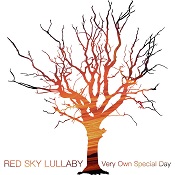 Things get pretty diverse on Red Sky Lullaby’s Very Own Special Day, but they also manage to keep a fairly steady groove. Producer Stuart Kilbride tags his work as chilled electronica, which it is, but that doesn’t capture the depth of detail and the wide library of sounds and styles he’s pulling from. While not everything is spot on, there’s a lot of goodness to dip into.
  Loren Nerell revisits an older track and expands upon it on The Venerable Dark Cloud. Stemming from a 23-minute song originally released on a mini-disc on the Amplexus label, this new release more deeply explores Nerell’s signature blend of shadowy ambient spaces, primitive percussion, and the unique tones of the Indonesian gamelan. Much of this album goes by like watching thick incense smoke waft across a moonless night sky. The sense of ritual is very strong, and these sonic meditations open the gate to a wide realm of imagery. “Dark Horizon” brings us in slowly on low drones, bits of percussion, and vocal snippets with a call-to-prayer feel. Field recordings layered into the background enrich the overall atmosphere. On “Eclipse,” which follows, we get the first appearance of the gamelan as it lays out a swaying cadence against a steady rhythm on drum. The gamelan’s bright, odd voice is compelling as it hypnotically repeats its line. “Another Cloud” follows suit later, falling into a repetitive pattern between chimes and drums as the background continues to move like mist. It starts a deep immersion that takes us completely under as we’re cut adrift on the long ambient flow of “Tenganan Grove.” This piece has a great humid, organic, lost-in-the-undergrowth sensibility right from the start. All the percussion from the previous tracks drops away in favor of nature sounds and long, murky drones. Within its first two minutes it gently takes control of your breathing. The track is just six minutes long but it’s absolutely the deepest six on the album and feels pleasantly longer. At its far end, it rises back up into “Within the Cloud.” The gamelan returns, bringing rhythm with it, and a sense of passage. Toward the end of this track, Nerell veers into sounds that are more assertive, if not jarring. which brings me to the one place on Venerable… where he loses me a bit. Although I am sure Nerell has a reason for including them, I could honestly do without the rooster and the storm sounds in “Ablution.” Both, but especially that rooster, are the only things that pull me out of this flow. The good news is, I fall back into it right away with the 24-minute closer, “Lambat Lane.” A dense cloud of pads, drones, and distant vocal samples at the start, it grows to include soft chimes and the curling call of didgeridoo. It swallows time as it goes, the sound swirling into a smooth vortex. A brilliant piece. Throughout the album, flute from Sasha Bogdanovich alternately soars and slithers through the shadowy proceedings, trailing a touch of sacred-music influence in its beautiful wake.
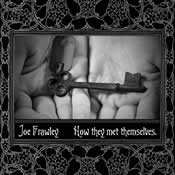 In my past encounters with Joe Frawley, I have been taken to surreal, waking-dream places where altered vocal samples stand in for fragments of other peoples’ memories, where no sound is left well enough alone and exist only to be torn, chopped, and reconfigured as the musician sees fit. On How They Met Themselves, although the music in places retains that I had the weirdest dream feel, Frawley focuses more than usual on his role as contemporary composer rather than sound surgeon. Which is not to suggest he offers us a dish of vanilla this time. As ever, his penchant for quirky construction, complex interplay, and affecting beauty is in place. But the clean simplicity of the opening track, “Aubade,” does come as a bit of a surprise if you’ve listened to Frawley before. This solo piano piece is certainly as close as he’s ever come to a New Age sound. It took me a few listens to stop waiting for it to get the usual treatment. Now I just let its softness and story wash over me. He revisits this emotional space later on “The Ruins of April.” Edged with a hint of sadness, it is flecked with arpeggios that spatter like a light rain. As much as I enjoy my stranger Frawley pieces, the solo songs reveal a musician with an elegant, nuanced hand who needs nothing more than his instrument to tell a deep and involved story. There are, of course, places where things do get less straightforward. On the title track, piano and xylophone hold a dialogue, tumbling and tangling. The xylophone rolls and trills; the piano plods pleasantly forward. The mix is delightfully dizzying at times. With “Un Salon Fantôme” we smoothly shift into a dreamier territory…even if that dream is a little dark. Frawley takes the voice of frequent collaborator Michelle Cross and cuts it into slivers, which he then floats, appropriately ghost-like, across the scene. The piano gets dosed in reverb, and strange sounds slip through in the background. “What the Wind,” which follows, is softly haunted by the whispering of said wind, backward echoes, and long, quiet string draws. A standout track for me on this excellent album is “The Waxwork Heart.” With a blend of sounds, from strings to voice to piano to an unexpected roll of thunder, over a syncopated rhythm, it is charming and fanciful. Something in its central piano phrase puts me in mind of Jobim’s samba “Waters of March.”
 I remember when a friend introduced me to Eno’s Music for Airports. I was struck by how deliberate each note seemed, how unhurried and yet placed precisely where it needed to be. I had never experienced anything quite so purposely slow but still capable of holding–at times, of course–my attention. I hear that deliberateness again in The World is Yours by Secoya (George Robinson) and the effect, the mesmeric draw and the emotional effectiveness, are quite the same. The World is Yours is something of a sad album, or at least seems to spend much of its time on the verge of tears, and it brings the listener into that same space. It is beautiful and slow-moving, graceful and thoughtful. Ambient washes, warm low string tones, and vocal pads applied with a gentle hand greet the listener on the title track. It’s an intimate space, with the focus on the strings, and then Robinson opens it up with the introduction of another breathy, low element. It’s a simple but effective change in tone, the unfolding of wings you weren’t aware you had. The sensation of being visited by the spirit of Eno comes to me me most strongly first in “Saturated,” where crystalline tones float and peak over more vocal pads and a patient piano line. This is not to say it’s cribbing directly from Music for Airports; but its spatial elegance, its careful placement of notes, create that mental waypoint for me. It carries into the next track, “November Dusk,” with a beautifully melancholic piano lead. A very moving piece. For even deeper melancholy, head to “Nothing,” a light blend of pads and piano that takes ample pauses before speaking. There is some brightness here, mind you. “Towers” starts with glistening tones, and although there is a touch of thoughtful sadness to the piano, it retains an essence of hopefulness throughout.
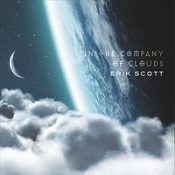 Readers who follow me on Facebook may know I often take my review listens in the company of wine. Sometimes I also refer to music in terms of wine. For example, I have unrepentantly referred to some lighter New Age as “Chardonnay music.” In listening to Erik Scott’s In the Company of Clouds, I find myself thinking that for me it’s like a Riesling. I enjoy it although it sometimes borders of being a little too sweet, but under the right conditions and in the right mood it’s perfectly refreshing. On this beautifully produced album, everything is built around two dominant sounds: the sensual, round tones of Scott’s bass guitar and the saucy drawl of pedal steel guitar from John Pirruccello. If you’re not a fan of pedal steel, you may want to take this album in smaller sips, because it’s everywhere. It swaps between its familiar heart-tugging country-music feel, as in the opening track, “Nine Lives” and the closer, “The Long View,” and something a bit more bouncy and island-flavored, as on “Waves” where it comes in like an ocean breeze. Scott rolls in a host of side players, including ambient guitar maestro Jeff Pearce, who appears on “Breathing Room,” a piece that shimmers and yawns beautifully against a backing of light hand percussion. The players get their moments behind the bass and steel, and every track has a rich and full ensemble feel thanks to superb mastering and production from Tom Eaton. Chris Cameron brings piano lines that skip from the swelling romance of neo-classical to the riffs and trills of borderline honky-tonk on “Open Door.” Cameron and Scott swap phrases over big clouds of string pads. A lovely piece. Scott’s bass takes on a lyrical voice on “Seven Veils,” and I fall totally into the complex lines of his incredible playing. I can just envision his fingers zipping across the strings as he pulls this speaking/singing quality out of the instrument. I’m a sucker for good bass to begin with, so this lands precisely in my wheelhouse. The speedy joy of “First Cup” loads up on feel-good to get the heart racing. A tapping, dopplered percussion line adds character and keeps the pace up. I do have to say that not all of In the Company of Clouds is entirely to my liking. The “ooo-ooo” vocals on “Women of Avalon” are where this charming Riesling ups the sugar content a bit too much for me, and there’s an odd moment in it where we’re suddenly thrust smack into the middle of an Ennio Morricone western soundtrack. As much as I dig its sound, I could have used a break from the steel here and there. Plus, between the steel and the bass track after track, there are points where the album can suffer from a touch of sameness.
 Hypnagogue Music Reviews